Deposits in transit and outstanding payments are timing gaps, so they stay on next month’s list until they clear.
Carry each outstanding payment and all deposits in transit into the next reconciliation as an open item, not as a new cash book entry. Match it to the next bank statement when it posts, then remove it from the outstanding totals for that statement date. If it still hasn’t posted, carry it forward again with its original date and reference.
The distinction is between what’s already in the books and what the bank has posted. A £760 payment recorded on 29 April and posted by the bank on 3 May reduces April’s adjusted bank balance. In May, the bank statement already includes the debit, so the payment no longer needs an adjustment. Posting it to the cash book a second time would understate cash by £760.
Carry deposits in transit and other open items forward in the spreadsheet
Start with the signed-off reconciliation for the same account. Use the prior period’s final outstanding schedule, not an earlier draught or the full cash book export. If you’re reconciling to 31 May, the 30 April schedule tells you which April entries were still missing from the bank statement at that date. Keep the April version unchanged so it still shows what was outstanding when the close was approved.
Bring forward the individual items, not the net adjustment. Copy the open rows into the May worksheet or display them from a master register. For deposits in transit and open payments, retain the account, original book date, transaction type, reference, description and amount. Keep the original date for ageing: a payment issued on 29 April is still dated 29 April in the May schedule. A single line called ‘April carry-forward’ won’t tell you which payment cleared if two suppliers were paid the same amount.
Check what qualifies as a timing difference. An outstanding payment is a payment recorded in the cash book but not yet posted by the bank at the cut-off. Deposits in transit are receipts recorded in the bank account’s cash book but not yet posted on the statement. An invoice approved but not paid doesn’t qualify. Neither does a processor balance still held in a separate clearing account: reconcile that balance in the clearing account until the transfer is recorded in the bank ledger under the business’s accounting policy.
Match carried items to posted bank lines before reviewing new ones. Compare the amount and direction, then confirm the reference, counterparty or payout ID. Record the bank posting date and a statement line ID or other traceable reference. If a £460 debit could match either of two £460 payments, leave both open until the payment reference or supporting record identifies the right one. Also check that the bank line hasn’t already been used to clear another item.
Add this period’s unmatched cash book entries. After matching the May statement to the May cash book, add the May payments and receipts that were booked by 31 May but hadn’t posted by that date. Keep bank-only entries, such as an unrecorded account fee, out of the timing schedule. Verify those entries and record them in the books instead. If the close uses separate book and bank adjustment columns, put the fee on the book side and make sure it isn’t counted again once posted.
Calculate the adjusted bank balance and save the close. With unsigned amounts in the register, add deposits in transit to the statement balance and subtract open payments. Compare the result with the corrected cash book balance. Keep the period-end statement, the open-item schedule and references for any book adjustments together. For the full process, including adjustments on both sides, use this worked bank statement and cash book reconciliation.
If the close is spread across several clients, the Tieout month-end close checklist and tracker can track which reconciliations are closed and which are waiting on evidence. The schedule of deposits in transit and open payments still belongs with the reconciliation for each bank account.

Set the spreadsheet to report what was open at the cut-off
A live ‘Cleared’ status tells you what’s open today. It can give the wrong answer for a prior month. If a deposit posted on 2 June and you reopen the May reconciliation on 5 June, that deposit must still appear among the deposits in transit at 31 May.
For a register with one row per item and no partial clearances, use the book date and bank posting date to calculate the period-end status. In this example, B2 contains the book date, G2 contains the bank posting date and $K$1 holds the statement cut-off. The formula works in Excel and Google Sheets:
=IF(AND(B2<>"",B2<=$K$1,OR(G2="",G2>$K$1)),"Open","")
Use date-only values. A line posted on the cut-off date is cleared for that reconciliation; a line posted the next day is open. If one register holds multiple accounts, filter or sum by account as well as status and transaction type. A £200 receipt for a savings account doesn’t belong in the operating account’s adjusted balance.
For partial or grouped settlements, keep a separate match log with the original item ID, bank line ID, posting date and matched amount. The amount open at the cut-off is the original amount less the matches posted on or before that date. This preserves the original transaction and means a later match won’t change an earlier reconciliation.
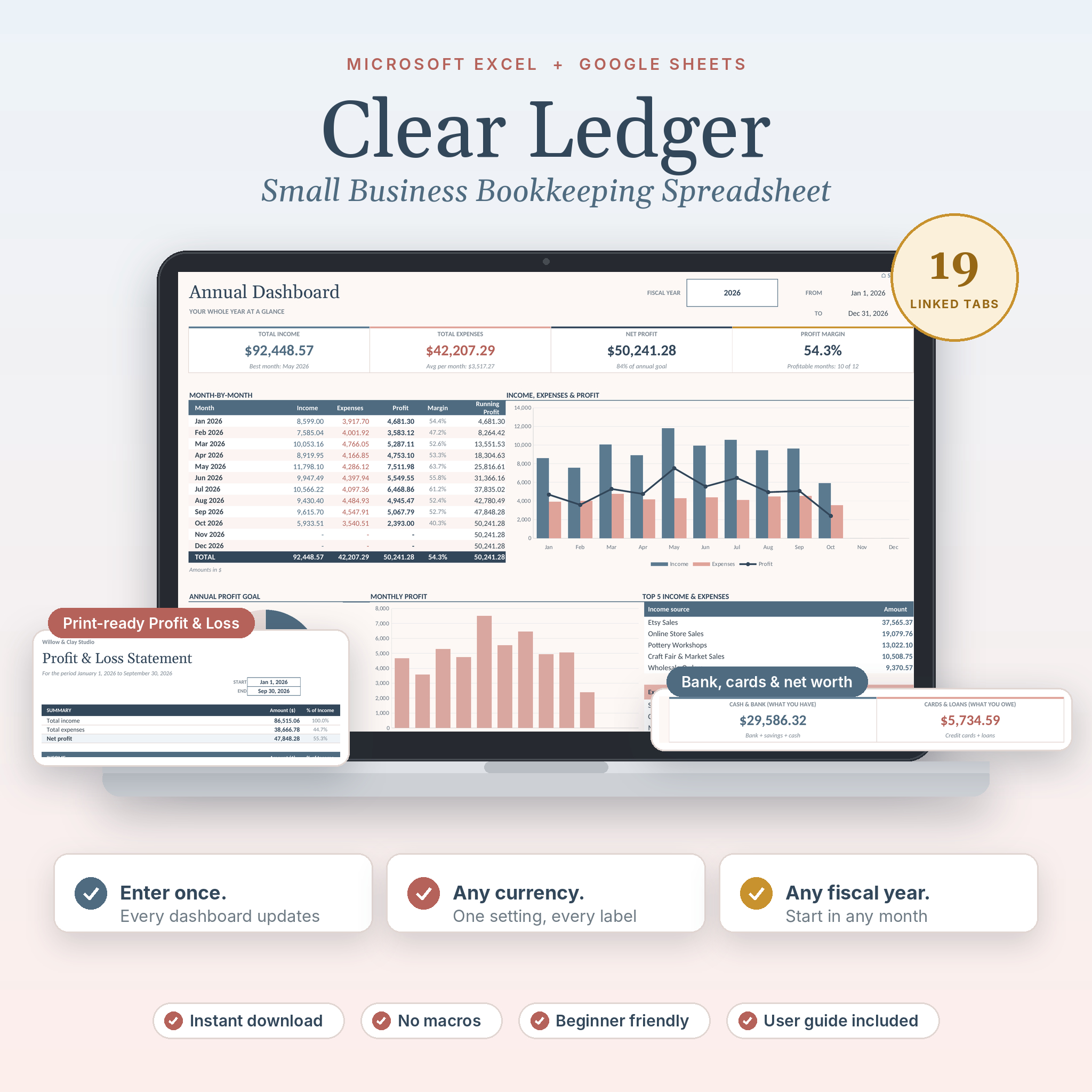
If the cash book itself is still being built, the Clear Ledger bookkeeping spreadsheet provides income and expense tracking and account balances in Excel and Google Sheets. Keep a separate open-item schedule alongside it so the close file shows exactly which booked entries had yet to reach the bank.
Worked example: April’s open items in the May reconciliation
At 30 April, the bank statement ends at £12,540. The books include a £1,120 deposit that hasn’t reached the bank and two outstanding supplier payments totalling £760. The cash book shows £12,925 before a £25 bank fee is recorded.
On the bank side, £12,540 + £1,120 − £760 gives £12,900. On the book side, £12,925 − £25 also gives £12,900. The fee goes into the April cash book once. It doesn’t go on the carry-forward schedule.
| Item and original book date | Amount | May bank evidence | Open at 31 May |
|---|---|---|---|
| Deposit D042, 30 April | £1,120 | Credit posted 2 May | £0 |
| Supplier payment P118, 29 April | £460 | Debit posted 3 May | £0 |
| Supplier payment P119, 30 April | £300 | No matching debit | £300 payment |
| Deposit D057, 31 May | £690 | No matching credit | £690 deposit |
| Supplier payment P143, 30 May | £210 | No matching debit | £210 payment |
The first three rows come from April. The last two are new May items. When the May credit and debit clear D042 and P118, record the matches in the register. Neither match creates a May receipt or payment in the cash book because both transactions were booked in April.
The 31 May statement ends at £14,880. Add the £690 of deposits in transit and subtract the £510 of open payments to get £15,060. The May cash book shows £15,072 before an unrecorded £12 bank fee. Once the fee is booked, May reconciles to £15,060.
The June opening schedule contains three rows: P119 for £300, P143 for £210 and D057 for £690. P119 still carries its original date of 30 April. If D057 posts on 2 June, record the bank match against D057 in June and leave the signed-off May schedule unchanged.
Fix exceptions without posting a balancing entry
A carried item still hasn’t cleared
Check the payment method and expected settlement date before moving the row forward again. For P119, check the payment confirmation and look for a rejection, return or debit under a different reference. If the business actually cancelled the payment, retain the cancellation evidence and check what happened in the ledger. A recorded payment that was voided may need a documented reversal; marking it as cleared would falsely imply that the bank paid it.
The bank amount differs from the book amount
Suppose the books show £1,120 but the bank credits £1,100. Don’t assume the £20 is still among the deposits in transit. Check the remittance or settlement report to see if £20 was withheld as a fee, paid separately or never due. If a fee explains the difference and it hasn’t been booked, record it according to how the receipt was originally entered. For grouped processor settlements, reconcile the net payout to its sales, fees and refunds before clearing the bank line.
One statement line clears several book entries
If the bank debits £760 in one batch and the payment file identifies two supplier payments of £460 and £300, link both rows to that bank line. Allocate £460 to one and £300 to the other. The match log should show a total allocation of £760, not £760 on each row. If only £200 of a £300 payment has posted and the evidence shows another £100 is still due, carry £100 forward under the original reference.
The difference survives the carry-forward check
Compare the May opening list with the signed-off April closing list by item ID and amount, then check the signs of the remaining May items. In the worked example, forgetting to remove the cleared £1,120 from deposits in transit overstates May’s adjusted bank balance by £1,120. Entering an open £300 payment as an addition instead of a deduction creates a £600 difference. If neither check explains the balance, trace the nonzero reconciliation difference without forcing an adjustment.
Print and assemble planner inserts for close follow-up
Use paper for follow-up dates and sign-off notes, and keep the spreadsheet as the source for balances and match evidence. A monthly insert can show when to chase P119 and who owns the query without carrying supplier bank details into a binder. If you print a copy of the open-item schedule, label it with the account, cut-off and print date so it can’t be mistaken for a live report.
For a printed finance planner, the Rosefold business bookkeeping printable comes as a fillable PDF in US Letter, A4 and A5. Use the size that matches the binder, then file close notes separately from budget or expense worksheets so the reconciliation evidence stays easy to find.
For printing and assembling planner inserts, test one sheet before printing a batch. Use actual size for a PDF that already matches the intended page size. If you’re printing A5 artwork on a larger sheet, check the finished dimensions after trimming. Punch a test sheet and turn it in the binder to check that the writing area clears the rings or discs. For double-sided printing, check that both sides read upright when the page turns.
If you want preprinted divider or follow-up pages, check the binding first: 11-disc letter refill, 7/3-hole letter refill, Forvencer A5 monthly refill, A5 project tracking inserts and Beautiful six-ring monthly inserts.
Letter-size inserts for the close calendar
The 2027–2028 11-disc monthly refill and the 2027–2028 7/3-hole monthly refill both provide 18 monthly calendars on 8.5 × 11 in pages. Choose by binding, not sheet size. Mark the statement cut-off, review date and first follow-up date for aged items.


Ring-binder inserts for dates and exception notes
The Forvencer 2027 monthly refill is an A5 six-hole option for scheduling close reviews. The Beautiful 2027–2028 monthly inserts are listed for six-ring binders; confirm the page dimensions and hole spacing against the binder before pairing them with printed sheets.


The double-sided A5 project planner inserts come in 100 sheets and use six-hole punching. The task and deadline fields suit exceptions that need more than a calendar reminder, such as a returned supplier payment that needs confirmation before it can be reissued.

Before filing the close, assign an owner and a follow-up date to any item past its expected clearing date. Put the original transaction ID on the reminder for each of the deposits in transit. At the next reconciliation, that ID should lead straight to the open row and its evidence, without anyone having to reconstruct the payment from a calendar note.