A reconciliation difference is a clue, not a number to plug.
Keep the reconciliation difference visible and trace it to a transaction, a timing item or a spreadsheet error. Don’t post the reconciliation difference as a journal entry: a £42 gap tells you how far apart two balances are, not what happened to the money.
For a shop that prints and assembles planner inserts, the trail might run from three online orders to one processor payout, then to one bank deposit. Keep order and SKU details in the sales export, but match the bank deposit to the payout ID and net amount. An order for a letter-size 11-disc monthly refill and one for a letter-size 7/3-hole monthly refill can look similar in the order file without being duplicates.
The same applies to a Forvencer six-hole A5 monthly refill, an A5 project planning refill and a monthly insert set for six-ring binders. Use transaction references to decide which sales belong to a payout, not the wording of the product line.
Trace the reconciliation difference in order
Fix the account, currency and cut-off before matching anything. Save the bank statement, the cash book export and, if applicable, the processor payout report. Record the opening and closing dates on the worksheet. For a 30 June bank reconciliation, use the bank’s posted closing balance, not the banking app’s available balance, which may reflect pending activity. Keep GBP and USD accounts on separate tabs rather than combining their raw totals.
Check the opening balance against the last completed reconciliation before investigating June activity. If June opens £42 out and closes £42 out, review the prior close and any edits to earlier postings first. An opening gap doesn’t rule out new errors, but it gives you a specific place to start. If the two sides of the worksheet aren’t set up yet, follow this worked bank statement and cash book reconciliation.
Recalculate the reconciliation difference with a fixed sign convention. Use positive amounts for money into the account and negative amounts for money out. On the bank side, add deposits in transit and deduct outstanding payments. On the book side, start with the unadjusted closing balance and include only evidenced corrections not already reflected in that balance. Once you refresh the cash book export after posting, remove those corrections from the worksheet calculation so they aren’t counted twice.
Set the difference to adjusted bank balance minus corrected book balance. If the bank side is £12,430 and the book side is £12,472, the reconciliation difference is negative £42. That’s consistent with books overstated by £42, a bank side understated by £42, or several items working in opposite directions. Check that opening balance plus signed movements reproduces each source’s closing balance. A clipped
SUMrange or an amount stored as text can create a gap before any matching begins.Match on references first, then check amount and date. Give each source row its own line. Keep columns for source reference, posted date, signed amount, match ID, status and evidence. Match a bank deposit to a book entry using a transfer reference or payout ID where available. If the bank has shortened the reference, use the amount and a sensible date window to find candidates, then verify them against the underlying payment record.
Use a group ID for a deposit that covers several sales. A payout can combine £540 in sales, £18 in processor fees and £50 in refunds into one £472 deposit. Match £472 to the bank and prove the components separately, using the one-deposit reconciliation workflow for sales, fees and refunds. If the processor holds funds between sale and payout, leave those amounts in the processor clearing reconciliation until settlement. A sale awaiting payout isn’t automatically a deposit in transit at the bank.
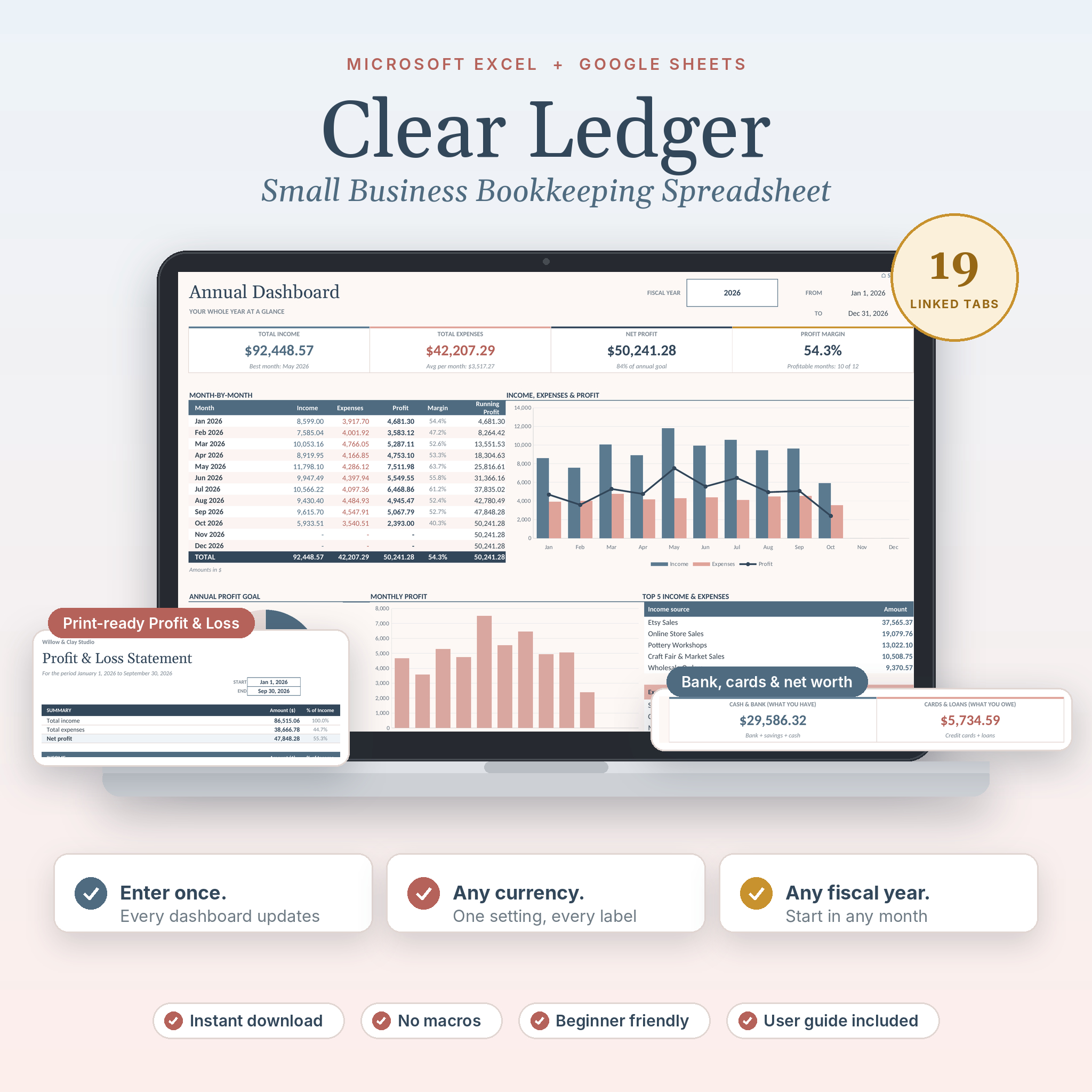
Where sales, expenses and owner drawings are kept in separate files, the Clear Ledger small business bookkeeping spreadsheet provides a single book-side record. Compare its account balance with the bank statement and use the processor export to verify the underlying fee and refund lines.
Sort unmatched items by what the evidence shows. A timing item is already recorded in the cash book but hasn’t cleared the bank by the cut-off. A missing bank fee or a duplicate receipt is a book error. An amount with no supporting record is unresolved. Keep those statuses separate: writing “timing” next to an unexplained amount can make the bank side tie while leaving a duplicate in the ledger.
For each timing item, record the original date, amount and what will prove clearance. If a £140 deposit appears in July, record that clearance date without moving the original June receipt. If it doesn’t appear, check the deposit record and the account it went into before carrying it again. Use a carry-forward schedule for outstanding payments and deposits in transit so the next close starts with named items rather than a lump sum.
If a single bank receipt covers two invoices, check the remittance and allocation before treating either invoice as unpaid. The Paidkite invoice and payment tracker can show partial payments and the remaining invoice balance. The statement still controls how much cash cleared.
Use the residual to narrow the search, not to choose an entry. With a £42 residual, search both exports for £42 and then look for pairs among unmatched rows. Inspect repeated references, overlapping import dates and transactions that match the £42 reconciliation difference. A reversed sign doubles the effect of a line: a £21 debit imported as a £21 credit produces a £42 swing. Where a worksheet flags repeated amounts, check the IDs before removing anything. Two customers can pay the same price on the same day.
Move each resolved item out of the unmatched list only after recording its disposition. Post a missing bank charge against its documented expense account, or reverse a duplicate using the original entry reference. If a closed period would be affected, follow the close procedure for approval rather than silently rewriting the prior month. Rerun the workbook and save the updated reconciliation difference alongside the transaction evidence.
Worked example: a £42 month-end gap at a planner insert shop
The figures below are illustrative. At 30 June, a planner insert shop has a bank statement balance of £12,670 and a cash book balance of £12,472. The opening balances agree with the approved May reconciliation. Both exports reproduce their closing totals from the opening balances and June activity, so the search moves to individual transactions.
The first item to check is a £472 bank deposit. The payout report lists £540 in sales, less £18 in processor fees and £50 in refunds. Its reference matches the book transfer into the bank account for £472. The sales, fees and refund are already recorded in processor clearing, so there’s no extra £18 bank expense to post. The payout group ties and comes off the unmatched list.
Two genuine timing items remain on the bank side. A £140 deposit recorded in June is posted by the bank on 1 July, and a £380 supplier cheque issued and recorded in June clears on 2 July. The adjusted bank balance is £12,670 plus £140 less £380, or £12,430. Compared with the uncorrected books, that leaves a negative £42 difference.
There’s no £42 transaction. The bank statement does show a £12 account charge absent from the cash book. Posting the charge takes the book balance from £12,472 to £12,460 and leaves a negative £30 reconciliation difference. The fee is tied to the bank charge reference, not to the processor’s fee breakdown.
The cash book also shows two £30 counter-sale receipts with the same source reference. The receipt record and bank evidence support just one payment, and the import log shows that the row came in twice across overlapping exports. Reversing the duplicate reduces the cash book to £12,430. The reconciliation difference is now zero, with two separately supported book corrections and two bank timing items. There’s no £42 balancing entry.
The June close file retains the payout breakdown, the fee reference, the duplicate receipt ID and the July clearance dates. For a bookkeeper tracking several clients, the Tieout month-end close checklist and tracker gives that follow-up a place in the close workflow. A reconciliation awaiting a statement or remittance can be marked as waiting instead of complete.
Keep printed planner inserts in their proper place in the workflow
If the close checklist goes into a physical planner, print a one-page exception log with fields for the account, cut-off, residual, source reference, owner and next action. Print one test sheet at actual size and check the inner margin against the punch before assembling a batch. The printed insert can prompt a check on the £140 deposit; keep the bank evidence and sign-off in the controlled close file.
If the shop sells planner inserts, use the pack format to check whether a refund or replacement belongs to the original order. Five listings show why the order reference is a better matching key than a short description such as “monthly refill”. The formats below describe the listings, not the contents of the worked payout.
Letter-size refill formats
The 2027–2028 11-disc monthly refill and the 2027–2028 7/3-hole monthly refill both list 18 monthly calendars on 8.5 × 11 inch pages. Record the binding variant on a replacement request so a full-size pack sent in error can be traced back to the right sale.


A5 and six-ring refill formats
The Forvencer 2027 monthly refill is listed as six-hole A5. The six-hole A5 project planning refill lists 100 sheets and 200 double-sided pages in the sense of 200 printed sides. The 2027–2028 monthly inserts for six-ring binders are described by their binding in the supplied listing title. Don’t infer the paper size from six rings alone when checking a customer’s return.



Fix the patterns that survive a first pass
A net payout ties, but clearing still has a balance
Check the processor balance independently of the bank. Start with the processor’s opening balance and add sales, deduct fees and refunds, then deduct payouts, using the provider’s report to account for any other signed movements. Compare the result with its closing balance. A sale on 30 June can remain in clearing after a correctly matched June payout. A fee recorded twice will also leave a balance, but it needs a correction rather than more time.
The total is zero, but some rows are still unmatched
Two errors can cancel. A missing £25 bank debit and a duplicate £25 book debit elsewhere can leave the overall balance unchanged. Filter for rows without a match ID, review each one and verify that no source row was used in two match groups. A zero residual is part of sign-off, not a substitute for reviewing the unmatched rows.
The residual is a penny or appears only after import
Compare the raw exported amount with the displayed value. Check for text-formatted numbers, sign changes and formulas that compare a rounded line total with an unrounded batch total. If the processor reports foreign exchange, use its settlement record to check the currency conversion and any fee. Record a rounding correction only when the evidence and accounting policy support it. A small amount alone doesn’t prove rounding.
The item cannot be proved before the close deadline
Keep an exception open with the signed amount, affected account, evidence already checked, the person responsible and the next review date. For a missing payout breakdown, name the payout ID and request the settlement report instead of asking for “the June figures”. If policy permits provisional close, record the approval and keep the reconciliation difference visible as an exception. If you can’t point to the source that explains the reconciliation difference, don’t post an entry to clear it.
