Budgets, debt and savings are not three separate projects. They are one flow of money. The budget decides how much is free each month. Debt payments and savings goals compete for that free money. When they live in three different apps, or three different notebooks, it is easy to feel like you are failing at all of them at once.
A finance planner puts the three on facing pages, so every decision has context. This guide shows how the pieces connect, a sensible order to tackle them, a debt payoff example with real numbers, savings pages that keep motivation up, and a weekly routine that takes about fifteen minutes. It ends with four printable and digital planners from Taskdale and how to start each one.
Quick picks: finance planners for budgets, debt and savings
| Product | Best for | Price | Link |
|---|---|---|---|
| Sandstone Budget Planner | Printing and writing by hand | Original price was: $8.99.$6.99Current price is: $6.99. | View |
| Money Petals Digital Budget Planner | Tablet users with several debts and goals | $3.49 | View |
| Steady Budget Planner | Beginners who want a simple layout | $2.70 | View |
| Ledgerlark Digital Budget Planner | A big undated system with stickers | $21.99 | View |
How budgets, debt and savings connect
Picture your monthly income as water flowing downhill through three pools. First it fills essentials: housing, food, transport, utilities, minimum payments. Whatever spills over is your free money. That spillover then gets split between paying debt faster and building savings.
This is why a budget comes first. Without it, you do not know how much spillover there is, so debt and savings plans are guesses. A family that thinks they have $600 a month to spare, but really has $310, will set a debt payoff date they can never hit, then feel like they failed. The planner did not fail them. The missing budget did.
On paper, the connection looks like this:
- Monthly budget page: income, bills, flexible spending, and a line called Left Over.
- Debt pages: each debt’s balance, minimum payment and any extra payment from Left Over.
- Savings pages: each goal’s target, monthly amount and running balance, also funded from Left Over.
When the planner has all three, you can see at a glance that the extra $150 on the credit card this month came from trimming eating out. That link between a small choice and a visible result is what keeps people going.
The order to tackle them
Everyone’s situation differs, and nothing here is personal financial advice. But many budgeting approaches follow a similar sequence, and it is a helpful starting point.
- Cover essentials and every minimum payment. Missing minimums usually adds fees and damage you then have to dig out of.
- Build a small starter emergency fund. Even $500 to $1,000 stops a flat tire or a broken phone from going straight onto a credit card.
- Put extra money toward high-interest debt. Credit cards and store cards usually come first.
- Grow the emergency fund. Many people aim for a few months of essential costs.
- Save for bigger goals. A house deposit, a car, a trip, retirement.
Sinking funds for known yearly costs, like car insurance or holiday gifts, run alongside all of this. They are not luxuries. They stop predictable bills from turning into new debt.
Building the monthly budget page
Your planner’s budget page is where the month gets decided. Do it a few days before the month starts.
Income
Take-home pay only, plus any regular side income you are sure of.
Fixed bills
Rent or mortgage, utilities, phone, insurance, subscriptions, childcare. Copy these from last month and update anything that changed.
Debt minimums
List every minimum payment. These are non-negotiable, so they sit with the bills.
Flexible spending
Groceries, fuel, household, personal care, eating out, fun money. Use last month’s real totals, not wishful ones.
Left over
Income minus everything above. This number is your fuel for extra debt payments and savings. Split it on purpose. For example, a household with $520 left over might send $350 to the credit card and $170 to the emergency fund.
Finding more left over without feeling deprived
The bigger the left over line, the faster debt shrinks and savings grow. Most households can find $100 to $300 a month without giving up anything they truly love. The trick is to look at the boring stuff first.
- Subscriptions. List every one, including the yearly ones. Cancel anything nobody used last month. Three forgotten services at $12 each is $432 a year.
- Insurance and phone plans. Shop around at renewal. A 20-minute call can trim a bill without changing your life at all.
- Groceries. A weekly meal plan and one list cut impulse buys. Many families save $40 to $80 a month this way.
- Bank fees and interest. Overdraft fees and card interest are money for nothing. Clearing high-interest debt is itself a raise.
Write each saving in the planner’s margin with the amount. After a month, add them up and move that total straight into the debt or savings line. Seeing that $160 came from four small calls feels like finding a pay rise you did not have to ask for.
Debt payoff: snowball or avalanche, with real numbers
The two best-known payoff methods both pay minimums on every debt and send all extra money to one target debt. They differ in which debt you target first.
- Snowball: smallest balance first. You clear debts quickly, which feels great and builds momentum.
- Avalanche: highest interest rate first. You usually pay less interest overall.
Here is Maria’s situation. She has $400 a month in total for debt, covering minimums plus extra.
| Debt | Balance | Interest rate | Minimum |
|---|---|---|---|
| Store card | $650 | 26% | $35 |
| Credit card | $3,900 | 22% | $95 |
| Car loan | $7,200 | 7% | $210 |
Minimums add up to $340, leaving $60 extra. In this case both methods start with the store card, since it has the smallest balance and the highest rate. Paying $95 a month ($35 minimum plus $60 extra), Maria clears it in seven to eight months. Then that $95 rolls onto the credit card, which now gets $190 a month.
The methods would split if the store card had a low rate. Snowball would still clear it first for the quick win. Avalanche would go to the 22% credit card. The difference in interest is often modest on smaller debts, so many people pick whichever method they are more likely to stick with. Our side-by-side guide to the debt snowball spreadsheet shows how the totals compare over time.
The best part of a paper or tablet planner here is the color-in tracker. Every $100 paid shades another box. Watching a row fill up on the 25th of each month is a small, steady pleasure, and it carries you through the months when the balance seems to barely move.
If you like to write it all by hand and shade those boxes with a real pen, a printable planner suits you best.
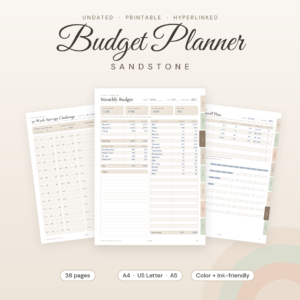
Sandstone Budget Planner
Price: Original price was: $8.99.$6.99Current price is: $6.99. | Best for: pen lovers paying off debt
A 38-page undated printable budget planner in US Letter, A4 and A5, in a soft sand, sage and clay palette. It walks through the whole money cycle: a starting point, a monthly budget, tracking as you go and a review, with a bill tracker, debt snowball pages, savings challenges and an Annual Overview. Small math hints on each page make totals quick. Print the starting point and first month’s budget, then fill in the debt snowball page with every balance and minimum.
Savings pages that keep you going
Savings feel slow. That is the main reason people stop. A good finance planner fights that by making progress visible and by breaking big goals into small, frequent wins.
Name every goal
“Savings” is vague. “Emergency fund: $3,000”, “Kids’ summer camp: $640” and “New laptop: $900” are real. Give each its own tracker with a target, a date and a monthly amount.
Use sinking funds for known costs
Car insurance, birthdays, school uniforms, the dentist. Divide the cost by the months until it is due. A $480 renewal in eight months needs $60 a month.
Try a savings challenge
Challenges turn saving into a game. A 52-week challenge, a no-spend weekend or an envelope challenge all give you something to tick off. They work best for small extra goals, not as a replacement for your main plan. Our guide to savings goal trackers covers how to hit every target on time.
Tablet planners make this especially satisfying. Tap a goal, shade a box, and the page is right there next time without flipping through paper.
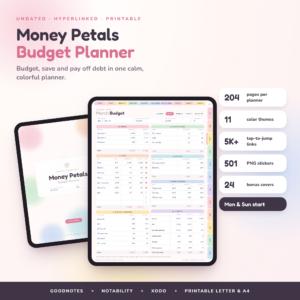
Money Petals Digital Budget Planner
Price: $3.49 | Best for: tablet planners juggling several goals and debts
An undated, hyperlinked finance planner for GoodNotes and other PDF apps on iPad and Android, with printable US Letter and A4 files. Each file has 204 pages and more than 5,000 links, including monthly budgets, spending logs, weekly check-ins, snowball and avalanche planners, pages for up to eight debts, eight savings funds, sinking funds and ten savings challenges. Import it into your note app, fill in the annual goals page, then set up one debt page and one savings fund before your first monthly budget.
A weekly 15-minute money date
Monthly planning sets direction. A short weekly check keeps you on it. Pick a regular slot, like Sunday evening with a cup of tea.
- Log the week’s spending in the flexible categories. Note anything unusual.
- Check upcoming bills for the next seven days.
- Update debt and savings trackers if any payments went out.
- Shade your progress boxes. Do not skip this. It is the reward.
- Pick one focus for the coming week, like a no-spend weekend or meal planning to keep groceries on track.
Couples often make this a shared ritual. Ten minutes on the sofa with the planner between you is far less tense than a big money talk once a quarter.
When a month blows up
Car repairs, a sick child, a reduced shift. Some months the plan breaks. That is normal, not a sign the system does not work.
First, use the emergency fund or the right sinking fund. That is exactly what they are for. Second, pause extra debt payments for the month if needed, but keep every minimum. Third, write a short note on the review page about what happened. After a year, those notes often reveal a cost that deserves its own sinking fund. One family discovered their “surprise” vet bills came to $700 a year, every year, and simply started setting aside $60 a month.
Paper or tablet?
Both work well for this kind of planner. Paper is tactile and sits on the kitchen table where everyone can see it. A tablet carries every page in one device, never runs out, and lets you duplicate a page instead of reprinting it.
If you are new to budgeting and want the simplest possible layout, choose a planner with one budget page and one spending log per month and nothing fancy. You can always add more trackers later.
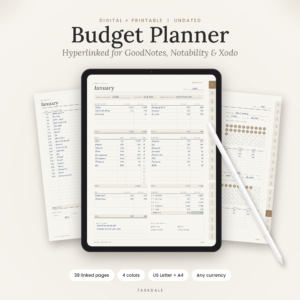
Steady Budget Planner
Price: $2.70 | Best for: first-time budgeters who want it simple
A hyperlinked PDF planner for GoodNotes, Notability, Xodo and other PDF note apps, with printable US Letter and A4 versions. Each month has one budget page with Budget and Actual columns and one spending log, plus thirteen trackers for bills, savings, sinking funds, debt, subscriptions, net worth and a full year review. Start with the first month’s Budget column, then log spending through the month and fill in Actual at the end.
For a broader comparison of debt tools in every format, see our ranking of the best debt payoff tracker options.
Mistakes that stall progress
- Throwing everything at debt with zero savings. One emergency then lands back on the card. Keep a small cushion first.
- Too many goals at once. Eight savings goals at $25 each feel like nothing moves. Focus on two or three.
- Forgetting to roll payments over. When a debt is cleared, its full payment should move to the next debt, not disappear into spending.
- Skipping the review. The end-of-month page is where you learn. Without it, the same overspend repeats.
- Waiting for a perfect month to start. An undated planner can start today, mid-month, with whatever is left.
Frequently asked questions
What should a finance planner include?
A monthly budget page, a spending log, a bill tracker, debt payoff pages, savings goal trackers, sinking funds and a yearly overview. Net worth and subscription trackers are useful extras.
Should I save or pay off debt first?
Many people build a small emergency fund first, then send extra money to high-interest debt, then grow savings. The right balance depends on your situation, so treat this as a common starting point rather than a rule.
Is the debt snowball or avalanche better?
Avalanche usually saves more interest. Snowball gives quicker wins. The better one is the method you will keep using every month.
Can I use a digital finance planner on Android?
Yes. Hyperlinked PDF planners work in PDF note apps on Android tablets as well as on iPad, and most include printable versions too.
What is the difference between a sinking fund and an emergency fund?
A sinking fund saves for a known future cost, like car insurance. An emergency fund covers the unknown, like a job loss or a sudden repair.
Your next step
Tonight, list every debt with its balance, rate and minimum, and every savings goal with a target. Seeing them on one page is the first real step. Then print the debt and budget pages from the Sandstone Budget Planner and decide where this month’s left over money goes.