A healthcare assistant CV works when the care skills are impossible to miss. A ward manager or care home manager reading it wants to see, within a few seconds, that you can deliver personal care with dignity, take and record observations, move people safely and spot when something is wrong. Put those first, back them with real detail, and you are already ahead of most applicants.
This guide gives you a full healthcare assistant CV sample you can model, explains which care skills to highlight and how to word them, and shows how to adapt the CV if you are new to care. It suits HCAs moving between hospital and care home settings, carers stepping up to an HCA role, and people applying for their first job in care.
Quick picks: CV templates for healthcare assistants
| Product | Best for | Price | Link |
|---|---|---|---|
| Sloane Resume Template | Skills column for care skills and training | $4.49 | View |
| Marlowe Resume Template | Two-page CVs with certifications | $4.79 | View |
| Hollis Resume Template | ATS versions for NHS-style portals | $8.99 | View |
| Alder Resume Template with Photo | Matching set with a job tracker | $4.79 | View |
What employers look for on a healthcare assistant CV
Healthcare assistant jobs vary between a busy hospital ward, a nursing home, a hospice and a GP surgery. Underneath, the people hiring tend to scan for the same things.
- Hands-on care skills. Personal care, washing and dressing, continence care, helping with meals, pressure area care.
- Clinical support tasks. Taking observations such as blood pressure, pulse, temperature and oxygen levels, and recording them accurately.
- Safe moving and handling. Using hoists, slide sheets and standing aids correctly.
- Training and checks. The Care Certificate, mandatory training and a current DBS check, where relevant.
- Communication. With patients, families, nurses and other staff, including people living with dementia.
- Reliability. Shift patterns you can work, and a record of turning up.
Your CV should answer each of those without making the reader hunt. That is what “care skills highlighted” really means.
Where to put care skills so they get seen
Most readers look first at the top third of page one. So that is where your care skills belong, in two places.
First, in your profile. Two or three sentences that name your setting, your experience and two core skills. Second, in a dedicated “Care skills” section straight after the profile, before your work history. Six to ten short lines, each a real task you do confidently.
Then your employment history backs those skills up with detail: the number of beds, the type of patients, the improvements you were part of. Skills at the top, proof underneath.
A two-column layout handles this well. The care skills and training sit in a side column the eye catches early, while the main column holds your profile and experience.
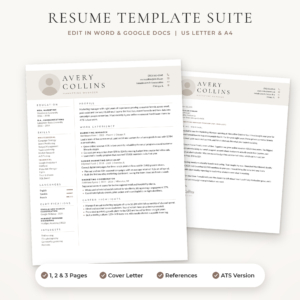
Sloane Resume Template
Price: $4.49 | Best for: HCAs with lots of training to list
Sloane has a slim left column for skills, education and languages and a wider right column for experience, built from tables and Word styles so it grows neatly as you type. You get a 1-page resume, 2-page resume, 3-page CV, ATS-friendly resume, cover letter and references page in three colours and US Letter and A4, plus a Resume Writing Toolkit with 96 action verbs. Put your care skills in the left column first, then your mandatory training under them.
Healthcare assistant CV sample
Here is a full sample for an experienced HCA moving from a care home to a hospital ward. The name and details are made up. Use the structure and the level of detail, then write your own facts.
Header
Grace Mensah
Leicester | 07700 900123 | grace.mensah@email.com
Profile
Healthcare assistant with four years’ experience in a 60-bed nursing home, caring for older adults with dementia, frailty and complex needs. Confident with personal care, observations, safe moving and handling and end-of-life support. Calm under pressure and known for building trust with anxious residents and families. Looking to bring these skills to an acute medical ward.
Care skills
- Personal care with dignity: washing, dressing, oral care, continence care
- Observations: blood pressure, pulse, temperature, oxygen saturation, respiratory rate
- Accurate charting: food and fluid, repositioning, bowel charts
- Pressure area care and skin checks
- Safe moving and handling with hoists, slide sheets and standing aids
- Dementia care and supporting people who are distressed
- End-of-life care alongside nurses and families
- Electronic care records
Employment history
Healthcare Assistant, Willowbank Nursing Home, Leicester, June 2021 to present
Nursing home with 60 residents, many living with dementia.
- Deliver personal care for a group of up to 10 residents per shift on 12-hour days and nights.
- Take and record observations, escalating changes to the nurse in charge straight away.
- Helped bring in a new repositioning chart, which made missed turns easier to spot at handover.
- Mentor new carers through their first two weeks, including shadow shifts and the Care Certificate standards.
- Support residents and families at end of life, including sitting with residents so no one is alone.
Care Assistant (bank), Home care agency, Leicester, January 2020 to May 2021
- Visited up to 12 clients a day for personal care, meals and medication prompts.
- Kept accurate visit notes and reported concerns to the care coordinator the same day.
Training and checks
- Care Certificate, completed 2020
- Level 2 Diploma in Care, 2022
- Mandatory training up to date: moving and handling, basic life support, infection prevention and control, safeguarding adults, fire safety, information governance
- Enhanced DBS check on the update service
Availability and references
Available for days, nights and weekends. References available on request.
On a two-page template, that sample sits comfortably with space to breathe. Every line shows either a skill, a setting or a result. That is why it reads strong.
How to word care skills so they sound real
Many HCA CVs say “caring and compassionate” and stop there. Every applicant says that. What makes yours different is a specific detail that proves it.
| Generic line | Stronger line |
|---|---|
| Caring and compassionate | Sat with residents at end of life so no one died alone, working with nurses and families |
| Good communication skills | Used picture cards and short, calm phrases with residents living with advanced dementia |
| Experienced with observations | Took and recorded full observations for up to 10 patients per shift, escalating any changes to the nurse in charge |
| Team player | Covered extra shifts during a winter outbreak and helped train three agency staff on the unit routine |
| Hard working | Worked 12-hour day and night shifts across four years with a strong attendance record |
Notice how each stronger line includes a number, a setting or a real action. You do not need big achievements. Ordinary care, described specifically, reads as skilled care.
Training, certificates and checks: list them clearly
Care employers often check training before they read anything else, because it affects whether you can start quickly. Give it its own section with dates.
- Care Certificate: say when you completed it.
- Qualifications: Level 2 or Level 3 Diploma in Care, or the equivalent where you trained.
- Mandatory training: list the topics and the month of your last refresher.
- Background checks: say if your DBS is current or on the update service.
- Extras: dementia awareness, catheter care, diabetes awareness, end-of-life training, a driving licence for community roles.
A two-page template with a certifications area keeps all of this neat, so the page does not look like a jumble of course names.
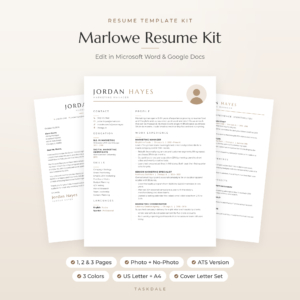
Marlowe Resume Template
Price: $4.79 | Best for: experienced HCAs needing two pages
Marlowe’s 2-page resume adds tools, certifications, awards, key achievements and selected projects, and the 3-page version adds references, memberships, volunteer work and professional development. Each comes with and without a photo, plus an ATS resume, cover letter, references page and thank-you letter: 60 Word files in Sand, Sage and Slate, in US Letter and A4. The bonus 10-page Resume Playbook includes 120+ action verbs. Start with the 2-page no-photo file and fill the certifications section with your training dates.
No care experience yet? Here is how to adapt the sample
Plenty of HCAs start with no paid care experience. Employers often train new starters, and they look for the right attitude and transferable skills. Change the sample like this.
- Profile: lead with why you want to work in care and the skills you bring. “Friendly, reliable retail team member with three years’ experience serving the public, now looking to start a career in care. Experienced at staying calm with upset customers and working early and late shifts.”
- Care skills section: rename it “Relevant skills” and list what you can prove: patience, clear communication, following procedures, working shifts, basic food hygiene.
- Life experience: if you have cared for a family member, say so in one line. “Supported my grandmother at home for two years, including personal care and hospital appointments.”
- Volunteering: hospital volunteer shifts, befriending schemes, helping at a day centre.
- Training: any short courses you have done, such as first aid or an online dementia awareness course.
Keep it to one page. A clear, warm, honest one-page CV gets new starters interviews in care.
Applying through online portals
Many hospital trusts and large care groups take applications through online systems, where you copy your details into forms or upload a CV. Software may read the file before a person does. A plain, single-column version of your CV, with standard headings like “Experience” and “Training”, reads more reliably than a design with icons or text boxes.
Keep both versions: a designed CV for emailing care home managers or handing in at a recruitment day, and an ATS version for online portals. Most care applications also ask for a supporting statement, so prepare one that matches the CV. Our guide to writing a cover letter that matches your resume works just as well for a short supporting statement.
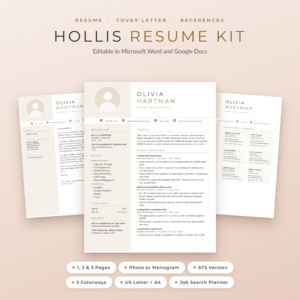
Hollis Resume Template
Price: $8.99 | Best for: applying through hospital and care portals
Hollis includes ATS resumes in 1 and 2 pages, with one clean column and no tables or images, alongside designed resumes in photo and monogram versions in 1, 2 and 3 pages, cover letters, a references page and a thank-you letter. There are 84 Word files in three colourways and two paper sizes, with fonts built in, a Resume Writing Guide with 216 action verbs and a Job Search Planner. Fill in the 2-page ATS file first if most of your applications go through online portals.
Let your CV set up the interview
Every line on your CV is a question waiting to be asked. If you write that you supported residents at end of life, expect “Tell me about a time you cared for someone who was dying.” If you mention escalating changes in observations, expect “What would you do if a patient’s blood pressure dropped?” That is good news. You get to choose the questions.
So before you send the CV, pick your three strongest care lines and prepare a short story for each. Use a simple shape: the situation, what you did, and what happened next. Keep each to about a minute when spoken.
For example, behind the line about the repositioning chart, Grace’s story might go: “We kept finding gaps at handover where we were not sure if a resident had been turned. I suggested a simple chart by each bed with a time and initials. The nurse in charge agreed to try it for a month. After that, handovers were quicker and nobody had to guess.” Ninety seconds. Honest, specific and easy to remember under pressure.
Walking into an interview knowing your CV will lead to stories you have already practised is a real confidence boost. It turns nerves into something closer to readiness.
Mistakes that hold back healthcare assistant CVs
- Burying training on page two. Managers need to know you are trained. Keep it on page one or in a clear section.
- Listing duties from the job description. Say what you did and how, not what the role required.
- Sharing patient details. Never name patients or residents, or give details that could identify them.
- Leaving out shift availability. One line about days, nights and weekends answers a key question.
- Forgetting referees. Care employers check references carefully. Have two ready, ideally a recent manager. Our guide to the resume references page shows how to lay them out.
Frequently asked questions
What skills should I put on a healthcare assistant CV?
Personal care, observations, accurate record keeping, safe moving and handling, dementia care, communication with patients and families, and infection control. Back each with a short real example.
How long should a healthcare assistant CV be?
One page for new starters, two pages for experienced HCAs with training and several roles to list.
How do I write a healthcare assistant CV with no experience?
Lead with transferable skills from customer service, retail or hospitality, add any caring for family or volunteering, and list short courses such as first aid. Keep it to one warm, clear page.
Should I include my DBS check on my CV?
Yes, if it is current. A short line such as “Enhanced DBS on the update service” helps employers who need staff to start quickly.
Do I need a cover letter for a healthcare assistant job?
Often yes, or a supporting statement. Use it to explain why you want to work in care and give one or two examples that match the job description.
Your next step
Write down every care task you did on your last three shifts. That list is your care skills section, almost word for word. Then choose a layout with a clear space for skills and training; the Sloane Resume Template gives your care skills their own column.