Meal plan services promise to take dinner off your plate. Printable plans and spreadsheets promise the same thing for a one-off price. So which actually costs less? The honest answer is that it depends on which kind of service you mean and how much your time is worth to you. But you can work it out for your own household in about ten minutes, and this guide shows you how.
You will see the three main types of meal plan service, what you are really paying for with each, a worked cost example over a full year, the hidden costs that rarely make it into the sales pitch on either side, and a simple way to decide. There is no single winner for everyone. There is usually a clear winner for you.
Quick picks: one-off planners to compare against a subscription
| Product | Best for | Price | Link |
|---|---|---|---|
| Larkspoon Meal Planner Spreadsheet | Seeing cost per serving and per week before you shop | $12.99 | View |
| Thymewise Digital Meal Planner | A year of weekly plans with a grocery budget tracker | $1.75 | View |
| Small Bites, Big Wins Meal Plan Printable | A ready-made 4-week plan with 150 meal ideas | $6.99 | View |
| Pantry Bloom Meal Planner Spreadsheet | Families tracking food cost against a weekly budget | $18.99 | View |
The three kinds of meal plan service
“Meal plan service” covers very different things. Lumping them together makes the cost comparison meaningless, so separate them first.
1. Meal plan subscriptions and apps
These send you a weekly menu, recipes and a shopping list, usually through an app or website. You still buy and cook the food yourself. You pay a recurring fee, typically monthly or yearly. Most need an account and login, and some show ads on free tiers or limit features unless you upgrade.
2. Meal kit delivery
These deliver pre-portioned ingredients and recipe cards to your door. You cook, but you skip planning and shopping for those meals. You pay per serving, and the box usually covers only some dinners, not a full week of meals.
3. Personal plans from a professional
A coach or dietitian builds a plan around your needs. You pay for their time, either once or on an ongoing basis. This is a different kind of service, because you are paying for expertise and accountability, not just a menu.
And the alternative: printable and spreadsheet plans
You buy a planner once, as a printable PDF, a tablet planner or a spreadsheet, and use it for as long as you like. Some come with ready-made plans and meal ideas. Others give you the structure and do the sums, while you choose the meals. You do the shopping and the cooking.
What you are really paying for
Every option is selling a mix of four things. Seeing them separately makes the price easier to judge.
- Decisions: someone else chooses what you eat this week.
- Organization: the shopping list, the order of prep, the reminders.
- Ingredients and portions: only meal kits include the actual food.
- Delivery and time: again, mostly meal kits, which save a trip to the shop.
A subscription app mostly sells decisions and organization. A meal kit sells all four. A printable or spreadsheet sells organization, and sometimes decisions if it includes ready-made plans. Once you know which of these you actually need, you can stop paying for the ones you do not.
Say you love choosing recipes but hate writing shopping lists. You do not need anyone to make decisions for you. You need the organization part, and a one-off planner covers that.
A worked cost example over twelve months
Here is an example with round, made-up figures, so you can see how the sums work. Swap in the real prices you see where you live.
Subscription app versus a one-off planner
Suppose a meal plan subscription costs $9 a month. Over a year, that is $108. Over three years, $324, and you own nothing at the end if you cancel. A one-off spreadsheet or printable planner is bought once (see the live prices in the table above) and keeps working year after year. For most households, the one-off planner costs less within the first month or two of what a subscription would have charged.
The subscription might be worth it anyway if its weekly menus save you real thinking time. That is the trade-off to judge: not the fee alone, but the fee against how much decision-making you hand over.
Meal kits versus planned grocery shopping
Now take a family of four eating four kit dinners a week. Suppose the kit works out at $9 per serving and the same style of dinner cooked from a planned shop costs $3.50 per serving.
| Meal kit (example) | Planned shop (example) | |
|---|---|---|
| Servings per week | 16 | 16 |
| Cost per serving | $9.00 | $3.50 |
| Weekly cost | $144 | $56 |
| Yearly cost (48 weeks) | $6,912 | $2,688 |
On these example numbers, the planned shop saves about $88 a week. Your local figures will differ, but the shape usually holds: you pay a premium for someone else to portion and deliver ingredients. That premium can be worth it. It just needs to be a choice, not an accident.
The weak point of the planned-shop column is that it only works if you plan. Without a plan, top-up shops and wasted food can quietly push the cost per serving up toward the kit price. That is where a planner earns its keep.
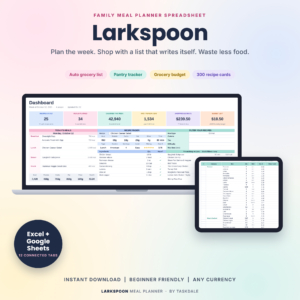
Larkspoon Meal Planner Spreadsheet
Price: $12.99 | Best for: households comparing real cost per serving
Larkspoon is a meal planner for Excel and Google Sheets with twelve connected tabs. It prices each dish, shows cost per serving, cost per day and a weekly total checked against your budget, subtracts what is already in your pantry and writes an aisle-sorted grocery list. Nutrition tracking is there if you want it. Enter your ingredient prices once, plan a normal week, and you will have your own real cost per serving to compare against any service.
Run your own comparison in ten minutes
Example numbers only go so far. Your own numbers settle the question. Grab your last month of bank statements and a notepad.
- Add up every food-related charge for four weeks. Supermarket shops, top-up trips, takeaways, any subscription or meal kit. Divide by four for a weekly figure.
- Count the meals that money covered. Roughly how many breakfasts, lunches and dinners did your household eat at home? Divide your weekly figure by that number for an average cost per meal.
- Price one planned week. Write five dinners you already make, list the ingredients and look up their prices online or on a recent receipt. Divide by the number of servings.
- Compare the two per-meal costs. The gap is roughly what planning saves you per meal, before any service fee.
- Put a value on your time. If planning takes 30 minutes a week and the service saves you that, ask whether the price difference is worth half an hour.
One family might find the gap is small and gladly keep paying for convenience. Another might find it is the size of a car payment. Both are right for themselves. The point is to choose with real figures instead of a feeling.
If you would like to keep that comparison going each week, a grocery list that shows prices as you write it helps. Our guide to a grocery list with prices explains how to set one up.
Hidden costs on both sides
Neither option is as cheap or as easy as its sales page suggests. Be honest about both.
Hidden costs of services
- Forgotten skips: with weekly deliveries, missing the deadline to skip a week means paying for a box you did not plan to use.
- Delivery fees and minimum orders, where they apply.
- Top-up shopping: a kit covers some dinners. You still need breakfasts, lunches, snacks and the remaining dinners.
- Subscriptions you stop using but keep paying for.
- Packaging to sort and recycle.
Hidden costs of printable and spreadsheet plans
- Your time: 20 to 30 minutes a week to plan, plus shopping.
- Ink and paper, if you print every week. Ink-saver versions and tablet planners help.
- Discipline: a planner only works if you open it. Nobody emails you a reminder.
- Learning curve: the first week takes longer while you enter recipes.
For a similar comparison in the money world, our look at a printable budget planner vs spreadsheet vs budget app covers the same stick-with-it question.
When a meal plan service is worth the money
There are real situations where paying for a service makes sense:
- The first months with a new baby, when even shopping feels like a mountain.
- Learning to cook, when step-by-step kits with exact portions build confidence quickly.
- No easy access to a good shop, or no car, where delivery saves hours.
- A specific need where expert advice matters, where a professional plan is the right tool.
- A short, busy stretch, like a house move or exam season, where paying for convenience for a few weeks is sensible.
In these cases, think of the service as a temporary helper. Use it for the stretch you need, then switch to your own plan once things settle.
When a printable or spreadsheet plan wins
For most households most of the time, a one-off planner comes out cheaper, often by a wide margin. It wins clearly when:
- You already cook most nights and mainly need help with organization.
- Your food budget is tight and every week’s shop matters.
- You have family favorites you want to keep, rather than new recipes each week.
- You dislike accounts, logins, ads or recurring charges.
- You want to plan breakfasts, lunches and snacks, not just a few dinners.
A tablet planner gives you a lot of the convenience of an app without the subscription. You plan on screen, tick off the grocery list in the shop, and track the food budget in the same file.
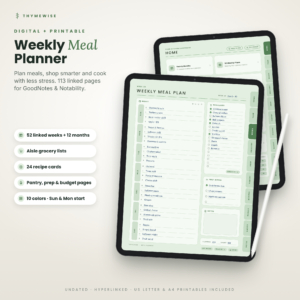
Thymewise Digital Meal Planner
Price: $1.75 | Best for: tablet users leaving a subscription app
Thymewise is an undated, hyperlinked meal planner for GoodNotes, Notability and other PDF apps, with 113 pages: 52 weekly meal plans, 12 monthly meal calendars, aisle-sorted grocery lists, a meal prep planner, pantry and freezer inventories, 24 recipe cards, a grocery budget tracker and a healthy habits tracker. Printable US Letter and A4 versions come with it. Because it is undated, it lasts a full year from whenever you start. Open the grocery budget tracker first and log this week’s shop as your starting point.
If what you want is someone else’s plan
Some people do not want structure. They want to be told what to eat. That is the main reason to pay for a subscription. But a printable can do this part too, if it comes with a ready-made plan and a big bank of meal ideas. You get the decisions made for you, without the monthly fee.

Small Bites, Big Wins Meal Plan
Price: $6.99 | Best for: people who want a ready plan to follow
Small Bites, Big Wins is a 49-page printable in US Letter and A4 with a ready-made 4-week meal plan, 150 photo meal ideas with approximate protein and fiber, a 206-item food list and 13 tracker pages. It was designed for smaller appetites, including people on GLP-1 medication, so meals lean on protein. You can print it or use it on a tablet with clickable tabs. Start with week one of the ready-made plan and swap meals from the photo charts as you go.
A hybrid that many households end up with
You do not have to choose one forever. A common, sensible mix looks like this:
- Use a one-off planner for the week’s structure, shopping list and budget.
- Cook your own family favorites most nights.
- Add a meal kit or ready meal for one or two of the busiest nights, if the budget allows.
- Review costs monthly and drop whatever is not earning its place.
This gives you the savings of planning with a little paid-for convenience where it matters most. If you want more ways to bring the bill down, our guide to meal planning on a budget lists eight habits that shrink the food bill.
Frequently asked questions
Is a meal plan subscription worth it?
It can be if it saves you real time and you use it every week. If you mainly need a shopping list and structure, a one-off planner usually costs less over a year.
Are meal kits cheaper than grocery shopping?
Usually not per serving, because you pay for portioning and delivery. They can reduce waste and top-up shopping for some households, so compare your own real costs.
What is the cheapest way to meal plan?
A one-off printable or spreadsheet planner plus a weekly planned shop, cooking mostly from scratch with leftovers built in.
Can a printable meal plan replace an app?
For planning, shopping lists and budgets, yes. Some tablet planners and spreadsheets do much of what an app does, without logins or a recurring fee.
How do I work out my cost per serving?
Add up what a recipe’s ingredients cost, then divide by the number of servings. A meal planner spreadsheet can do this for every recipe automatically.
Should I cancel a meal kit straight away?
Not necessarily. Run your own comparison first, then decide whether to keep it for one or two busy nights or drop it altogether.
Your next step
Find your last four weeks of food spending, including any subscriptions or kits. Work out what you spend per week, then plan one week yourself and compare. Most people are surprised by the gap. To see your own cost per serving in black and white, set up the Larkspoon meal planner spreadsheet and price your next week’s meals.