The first week with a new puppy is equal parts joy and mild panic. You’ve read three articles, watched six videos, and the puppy has just weed on the one rug you told everyone not to step on.
A puppy training schedule takes the panic out. Instead of trying to teach everything at once, you pick a small focus each week and practise it in short, frequent sessions. Puppies learn fast, but only in tiny bites. Three 5-minute sessions a day beat one 30-minute battle every time.
Below is a week-by-week plan for the first eight weeks at home, plus a daily routine that makes it stick.
Before you start: agree on the words
If one person says “down” to mean lie down and another says “down” to mean get off the sofa, the puppy can’t win. Sit with everyone in the house for ten minutes and agree on a cue word for each behaviour. Write them down and stick the list on the fridge.
Also agree on the rules. Is the puppy allowed on the sofa? Upstairs? Fed from the table? Decide now, because changing the rules later is much harder than setting them once.
Your 8-week puppy training schedule
Week 1: Settling in
Focus on routine, not tricks. Take the puppy to the same toilet spot after every sleep, meal and play session, and praise the second they go. Introduce the crate with the door open and treats inside. Say their name and reward when they look at you. Gently handle paws, ears and mouth for a few seconds each day.
Week 2: Sit and a hand target
Teach “sit” with a treat lure and reward fast. Add a hand target: hold out two fingers, reward when the nose touches them. It’s the most useful foundation behaviour nobody talks about, because you can use it to move the puppy anywhere without grabbing. Start closing the crate door for a minute or two while you’re in the room.
Week 3: Down and the lead indoors
Lure into a down from a sit. Let the puppy wear a light collar around the house, then clip on the lead for a few minutes indoors and reward them for following you. Start a socialisation list: new people, sounds, surfaces, a hat, an umbrella. Keep it calm and positive.
Week 4: Come and leave it
Practise “come” inside the house. Say it once, happily, and reward big when they reach you. Never call them to something they dislike, like a bath. Start “leave it” with a treat in a closed fist. Begin short alone-time practice: leave the room for 30 seconds, come back calmly.
Week 5: Loose lead walking
Once your vet says it’s safe to walk in public places, start short walks. Reward the puppy every few steps for being next to you. If they pull, stop and wait. Five minutes of good walking is worth more than half an hour of being dragged.
Week 6: Wait, drop it and settle
Teach “wait” at doors and before meals. Trade a toy for a treat to build “drop it”. Introduce a mat or bed as a place to settle: reward any calm lying down on it.
Week 7: Take it on the road
Practise every cue in new places: the garden, a friend’s house, a quiet car park. Puppies don’t generalise well. A perfect sit in the kitchen often vanishes in the park. Lower your expectations in new places and reward generously.
Week 8: Review and add distractions
Go back over everything. Add small distractions one at a time: a toy on the floor, someone walking past. If your puppy struggles, make it easier and build back up. This is also a good week to start a puppy class if you haven’t already.
A daily routine that supports training
Training sessions are the easy part. The routine around them is what makes the difference. A typical day for a 10 to 12 week old puppy might look like this:
- 7:00 Toilet, breakfast, toilet again, short play
- 8:00 Training session 1 (5 minutes), then nap in the crate
- 10:30 Toilet, play, socialisation outing
- 12:30 Lunch, toilet, nap
- 15:00 Training session 2, chew toy time
- 17:30 Dinner, toilet, family time
- 19:30 Training session 3, calm play
- 22:00 Last toilet trip, bed
Young puppies need a lot of sleep, often 18 hours or more. An overtired puppy bites, zooms and can’t learn. If training is going badly, check whether they need a nap.
Keep a simple log
You’ll be surprised how quickly you forget what happened on Tuesday. A quick log of training sessions, toilet trips and accidents shows patterns you’d miss otherwise, like accidents always happening 20 minutes after drinking.
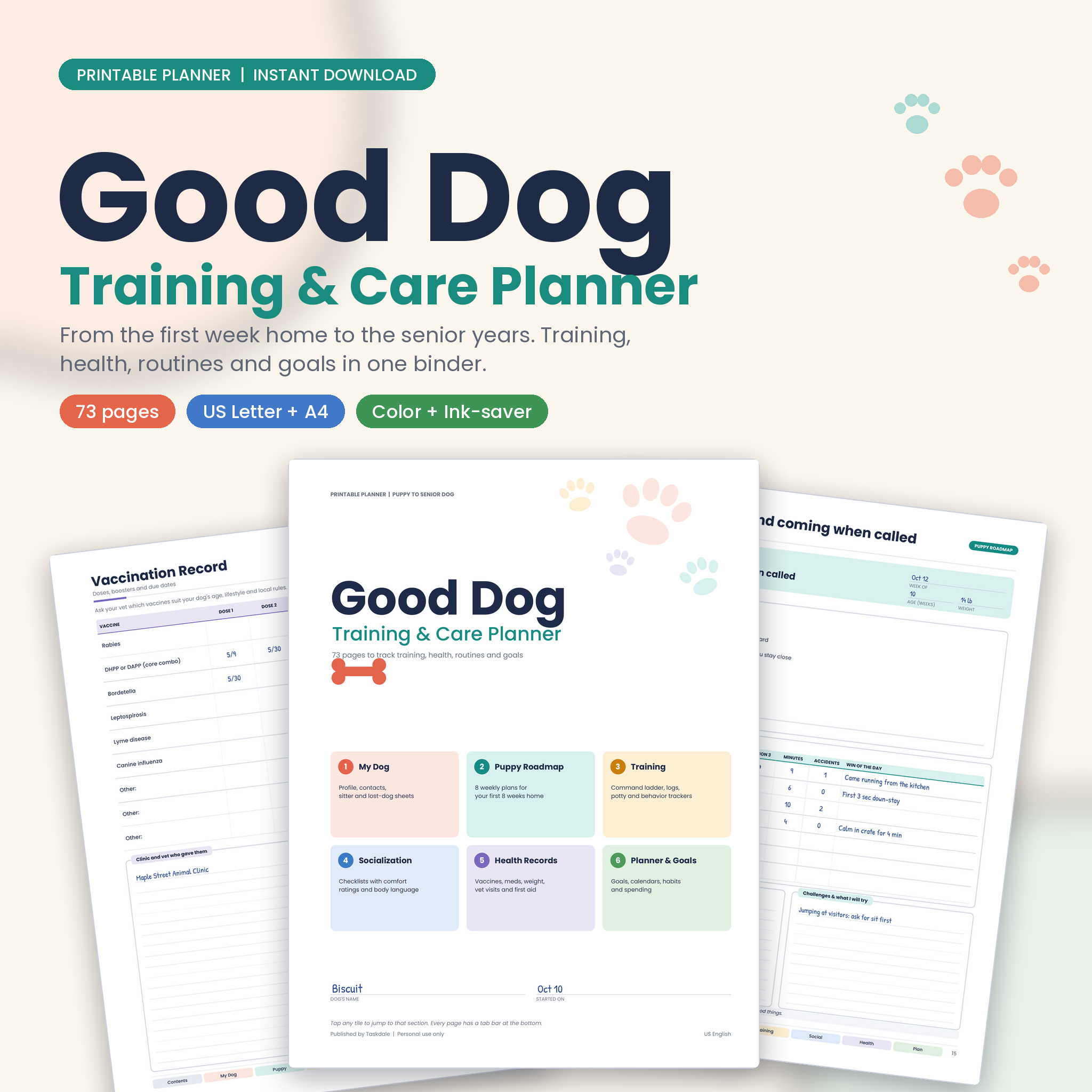
The Good Dog Training & Care Planner is built for this. Its Puppy Roadmap has eight weekly plans, one for each of your puppy’s first eight weeks at home, each with a focus, a goal checklist, a daily practice grid for three sessions a day, a place to log accidents and one small win, and a short tip. It also has a page for cue words and hand signals, 24 command ideas, and a Command Mastery Ladder that takes each skill through five stages, from a quiet room to reliable anywhere.
There’s a Crate and Alone-Time Ladder, a potty tracker, a socialisation checklist where you rate each experience Comfy, Unsure or Worry, and a body language guide to help you read when your puppy needs space. It’s 73 printable pages in US Letter and A4, in full colour or ink-saver. You print it, keep it by the door, and write in it with a pen. It’s not a fillable form, which is sort of the point: no app, no login, no notifications.
Common mistakes to avoid
- Sessions that are too long. Stop while the puppy still wants more.
- Repeating cues. “Sit, sit, SIT” teaches them to wait for the third one.
- Punishing accidents. It teaches the puppy to hide when they go, not to go outside.
- Skipping socialisation. The window for easy socialisation is short. Little and often, always positive.
Puppy training schedule FAQ
How long should puppy training sessions be?
Three to five minutes, two to four times a day. Short sessions keep a puppy focused and end before frustration sets in.
When can I start training my puppy?
The day they come home. Start with their name, toilet routine and crate, then add simple cues like sit in the second week.
How long does it take to toilet train a puppy?
Many puppies get the idea in a few weeks, but full reliability can take a few months. A consistent schedule and quick praise make the biggest difference.
Does the schedule work for an older rescue dog?
Yes, with some changes. Skip the puppy-specific bits, start with routine and trust, and work through the same cues at the dog’s pace.