A ready made meal plan for instant structure hands you what a blank planner cannot: decisions already made. Every breakfast, lunch and dinner chosen, the grocery list written, the recipes waiting. You open week one, shop from the list and cook. For anyone who is worn out from deciding, that is a real relief.
The trade-off is that someone else wrote it. They do not know you hate mushrooms, that your oven runs hot or that Wednesday is swimming lessons. So the trick is to follow a ready-made plan closely enough to get the structure, and loosely enough to make it fit.
This guide covers where ready-made plans come from (including free ones), the six questions that separate a good plan from a pretty one, how to run your first week, how to swap meals without wrecking the shopping list, and how to turn a borrowed month into a plan you can repeat on your own. It is for new planners, busy parents, anyone starting a new way of eating, and anyone who has bought a blank planner and never filled it in.
Quick picks: plans that come with the meals already chosen
| Product | Best for | Price | Link |
|---|---|---|---|
| Root & Ladle Plant-Based Meal Planner | A full 4-week menu with recipes and weekly grocery lists | $8.99 | View |
| Small Bites, Big Wins GLP-1 Meal Plan | A ready 4-week plan built around smaller, protein-first meals | $6.99 | View |
| Pantry Bloom Meal Planner Spreadsheet | A filled sample family week to copy, then make your own | $18.99 | View |
What a ready-made plan actually gives you
Most people do not struggle with cooking. They struggle with deciding. What to cook, which night, what to buy, how much. A ready-made plan removes about thirty small decisions a week, and that is why it feels so calming to start one.
A good one gives you four things:
- A menu. Every meal for every day, usually for one to four weeks.
- Recipes. Written out, with times and servings, so you are not hunting online.
- Grocery lists. One per week, matched to that week’s recipes.
- A rhythm. Prep day, leftover night, cook-once-eat-twice built in.
What it cannot give you is a perfect fit. It does not know your budget to the dollar, your schedule or your picky ten-year-old. That part is your job, and it is a much smaller job than starting from blank.
Where ready-made plans come from, including free ones
You do not have to pay for a ready-made plan. Plenty of free ones exist, and they are a fine way to test whether following a plan suits you.
Free sources
- Your library. Many cookbooks include a week or a month of menus. Borrow three, photocopy the plan pages for personal use.
- Supermarket websites and apps. Some publish weekly menus built around their own deals.
- Public health and nutrition websites. Some government and charity sites share sample menus and budget recipes.
- Food magazines and blogs. Lots of seasonal menus, though often without a full grocery list.
Free plans are great for ideas. Their usual gaps are a missing grocery list, ingredients that do not overlap from day to day (so you buy a lot and use a little), and nothing for week two. They can also come with ads, sign-ups or an app that wants a subscription after the trial.
When a paid plan is worth it
A paid printable or spreadsheet is worth it when you want the whole package in one place, matched lists, and blank pages or a sheet to carry on with after the plan ends. It is a one-time download you keep, which suits people who dislike monthly app fees.
Six questions to ask before you choose
Plans can look lovely and still fall apart in your kitchen. Ask these before you commit.
- How many servings does each dinner make? A plan for four will drown a couple in leftovers. One for two will leave a family of five hungry.
- How long do weeknight dinners take? If it is 60 minutes and you get home at 6:30, it will not survive Tuesday.
- Do ingredients repeat across the week? Good plans use one bag of spinach three ways. Weak ones buy a new herb for every recipe.
- Is there a grocery list for each week? And is it sorted by store section?
- Are swaps included? A vegetarian option, a dairy-free option, a cheaper option.
- What happens after the last week? Blank pages, a planner or a spreadsheet to plan month two yourself.
A plan that scores well on five of the six is a keeper. One that scores two is a nice-looking PDF you will never open twice.
Week one: follow it exactly as written
This is the bit people skip, and it is the bit that matters most. For the first week, do not change anything except true dealbreakers like allergies. Shop from the list. Cook the recipes as written. Do the prep day.
Why? Because the plan’s structure only shows itself when you follow it. You will see how Sunday’s big pot becomes Monday’s lunch. How the Saturday clean-out bowl uses up the odd carrots. How the list is shorter than you expected because the ingredients overlap. Change things on day one and you never see the pattern that makes it work.
Keep a pen nearby and make notes as you go: “too spicy for kids,” “took 50 minutes, not 30,” “loved this.” Those notes are gold for week two.
What to watch for during week one
- Real cooking times. Write down how long each dinner actually took you, start to table. Recipe times are often written for someone who has all the chopping done.
- Portion fit. Was there too much, or did someone go looking for toast at 9 pm? Adjust the quantities on next week’s list.
- Leftover use. Did every planned leftover lunch get eaten? If not, the plan makes too much for your household.
- The spend. Keep the receipt. Compare it to what you usually spend in a week. Many people are pleasantly surprised.
- Your energy. Which night felt like a slog? That night needs the quickest dinner from now on.
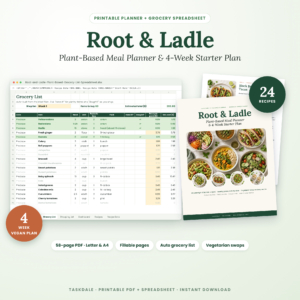
Root and Ladle Plant-Based Meal Planner
Price: $8.99 | Best for: beginners who want a month planned
A printable plant-based planner with a complete 4-week vegan starter menu for breakfast, lunch, dinner and a snack every day, 24 written recipes with a vegetarian swap on each, weekly grocery lists sorted by aisle and a grocery list spreadsheet. Dinners take 20 to 40 minutes and each one makes the next day’s lunch. Start with Week 1 and its Sunday prep checklist.
How to swap meals without breaking the plan
From week two, make it yours. The secret is to swap like for like, so the shopping list barely changes.
Swap within the same protein
If Tuesday is a chickpea curry and you would rather have chickpea tacos, swap it. Same chickpeas, same onions, a tortilla instead of rice. The list changes by one line.
Swap days, not meals
Thursday’s 40-minute bake on a late night? Swap it with Saturday’s quick bowl. Nothing on the list changes at all.
Swap one meal a week for a favorite
Keep one slot each week for a meal your household already loves. Taco night, Grandma’s soup, homemade pizza. It makes the plan feel like home, and it is something to look forward to.
Do not swap the prep day
The Sunday prep is the engine of most ready-made plans. Drop it and the weeknight times stop working. If Sunday never suits you, move prep to another day, but keep it.
Ready-made plans for specific goals
A pre-built plan is especially useful when you are starting something new and do not yet know what a good week looks like.
Starting plant-based eating
The first month is hardest because you do not know which beans go where or how to get enough protein from plants. A ready-made month shows you, meal by meal. By week four, you will have a feel for it.
Eating with a smaller appetite
If you feel full quickly, maybe on a GLP-1 medication, three big plates a day can be a struggle. Plans built around small, protein-first meals and four or five eating times can make this much easier to manage, and your care team can help set targets. A ready-made plan with ideas means less guesswork on days when you have little interest in food.

Small Bites, Big Wins GLP-1 Meal Plan
Price: $6.99 | Best for: small appetites wanting a ready plan
A 49-page printable in US Letter and A4 that you can also use on a tablet with clickable tabs. It includes a ready-made 4-week meal plan, 150 photo meal ideas with approximate protein and fiber, a 206-item food list, a small-plate method and hand-portion guide, and 13 tracker pages for water, protein, habits and progress. Read the portion guide first, then follow week one of the plan.
Losing weight on a budget
Structure helps here too, because most extra eating and extra spending happens when there is no plan. Our weight loss meal plan on a budget lays out four weeks of meals and grocery lists you can follow as written.
Feeding a busy family
Families get the most from plans where dinners make leftovers and meals can be built in parts, so kids can pick and adults can add spice. Look for servings of four or more and dinners under 40 minutes.
From ready-made to your own: planning month two
The best thing a ready-made plan can do is teach you to plan. After four weeks, you have a list of recipes you have cooked, notes on what worked, and a feel for how a good week flows. Now build month two yourself.
- List every meal you would happily eat again. Most people end up with twelve to eighteen.
- Keep the rhythm. Prep day, leftover lunches, a clean-out night.
- Repeat the best two weeks with a few swaps.
- Add one new recipe per week from a cookbook or the plan’s swaps.
- Use a planner that writes the grocery list for you, so you keep the convenience of the ready-made lists.
For a deeper guide on writing your own month, see how to make a monthly meal plan you will actually follow.
A spreadsheet that comes with a filled sample week is a handy bridge. You copy the sample to see how a planned week behaves, then replace its meals with your own favorites one by one.
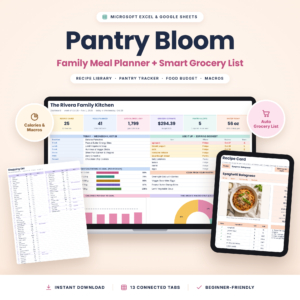
Pantry Bloom Meal Planner Spreadsheet
Price: $18.99 | Best for: moving from a sample to your own plan
An Excel and Google Sheets planner with 13 connected tabs. It comes with a blank planner plus a sample file filled with a family week, 25 recipes, pantry, budget and trackers, and an 18-page user guide. Save recipes once, pick meals from dropdowns and it builds the grocery list, checks your pantry and works out cost and nutrition per day. Open the sample first, then add your own recipes to the blank file.
Mistakes people make with ready-made plans
- Changing everything on day one. You lose the structure you paid for, or downloaded, in the first place.
- Ignoring serving sizes. Halve or double the list before you shop, not after.
- Skipping the leftover lunches. Then the plan feels expensive, because you are buying lunch anyway.
- Treating a missed day as failure. Skip it, move it, or freeze the ingredients. Then carry on.
- Stopping after week four. Rerun the best two weeks. It gets easier the second time round.
Frequently asked questions
Are there free ready-made meal plans?
Yes. Cookbooks from the library, supermarket websites, public nutrition sites and food blogs all publish sample menus. They are good for ideas, though many do not include matched grocery lists or anything for after the first week.
How do I follow a meal plan when I am busy?
Do the prep day, cook dinners that make next-day lunches and swap long recipes onto quieter nights. Keep one freezer meal as a backup for the night the plan does not fit.
Can I change a ready-made meal plan?
Yes, and you should after the first week. Swap meals that share ingredients, move dinners between days and keep one slot for a family favorite so the plan feels like yours.
How long should I follow a pre-made meal plan?
Four weeks is a good run. It is long enough to learn the rhythm and build a list of meals you like, then you can repeat the best weeks or plan month two yourself.
Is a ready-made plan good for beginners?
It is one of the easiest ways to start, because it shows what a planned week looks like. For a step-by-step guide to planning on your own afterwards, read how to meal plan for the week.
What if a ready-made plan makes too much food?
Halve the recipes and the grocery list before you shop, or cook the full amount and freeze the extra portions for the following week. Either way, note it on the plan so week two is right from the start.
Your next step
Pick one plan, free or paid, and check it against the six questions above. If it scores five or more, follow week one exactly as written and keep a pen nearby for notes. For a full month of plant-based meals with recipes and lists ready to go, start with the Root & Ladle Plant-Based Meal Planner.