A study planner for exam season does one job: it turns “I have four finals in twelve days” into a list of what to study tonight. That is all. No color-coded masterpiece, no five-hour planning session on a Sunday. Just a countdown, a topic list and short sessions spread out so the material sticks.
This guide is for high school and college students heading into midterms or finals, and for adult learners sitting a certificate exam. You will build a plan backwards from each exam date, split your time by what each test is worth, and set up sessions that actually move material into memory. Four Taskdale tools are below if you want the counting done for you.
Quick picks for exam season
| Product | Best for | Price | Link |
|---|---|---|---|
| Semester Pilot Student Academic Planner App | Spaced study sessions planned for you | $20.39 | View |
| Campus Compass Student Planner Spreadsheet | Grades, final-exam targets and a study log | Original price was: $11.99.$5.99Current price is: $5.99. | View |
| Semester HQ Student Planner Spreadsheet | Deadlines, budget and habits in one file | Original price was: $11.99.$5.99Current price is: $5.99. | View |
| Mind Atlas Psychology 101 Study Guide Workbook | Active review for an intro psych final | $3.99 | View |
Start with a countdown, not a timetable
Most students open a blank weekly grid and start filling hours. Wrong first move. You do not know yet how many hours each subject needs, so the grid ends up even and fair and useless.
Start with three facts instead. Write each exam, its date and time, and how many days away it is. For example:
- Biology final: Monday at 9am. 14 days.
- Statistics final: Wednesday at 1pm. 16 days.
- History essay exam: Thursday at 9am. 17 days.
- Psychology final: Friday at 10am. 18 days.
Now you can see the shape of the season. Biology comes first, so it gets attention early. Psychology comes last, but four exams in five days means you cannot leave it for the final weekend. That one list already tells you more than a pretty grid.
Plan each exam backwards
Work from the exam date toward today. For each subject, list the topics from the syllabus or review sheet. Biology might have eight units. Then give each topic three touches: learn it, review it a few days later, then test yourself on it.
A worked example
Say biology has 8 units and you have 14 days. Plan to cover two units every three days in the first nine days. Use days 10 to 12 for review and one full practice test. Keep day 13 light, and sleep properly on day 14. Spread across the fortnight, that is roughly 45 to 60 minutes of biology a day, not a six-hour cram the night before.
Spacing works because each return trip to a topic is a little harder than rereading it fresh. You forget a bit, then pull it back. That pulling is what builds memory. It feels slower. It is not.
Doing this by hand for four subjects takes an evening and a lot of counting. A planner that spaces the sessions for you takes about ten minutes per exam.

Semester Pilot Student Academic Planner App
Price: $20.39 | Best for: students with several exams close together
A single HTML file that opens in your browser with no account and no internet needed. Its exam prep tool takes an exam, a start date, the number of sessions and your topics, then spaces learn, review and practice-test sessions into your tasks and calendar. It also has a focus timer that logs time by course, grade and final-exam calculators, and a 23-page guide. Add your exam dates first, then build one prep plan per exam.
Split your time by what each exam is worth
Equal time for every subject sounds fair. It is rarely smart. A final worth 40 percent of a course where you sit on a 71 needs more of your week than a final worth 15 percent in a class where you already have a 94.
Run the numbers for each course. Here is how it works. Your current grade covers 70 percent of the course. The final covers the other 30. If you are on 82 now and want to finish with at least 80, you need about 75 on the final. If you want 90, you need roughly 109, which is not possible. So in that course, aim to keep the B safely and move hours to the class where a few extra points change a letter.
This is not about giving up on any subject. It is about putting effort where it counts the most, then feeling calm about the rest.
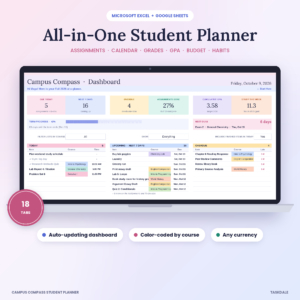
Campus Compass Student Planner Spreadsheet
Price: Original price was: $11.99.$5.99Current price is: $5.99. | Best for: students tracking grades course by course
An 18-tab .xlsx for Excel or Google Sheets with weighted grades for every course, a what-do-I-need-on-the-final tool, a GPA tab, an assignment tracker with countdowns, a calendar and a study log that shows minutes per session and hours by course against a weekly goal. A filled sample copy and a 22-page guide are included. Enter your grade weights from each syllabus, then check your final-exam targets.
If GPA is the number you are watching, the guide to a GPA calculator spreadsheet shows how term and cumulative GPA move with each grade.
What a good study session looks like
A study planner can only schedule sessions. What happens inside them is up to you. Rereading notes with a highlighter feels productive and does very little. Testing yourself feels harder and does far more.
A 50-minute session that works
- 5 minutes: write down everything you remember about the topic, from memory, before opening anything.
- 20 minutes: fill the gaps from your notes or textbook. Mark the parts you got wrong.
- 5 minute break. Stand up. Get water.
- 15 minutes: answer practice questions or explain the topic out loud as if teaching a friend.
- 5 minutes: write one line in your planner: what to review next time.
That final line is the bridge to the next session. Without it, every session starts cold.
For intro courses with lots of terms and diagrams, a workbook with built-in activities saves you writing your own questions. A psychology student, for example, can work through one unit’s review page per session in the last week.
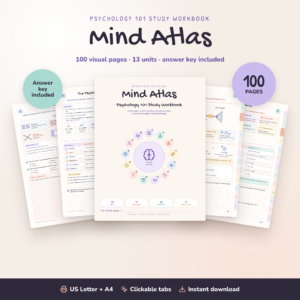
Mind Atlas Psychology 101 Study Guide Workbook
Price: $3.99 | Best for: Psych 101 and AP Psychology students
A 100-page printable workbook covering 13 units of intro psychology, each topic on one visual page with a diagram and an activity. Every unit ends with a review page of key-term matches, multiple-choice and written questions plus a confidence rating, and you get a 39-question final exam, 60 flashcards, a glossary and a separate answer key. Print the unit review pages first and use them as practice tests.
A sample exam-season week
Here is how the first week might look for the four-exam example above. Note that every day has a hard stop.
| Day | Morning | Afternoon | Evening |
|---|---|---|---|
| Monday | Biology units 1 and 2 (learn) | Class | Stats problem set, 45 min |
| Tuesday | Psych units 1 to 3 (learn) | Work shift | Rest |
| Wednesday | Biology units 1 and 2 (review) | Class | History: outline two essay answers |
| Thursday | Biology units 3 and 4 (learn) | Stats past paper, half | Psych units 1 to 3 (review) |
| Friday | Biology units 1 and 2 (self-test) | Class | Free |
| Saturday | Stats past paper, full | Psych units 4 to 6 (learn) | Free |
| Sunday | Plan next week (20 min) | History: timed essay | Early night |
It is not packed. That is on purpose. A plan with no slack falls apart the first time a shift runs long or a friend needs help.
Keep the rest of life running
Exam season does not pause rent, laundry or a part-time job. Students who plan only study hours often lose a whole day to something they forgot: a bill, a library book fine, groceries for the week.
Add three non-study items to your planner each week. Sleep target. One proper meal you will cook or buy. One thing that is not school, like a 30-minute run or a call home. They sound small. They are what stop week two from collapsing.
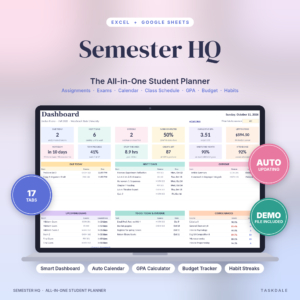
Semester HQ Student Planner Spreadsheet
Price: Original price was: $11.99.$5.99Current price is: $5.99. | Best for: students juggling classes, work and money
A student planner spreadsheet for Excel and Google Sheets with a 12-stat dashboard, an assignment and exam tracker for 300 items with late warnings, a calendar that stars exams, a final-exam calculator, a study log with weekly goals, a habit tracker for 15 habits and a student budget. Enter each exam and its weight first, then add your sleep and study habits to the tracker.
For a full walk-through of setting up a student spreadsheet before the term gets busy, see how to use a student planner spreadsheet for assignments and GPA.
Plan differently for different kinds of exams
Not every exam rewards the same kind of study. A planner that treats a chemistry final like a history essay exam wastes hours. Look at the format of each test, then shape the sessions to match.
Problem-based exams (math, stats, physics, accounting)
Here, doing beats reading every time. Most of your sessions should be worked problems, with the notes closed. Aim for at least two full past papers under timed conditions. Keep a running list of problem types you get wrong, like “conditional probability” or “two-step equations with fractions”, and come back to that list every second day.
Memory-heavy exams (biology, anatomy, intro psych, languages)
Flashcards and blank-page recall do the heavy lifting. Short, frequent sessions beat long ones. Twenty minutes three times a day often works better than one hour-long block, because each return forces you to pull the term back out.
Essay exams (history, English, politics)
Predict the questions. Most essay exams draw on a handful of big themes. Pick five likely prompts, outline an answer to each in bullet points, then write two of them in full under a timer. On the day you will be adapting outlines, not writing from scratch.
Open-book and take-home exams
These feel easy and catch people out. The work moves from memory to organization. Build a one-page index of where everything lives in your notes, so you spend exam time answering, not flipping pages.
For a side-by-side look at planners built for students, see the roundup of the best student planners.
The night before and the morning of
Your planner should cover the last 24 hours too, because that is when good plans get thrown away. The night before is for a light review, not new material. Read your one-page summary, do ten easy questions you know you can answer, and pack your bag: ID, pens, calculator, water, a watch if phones are not allowed.
Set two alarms. Plan to arrive 20 minutes early. Eat something, even if it is just toast and a banana. In the morning, skim your summary once, then put it away. Last-minute cramming in the hallway mostly adds panic.
After each exam, write two lines in your planner: what went well, and what you would study differently. Then close the book on that subject and turn to the next one. That small ritual helps you let go of a test you cannot change and walk into the next with a clear head.
Mistakes that make exam season harder
Planning in hours instead of topics
“Study biology for three hours” is vague. “Units 3 and 4, then ten practice questions” is a session you can finish and tick off.
Saving all practice tests for the last day
A practice test the night before only shows you gaps you no longer have time to fix. Take the first one about a week out.
Cutting sleep to fit more in
Memory needs sleep to settle. Trading two hours of sleep for two hours of tired rereading is a bad deal.
Rewriting the plan every day
Adjust once a week, on Sunday. Daily rewrites eat the time they are meant to save.
Frequently asked questions
How many weeks before exams should I start studying?
Two to three weeks for finals is a good target for most courses. That gives each topic time for a first pass, a review and a self-test.
How many hours a day should I study during exam season?
Most students do well with four to six focused hours split into 45 to 50 minute sessions. More than that usually means lower quality per hour.
Is a digital or paper study planner better for exams?
Digital is better for countdowns, spacing sessions and grade math. Paper is fine for a daily list. Many students use both.
What should I study first when I have several exams?
Start with the earliest exam and the course where a few points change your letter grade. Fill gaps with short reviews of later exams.
What is spaced repetition in a study plan?
It means returning to each topic several times with gaps between, such as day 1, day 3 and day 7, instead of covering it once in a long block.
Your next step
Tonight, write your exam list: subject, date, time and days left. Then count the topics in your earliest exam and plan its first three sessions. If you want the spacing worked out for you, open the Semester Pilot Student Academic Planner App and build your first exam prep plan in ten minutes.