A business plan is not judged on how long it is or how polished the cover looks. It is judged on whether the person reading it can answer their own questions quickly. A bank officer wants to know you can repay. An investor wants to know the business can grow enough to be worth their money. Plans that get read all the way through answer those questions early, plainly and with numbers that hold up.
This guide is for small business owners, founders and side hustlers preparing a plan for a bank loan, a microloan, an investor or a partner. You will see what lenders and investors each look for, how to write an executive summary that earns the next page, how to build a forecast from real assumptions, how to present use of funds and risks, and a checklist to run before you hit send. No plan can promise funding, but a clear one gives you the best chance of a proper hearing.
Quick picks: business plan and forecast templates
| Product | Best for | Price | Link |
|---|---|---|---|
| Clarity Business Plan Kit | A guided plan plus a 3-year forecast | $5.25 | View |
| 3-Statement Financial Model & Dashboard Kit | Investor-ready income, balance and cash flow | $9.00 | View |
| Small Business Finance HQ | Existing businesses showing real results | $7.99 | View |
| Orchid Business Hub | A one-page plan with goals and budget | $6.99 | View |
Lenders and investors read for different reasons
The same plan often goes to both, but they read it with different questions in mind. Knowing which reader you are writing for changes what you put first.
| Question | Lender | Investor |
|---|---|---|
| Main worry | Will I get repaid on time? | Will this grow enough to be worth my stake? |
| Numbers they check first | Cash flow and loan payments | Revenue growth and margins |
| What reassures them | Steady income, collateral, your own money in | A big enough market, a strong team, a clear edge |
| What they want to see on risk | A plan if sales fall short | Why the upside is worth the risk |
| How they get their money back | Regular repayments with interest | A share of profits or a later sale |
A lender does not need you to become huge. They need you to be steady. An investor does not mind a few lean years if the long-term picture is strong. Write with your reader’s worry in mind, and every section gets sharper.
The executive summary decides the rest
Many readers start with the executive summary and only keep going if it answers their first questions. So write it last, after everything else is clear, and keep it to one page.
A strong summary covers six things in plain language: what the business does, who buys from it, why they choose you, how the business makes money, what you are asking for and what it will pay for, and the one or two numbers that matter most.
Here is an example for a small café seeking a loan to add a second site:
Northside Coffee has served the Elm Street neighborhood since 2023 and earned $412,000 in revenue last year with a 9% net margin. Two-thirds of sales come from repeat weekday customers, many of them office workers. We are requesting a $95,000 loan to open a second, smaller site in the new Riverside office park, 1.5 miles away, where three office buildings have opened with no café on site. Funds cover fit-out, equipment and three months of working capital. Our forecast shows the second site covering its own costs by month seven, with combined cash flow covering loan payments by a comfortable margin from year one. The owners are investing $25,000 of their own savings alongside the loan.
In about 130 words, a lender knows the track record, the request, the purpose, the timeline and the owners’ own stake. Everything after that is evidence.
The sections that carry the most weight
Most plan templates list 12 to 16 sections. They all matter, but a few do the heavy lifting.
Market and customers
Who buys, how many of them there are nearby or online, and what they spend now. Use local, checkable facts where you can: the number of offices in the area, foot traffic counts you did yourself, customer survey results. Avoid vague claims like “everyone needs coffee”.
Competition and your edge
Name the real alternatives, including “people make coffee at home”. Then say clearly why customers will pick you. Location, speed, quality, price, a niche. One or two honest reasons beat a list of ten.
Operations
How the work actually gets done. Staff, suppliers, hours, equipment. Readers want to see you understand the day-to-day, not just the idea.
Management
Who runs it and what they have done before. Relevant experience reassures both lenders and investors. If there are gaps, say how you will fill them, like a part-time bookkeeper or an advisor.
Financials
The part most readers flip to first after the summary. More on this below, because it is where plans most often lose credibility.
For a step-by-step walk through every section, our guide on how to write a business plan covers each one with prompts.
A template that tells you what to write on every page saves days of staring at a blank document, and one that links the financial pages to a working forecast keeps text and numbers in agreement.
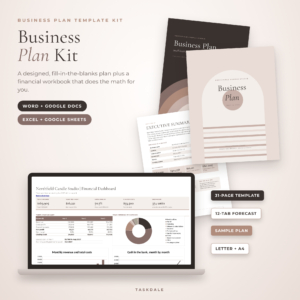
Clarity Business Plan Kit
Price: $5.25 | Best for: founders applying for a loan or grant
A 31-page editable business plan template for Word and Google Docs in US Letter and A4, with three cover designs, an automatic table of contents and 16 guided sections from Executive Summary to Risk Assessment. A matching Excel and Google Sheets forecast turns your assumptions into three years of startup costs, sales, profit, cash flow and break-even, and flags in red any month that would run short of cash. Fill in the forecast first, then write the sections around the numbers it produces.
Numbers that hold up under questions
A forecast that says sales will grow 40% a year with no explanation will not survive the first question. A forecast built from small, checkable assumptions will.
Build sales from the bottom up
Start from things you can count. For the café’s second site: 3 office buildings, about 1,200 workers, and a guess that 8% buy a coffee on a typical weekday. That is 96 sales a day. At an average spend of $6.50, about $624 a day, or roughly $13,700 a month across 22 weekdays. Add a smaller weekend figure. Now the reader can see the logic and argue with a single number, rather than dismiss the whole forecast.
Show the costs honestly
Rent, wages, ingredients, utilities, insurance, card fees, repairs, marketing. Use quotes and current bills where possible. If you are guessing, say so and explain how you got the figure.
Include a cash flow forecast
Profit and cash are not the same. A lender especially wants to see month-by-month cash for at least the first year, including loan payments, so they can check you never run dry. Our guide on the cash flow forecast template shows how to lay one out.
Show break-even
How many sales a month cover your fixed costs? If the café’s second site needs 70 coffees a day to break even and the forecast shows 96, the reader can see the cushion at a glance.
Offer a cautious case
Add a simple second scenario with sales 20% lower. If loan payments are still covered, you have answered a lender’s biggest fear before they ask it.
What lenders look for in particular
Every lender has its own criteria, so ask for theirs before you write. In general, though, banks and small business lenders tend to focus on a handful of things.
- Ability to repay. Cash coming in comfortably above all payments, including the new loan. Many lenders look at the ratio between cash available and loan payments, so show both clearly.
- Track record. For an existing business, recent profit and loss statements, bank statements and tax returns.
- Your own stake. Money you are putting in yourself shows commitment.
- Collateral. Equipment, property or other assets that secure the loan, where relevant.
- Personal credit history, especially for newer and smaller businesses.
If your business already trades, your own books are the strongest evidence you have. A clean one-page summary of recent results, with profit, cash flow and trends, often says more than ten pages of description.
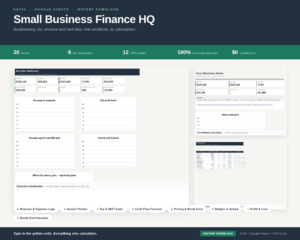
Small Business Finance HQ
Price: $7.99 | Best for: trading businesses applying for a loan
A 20-sheet bookkeeping and planning workbook for Excel and Google Sheets with revenue and expense logs, an invoice tracker, monthly and annual profit and loss, a cash flow forecast with a lowest-point warning, pricing and break-even, budget vs actual and six dashboards. Its Business Snapshot sheet is a single page that writes its own summary from your figures, made for sending when a bank or landlord asks how things are going. Log at least the last few months of income and expenses, then print the Snapshot and annual P&L for your plan’s appendix.
What investors look for in particular
Investors are buying a share of the future, so they read for growth and for the team that will deliver it. They also expect a more complete set of financials.
- Market size. Is there room for the business to grow well beyond today? Show how you worked out the figure.
- Traction. Early sales, sign-ups, repeat customers, pre-orders. Real evidence beats projections.
- Unit economics. What it costs to win a customer, what each customer is worth over time, and the margin on each sale.
- Three linked financial statements. An income statement, a balance sheet and a cash flow statement that tie together month by month.
- How they get a return. Profit sharing, a later sale or another route. Be realistic, not grand.
For property and development plans, our article on what investors expect in a multifamily development business plan covers the extra detail that sector needs.
A three-statement model that balances every month is the kind of thing investors’ advisers check first. Building one from scratch is fiddly, and a single broken link can make the balance sheet stop balancing.
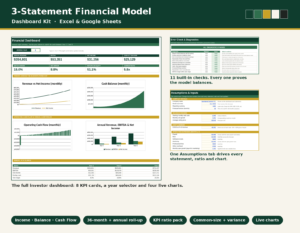
3-Statement Financial Model & Dashboard Kit
Price: $9.00 | Best for: founders pitching investors or partners
A 19-sheet model for Excel and Google Sheets driven by one Assumptions tab. Change units, price, cost of goods, payroll, rent, debt, tax and opening balances, and a 36-month income statement, balance sheet and cash flow fill in, with an annual roll-up and ratio pack. An investor-style dashboard shows eight KPI cards and four charts with a year selector, and an Error Checks tab runs eleven tests, including that the balance sheet balances every month. Enter your assumptions, then check every line says PASS before exporting charts into your plan.
Use of funds: show exactly where the money goes
Vague requests worry every reader. “$95,000 for expansion” invites questions. A table answers them.
| Use | Amount |
|---|---|
| Fit-out and counter build | $38,000 |
| Espresso machine, grinders and refrigeration | $24,500 |
| Furniture and signage | $9,000 |
| Deposit and first month’s rent | $8,400 |
| Opening stock and supplies | $3,100 |
| Working capital, three months | $12,000 |
| Total | $95,000 |
Add a line underneath stating your own contribution and what it covers. Quotes from suppliers can go in the appendix. Readers relax when every dollar has a named job.
Write the risks section like a grown-up
Some owners leave risks out, worried it will scare readers off. The opposite tends to happen. A plan with no risks looks naive. A plan that names the real risks and how you would handle them looks prepared.
Pick three to five real risks. For the café: slower uptake at the new site, a key barista leaving, rising coffee bean prices, and a new competitor opening nearby. For each one, write a sentence on what you would do. Shorter opening hours in a slow first quarter. Cross-training staff between sites. A supplier contract with fixed prices for twelve months. A loyalty scheme launched on day one. That is all it needs.
Length, layout and the appendix
Keep the main plan tight. For most small businesses, 15 to 30 pages is plenty, with the detailed financials and documents in an appendix. Use headings that match what the reader expects, short paragraphs, and tables for anything with numbers. Put charts next to the text they support.
The appendix is where evidence lives: three years of forecasts, recent accounts, supplier quotes, a lease offer, CVs of the team, letters of intent from early customers. Readers who want the detail can find it. Readers who do not are not slowed down.
A checklist before you send it
- Does the executive summary fit on one page and state the request and purpose?
- Do the numbers in the text match the numbers in the forecast exactly?
- Is every forecast figure traceable to a stated assumption?
- Does the cash flow show loan payments and never dip below zero?
- Is there a cautious scenario?
- Is the use of funds broken down line by line?
- Have you named real risks and responses?
- Has someone outside the business read it and asked questions?
- Is it saved as a PDF with a clear file name?
Frequently asked questions
What do lenders look for in a business plan?
Mainly evidence you can repay: steady cash flow above loan payments, a track record or realistic forecast, your own money invested, and in some cases collateral and good credit history.
What do investors look for in a business plan?
A market big enough to grow into, early proof that customers want the product, a capable team, healthy margins and linked financial statements showing how the business develops over several years.
How long should a business plan be for a bank loan?
Usually 15 to 30 pages for the main plan, with detailed financials and documents in an appendix. Ask the lender whether they have a preferred format.
How many years of financial projections do I need?
Three years is common, with monthly detail for the first year. Some lenders and investors ask for five, so check before you start.
Should I include a risks section?
Yes. Naming real risks and how you will handle them shows you have thought the business through, which usually builds trust.
Your next step
Write your executive summary in rough tonight, even before the rest is done, and see which sentences you cannot yet back up with a number. Those gaps are your to-do list. Then build the forecast and the sections around it in the Clarity Business Plan Kit.