Macros are just three numbers: grams of protein, carbs and fat. The trick is not finding the numbers. It is turning them into breakfast, lunch and dinner you would actually cook on a Tuesday.
This guide takes you from a goal (lose fat, hold steady, build muscle) to a set of daily targets, then splits those targets across your meals and builds a real week from simple food blocks. Two worked examples show the maths in plain figures. Then you will see which Taskdale planners can do the sums for you, so you spend your Sunday choosing food rather than punching a calculator.
Quick picks: planners that work with macros
| Product | Best for | Price | Link |
|---|---|---|---|
| MacroBloom Macro Meal Planner Spreadsheet | Setting targets with a built-in TDEE calculator | $27.95 | View |
| Larkspoon Meal Planner Spreadsheet | Macros per person plus cost and a grocery list | $12.99 | View |
| Pantry Bloom Meal Planner Spreadsheet | Families where one or two people count | $18.99 | View |
| Thymewise Digital Meal Planner | Planning by hand on a tablet or paper | $1.75 | View |
Your goal decides the calories first
Macros sit inside a calorie total, so the calorie total comes first. Start with an estimate of the calories you burn on a normal day, often called maintenance or TDEE (total daily energy expenditure). Online calculators and planner spreadsheets estimate it from your height, weight, age and how active you are. It is an estimate, not a fact. You will adjust it later using real results.
Then nudge it to match the goal. These are common starting points many people use:
- Fat loss: eat about 300 to 500 calories below maintenance.
- Maintenance: eat around maintenance and focus on food quality and protein.
- Muscle gain: eat about 200 to 300 calories above maintenance, paired with strength training.
- Endurance training: eat around maintenance on rest days and more on long session days, mostly from carbs.
Pick one goal. Not two. Trying to lose fat and gain lots of muscle at the same time usually leaves people stuck in the middle, eating a number that serves neither.
Turning a calorie target into three macro numbers
Each gram has a fixed calorie value. Protein and carbs give about 4 calories per gram. Fat gives about 9. So you set protein first, set fat second, and let carbs fill whatever is left.
Worked example 1: Sam, fat loss
Sam weighs 80 kg and his maintenance estimate is 2,500 calories. He wants to lose fat, so he sets 2,000.
- Protein: he picks 140 g. That is 560 calories.
- Fat: he picks 60 g. That is 540 calories.
- Carbs: 2,000 minus 1,100 leaves 900 calories, divided by 4, which is 225 g.
Sam’s targets: 140 g protein, 225 g carbs, 60 g fat, 2,000 calories.
Worked example 2: Priya, muscle gain
Priya weighs 60 kg, lifts three times a week, and has a maintenance estimate of 2,050. She adds 250 for a target of 2,300.
- Protein: 120 g, which is 480 calories.
- Fat: 70 g, which is 630 calories.
- Carbs: 2,300 minus 1,110 leaves 1,190 calories, divided by 4, which is about 300 g.
Priya’s targets: 120 g protein, 300 g carbs, 70 g fat, 2,300 calories. Notice how much more room she has for rice, oats and fruit. That surprises a lot of people who assume every macro plan means cutting carbs.
Doing this by hand once is useful, because it shows you how the numbers connect. Doing it every time your weight changes gets old fast.
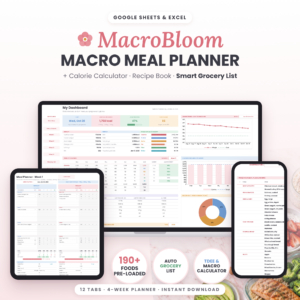
MacroBloom Macro Meal Planner
Price: $27.95 | Best for: anyone setting macro targets from scratch
MacroBloom works in Google Sheets and Excel. You enter your stats once and it calculates BMR and TDEE, then sets daily targets for calories, protein, carbs, fat, fiber and water. Those targets feed a 4-week meal planner, a 40-card recipe book, a 190-food library and a grocery list that builds itself. Fill in the profile tab first, check the targets it gives you against your goal, then plan just three days before trying a full week.
Split the day into meal-sized targets
A daily total of 140 g protein feels abstract. A target of 35 g at breakfast does not. Divide your numbers across the meals you really eat, not the meals a fitness magazine says you should eat.
Here is Sam’s day, split for three meals and one snack:
| Meal | Protein | Carbs | Fat | Approx. calories |
|---|---|---|---|---|
| Breakfast | 35 g | 50 g | 15 g | 475 |
| Lunch | 40 g | 65 g | 15 g | 555 |
| Snack | 20 g | 30 g | 10 g | 290 |
| Dinner | 45 g | 80 g | 20 g | 680 |
| Total | 140 g | 225 g | 60 g | 2,000 |
If Sam trains after work, he can shift 20 g of carbs from breakfast to dinner. If he skips breakfast, he folds it into lunch and a bigger snack. The total matters far more than the timing for most people.
Build meals from food blocks, not recipes
Recipes are lovely on weekends. On weeknights, blocks are faster. A block is a standard portion of one food with known rough macros. Combine one protein block, one or two carb blocks and a small fat block and you have a meal that lands close to target without a single calculation at the stove.
Protein blocks (about 30 to 40 g protein)
- 130 g cooked chicken breast
- 200 g plain nonfat Greek yogurt plus a scoop of protein powder stirred in
- 150 g cooked lean beef mince (5% fat)
- 1.5 cans of tuna in water
- 200 g firm tofu plus a cup of edamame
Carb blocks (about 40 to 45 g carbs)
- One cup of cooked rice
- 70 g dry oats
- A medium baked potato plus an apple
- Two slices of wholegrain bread plus a banana
Fat blocks (about 10 to 15 g fat)
- One tablespoon of olive oil
- Half an avocado
- 30 g cheddar
- A small handful of almonds
Sam’s dinner then becomes: one protein block, two carb blocks, one fat block and as many vegetables as he likes. Chicken, two cups of rice, a spoon of oil in the stir-fry. Done. Close enough to 45, 80 and 20 that the difference will not matter by Friday.
One full day on Sam’s plan
Numbers on a page only start to feel real when they turn into food. So here is a plain Wednesday for Sam, built entirely from the blocks above. Nothing fancy. Nothing he would need a recipe for.
- 7:00, breakfast: 70 g oats cooked with water, stirred with a scoop of protein powder once off the heat, topped with half a banana and a small handful of almonds. Roughly 35 g protein, 55 g carbs, 14 g fat.
- 12:30, lunch: a box of 130 g chicken, one and a half cups of rice, roasted peppers and courgettes, a spoon of pesto. Roughly 42 g protein, 65 g carbs, 14 g fat.
- 16:00, snack: a 200 g pot of Greek yogurt with a sliced apple and a drizzle of honey. Roughly 20 g protein, 30 g carbs, under 1 g fat.
- 19:00, dinner: beef and vegetable stir-fry with 150 g lean mince, a pile of frozen stir-fry vegetables, soy sauce, one tablespoon of oil and two cups of rice noodles. Roughly 43 g protein, 75 g carbs, 22 g fat.
That adds up to about 140 g protein, 225 g carbs and 50 g fat. A little under on fat, which leaves room for a square of chocolate after dinner if he wants one. That small bit of slack is what makes a plan feel livable rather than strict.
Write one day like this for yourself before you plan a whole week. Once a single day works, a week is just that day with some swaps.
Planning the week when the rest of the house doesn’t count
Most macro plans live inside a household where nobody else is counting. A partner wants pasta. The kids want pasta with cheese on top. Cooking two dinners every night is how macro plans end.
The better approach is a shared base meal with an adjustable plate. Everyone gets the bolognese. The person tracking has a bigger scoop of sauce, a smaller nest of pasta and a side salad. Same pot, different plate. A planner that tracks nutrition per person makes this easy, because you can see whose numbers moved.
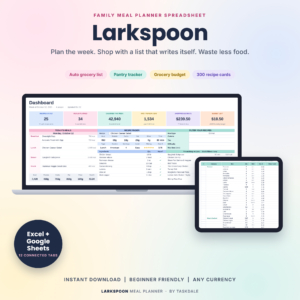
Larkspoon Meal Planner Spreadsheet
Price: $12.99 | Best for: households mixing counters and non-counters
Larkspoon is one Excel and Google Sheets file with twelve connected tabs. Plan seven days of breakfast, lunch, dinner and snacks, and it tracks calories, protein, carbs, fat and fiber per meal, per day and per person, prices each dish against your budget, and writes a grocery list sorted by aisle minus what is in your pantry. Nutrition tracking is optional, so the non-counters in the house never have to see it. Add your five most-cooked family dinners as recipes first.
If your household is bigger, or you want a pantry-first view, Pantry Bloom from the table above tracks the same nutrients per person and adds expiry alerts and cook-from-your-pantry ideas. For more on stretching a plan across the month, see how to make a monthly meal plan you’ll actually follow.
If you would rather plan with a pen
Not everyone wants a spreadsheet. Some people think better with handwriting, and that is fine. You can still hit macro targets on paper or a tablet. Write your daily targets at the top of each weekly page, list your go-to food blocks on a single reference page, and plan each meal as “P1 + C2 + F1” in shorthand. Total up protein for each day before shopping. That one check catches most misses.
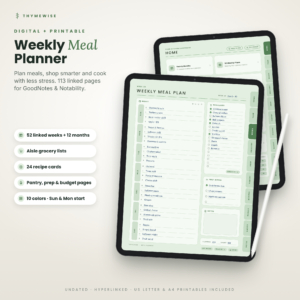
Thymewise Digital Meal Planner
Price: $1.75 | Best for: tablet planners who like handwriting
Thymewise is an undated, hyperlinked planner for GoodNotes, Notability and other PDF apps, with 113 pages including 52 weekly meal plans, aisle-sorted grocery lists, a meal prep planner, pantry and fridge inventories, 24 recipe cards and a healthy habits tracker. Printable US Letter and A4 versions are included. It does not calculate macros for you, so write your food blocks on a recipe card page first and refer back to it as you plan each week.
Check, then adjust after two weeks
Your first targets are a guess. A good guess, but still a guess. After two full weeks, look at what actually happened.
- Fat loss goal, weight not moving: drop about 150 calories, mostly from carbs or fat, and keep protein the same.
- Fat loss goal, losing fast and feeling flat: add about 150 calories back, mostly carbs.
- Muscle gain goal, no change on the scale or in the gym: add 100 to 150 calories.
- Maintenance goal, weight creeping up: trim 100 calories and watch the snacks.
Use a weekly average weight rather than single days. One salty takeaway on Saturday can add a kilo of water overnight, and it is gone by Wednesday. Small changes, then another two weeks. That is the whole loop.
If budget is part of the goal too, our weight loss meal plan on a budget shows four weeks of meals with grocery lists you can borrow from.
Mistakes that knock a macro plan off course
Chasing perfect numbers every day
Landing within about 10 g of protein and 100 calories is a good day. Hitting every gram exactly is not the goal, and chasing it makes people quit.
Forgetting cooking oil and sauces
A “splash” of oil can be two tablespoons and nearly 30 g of fat. Measure it for one week, just to learn what your splash really is.
Setting protein too high to reach
A target you miss every single day is not motivating. If you keep falling 30 g short, either add a protein snack or lower the target a little and build up.
Never updating the targets
After losing 6 kg, your maintenance number has changed. Recalculate every 4 to 5 kg of change, or every couple of months.
Frequently asked questions
What is a good macro split for weight loss?
There is no single right split. A practical way is to set protein first, keep fat moderate, and give carbs the rest. Sam’s example above, at roughly 28% protein, 45% carbs and 27% fat, is one common shape.
Do I have to count macros forever?
No. Many people count for six to eight weeks, learn what their portions look like, then switch to planning with food blocks and checking now and then.
Can I eat the same meals every day on a macro plan?
Yes. Repeating breakfast and lunch is one of the easiest ways to stay on target. Change dinner for variety.
How do I count macros for homemade recipes?
Add up the macros of every ingredient, then divide by the number of servings. A recipe spreadsheet does this automatically once you enter the ingredients.
Is a macro meal plan different from a calorie meal plan?
A calorie plan only watches the total. A macro plan also checks where those calories come from, which helps with fullness, training and keeping protein high.
What if I go over my macros at a party or dinner out?
Nothing needs fixing. Go back to your normal targets at the next meal. One high day inside a steady fortnight barely shows up in the weekly average.
Your next step
Work out your own three numbers today, using Sam or Priya as the template. Then write down two protein blocks, two carb blocks and one fat block you already like, and plan tomorrow’s meals from them. When you want the sums done for you, set up the MacroBloom macro meal planner and let it calculate your targets.