A monthly budget template for bills, food and savings works when it treats those three as separate jobs. Bills are mostly fixed and due on set dates. Food moves every week and is the line you can steer the most. Savings only happen if they leave your account before the month gets a chance to spend them. Give each one its own section and the whole budget gets easier to run.
Most budgets that fail do so in the food line. The rent is the rent; you know it to the cent. But groceries, takeout and the coffee on the way to work drift up quietly, and by the 24th the savings transfer gets skipped “just this month.” A good template makes that drift visible early, while there is still time to fix it.
This guide walks you through filling in a template from scratch: listing every bill, setting a food number you can actually live on, paying savings like a bill, a full worked example, matching bills to paydays and a 30-minute monthly review. It is practical and general; your own numbers will differ, and no template can promise a result. What it can do is show you where the money goes.
Quick picks for budgeting bills, food and savings
| Product | Best for | Price | Link |
|---|---|---|---|
| Daybloom Life Planner Spreadsheet | Bills, budget, savings and meals linked in one file | $2.00 | View |
| Well-Kept Life Planner | Printable budget, bill and meal pages in one binder | Original price was: $12.99.$6.99Current price is: $6.99. | View |
| Blush & Sage Meal Planner Kit | Keeping the food line on budget with a monthly meal plan | $1.49 | View |
| Linenleaf Digital Planner | Budget and monthly review on an iPad or Android tablet | $44.99 | View |
The four sections every monthly template needs
Before you write a single number, set up four sections. Most budget templates have them in some form, even if the names differ.
- Income. Every dollar that comes in this month, after tax. Wages, side work, child support, benefits.
- Bills. Rent or mortgage, utilities, phone, internet, insurance, loan and card payments, subscriptions, childcare.
- Food. Groceries, takeout, eating out, work lunches, coffee. Yes, coffee counts as food here.
- Savings. Emergency fund, sinking funds for things like car repairs or holidays, and any longer-term goal.
Everything else, like gas, clothes, gifts and kids’ activities, can live in a fifth “everyday spending” section. But keep food separate. It is the most flexible big line in most budgets, so it deserves its own spotlight.
Step 1: list every bill, including the sneaky ones
Open your bank statements for the last three months and go line by line. Write down every regular payment, its amount and the date it leaves.
Fixed bills
The same every month: rent, car payment, phone contract, insurance. Easy to plan.
Variable bills
Change with the season or usage: electricity, gas, water. Use the average of the last three months, or the highest one if you want a safety margin. A winter heating bill that jumps from $90 to $160 should not catch you off guard.
Bills that are not monthly
Car registration, annual subscriptions, school fees, the yearly insurance premium. These are the ones that break budgets, because they arrive in one lump. Divide each by 12 and set that amount aside every month. A $480 annual car insurance bill becomes $40 a month into a sinking fund. If you want to map the whole year ahead, our guide to an annual budget template shows how.
Subscriptions
Streaming, apps, cloud storage, the gym. Write every one down. Most people find at least one they forgot about. Canceling it is a quick, satisfying win.
Step 2: set a food number you can live with
Food is where good intentions go to die, so be honest here. Add up everything you spent on groceries and eating out over the last two months, divide by two, and that is your real starting figure.
Now split it into two lines: groceries, and everything bought ready to eat. Seeing them apart is often eye-opening. A couple spending $650 a month on food might find $420 goes to groceries and $230 to takeout, lunches and coffee. That second number is usually the easiest to bring down.
Monthly or weekly?
Budget food monthly but spend it weekly. Take your monthly grocery figure, divide by 4.33 (the average number of weeks in a month), and that is your weekly shop. A $430 monthly grocery budget is about $99 a week. Weekly targets are easier to stick to than one big monthly pot that seems endless on the 3rd and empty on the 22nd.
Let the meal plan set the food line
The most reliable way to hit a food number is to plan meals first and shop from the plan. When dinners are decided, takeout drops, and the grocery list stops growing extras. A monthly meal plan with a grocery list and a spot for budget and total spent on the same page keeps the food line honest.
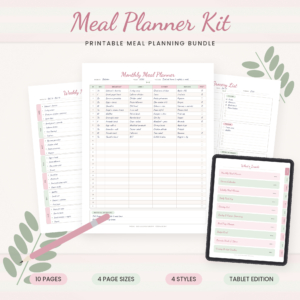
Blush and Sage Meal Planner Kit
Price: $1.49 | Best for: keeping the food budget on track
Ten printable meal planning pages in Letter, A4, A5 and Half Letter PDFs. It has a Monthly Meal Planner with 31 numbered days, a Dinner Calendar with boxes for monthly stock-up items, a weekly planner with a grocery list beside it, a Grocery List in 8 store sections with spots for budget and total spent, a Pantry and Freezer Inventory and a Meal Prep Planner. Fill in the monthly planner, then write your weekly food number on each grocery list.
Step 3: pay savings like a bill
If savings is whatever is left at the end of the month, savings will usually be zero. The fix is old but it works: put savings in the bills section, with a due date, and move it on payday.
- Start small. Even $50 a month builds the habit. You can raise it later.
- Automate it. A standing transfer the day after pay removes the temptation to skip it.
- Name each pot. “Emergency fund,” “car repairs,” “Christmas.” Named money is harder to raid.
- Build the emergency fund first. Many people aim for one month of essential bills to start, then grow it.
If you want a method where every dollar gets a job before the month starts, the zero based budget takes this idea further.
A worked example: one month, one household
Here is a filled-in template for a couple with one child. Take-home pay is $4,200 a month. Your figures will be different, but the shape is what matters.
| Section | Item | Planned | Due |
|---|---|---|---|
| Income | Wages (two earners, after tax) | $4,200 | 1st and 15th |
| Bills | Rent | $1,450 | 1st |
| Bills | Electric and gas (average) | $140 | 8th |
| Bills | Water | $45 | 12th |
| Bills | Phones and internet | $120 | 18th |
| Bills | Car payment and insurance | $390 | 20th |
| Bills | Childcare | $520 | 1st |
| Bills | Subscriptions | $35 | Various |
| Food | Groceries | $520 | Weekly ($120) |
| Food | Takeout and eating out | $120 | Fridays |
| Savings | Emergency fund | $200 | 2nd |
| Savings | Sinking funds (car, gifts, annual bills) | $150 | 2nd |
| Everyday | Gas, clothes, kids’ activities, personal | $500 | Weekly |
| Total planned | $4,140 | $60 buffer | |
A few things to notice. Savings goes out on the 2nd, right after the first paycheck, before anything else can touch it. Takeout has its own small line, which means a Friday pizza is planned, not a failure. And there is a $60 buffer, because no month goes exactly to plan.
Match bills to paydays
A budget can add up perfectly on paper and still bounce a payment, because the money arrives on the 15th and the car bill leaves on the 12th. So put every bill on a calendar next to your paydays.
- Mark each payday in one color.
- Write each bill on its due date.
- Split the month into “paid from paycheck one” and “paid from paycheck two.”
- Check each half adds up to less than that paycheck.
If one half is overloaded, call the company. Many will move a due date if you ask. Shifting the car payment from the 12th to the 20th can turn a stressful week into a calm one.
A printed monthly calendar with a bill tracker beside it is a simple way to see this at a glance, especially if you like ticking things off as they are paid.
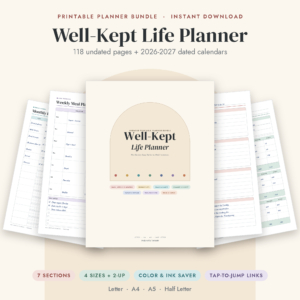
Well-Kept Life Planner
Price: Original price was: $12.99.$6.99Current price is: $6.99. | Best for: paper budgeters who track bills by date
A printable bundle of 118 undated pages plus 32 dated calendar pages from October 2026 to December 2027, in Letter, A4, A5 and Half Letter. It has 23 finance pages covering budgets, bills, savings, sinking funds, debt and net worth, plus monthly calendars and weekly and monthly meal plans with grocery lists. Print a monthly calendar and the bill pages together, then mark paydays first.
Spreadsheet, printable or tablet?
The format matters less than whether you open it each week.
Spreadsheet
Best for people who want totals and “left to spend” figures to update on their own. Log a payment once and it shows up in the budget, the bills list and the savings total. If you are tired of starting a fresh sheet every month, read why rebuilding your monthly budget spreadsheet is a waste of time.
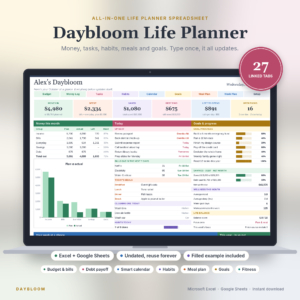
Daybloom Life Planner Spreadsheet
Price: $2.00 | Best for: one file for bills, food and savings
An undated Excel and Google Sheets planner with 27 linked tabs. Log a payment once and your budget, bills, savings, debt, yearly view and dashboard all update; bills schedule their own next due dates, and a meal planner sends ingredients to the grocery list. It also shows a safe-to-spend-per-day figure and comes with a filled example file. Open the example first, then enter your income and bills on Setup.
Printable
Best for people who think better with a pen. Writing each bill by hand makes you notice it in a way a spreadsheet sometimes does not.
Tablet
Best for people who already carry an iPad or Android tablet. A digital planner keeps your budget pages next to your calendar and meal plans, and you can write with a stylus wherever you are.
The 30-minute monthly money review
Set a date near the end of each month. Thirty minutes, a cup of tea, the template and your bank app. Work through it in order.
- Bills (5 minutes). Did everything get paid? Any bill go up? Any new subscription sneak in?
- Food (10 minutes). Groceries and eating out, planned against actual. Which week went over, and why?
- Savings (5 minutes). Did every transfer happen? Add up each pot. Enjoy that number for a moment.
- Next month (10 minutes). Copy the template, change what needs changing, put birthdays and one-off costs in now.
The food review is where most of the learning happens. After three months you will know your real grocery spend, which weeks blow out (often the one with a birthday or a school trip), and how much a planned meal week saves compared with an unplanned one.
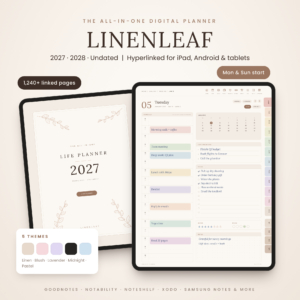
Linenleaf Digital Planner
Price: $44.99 | Best for: tablet users who review monthly
A hyperlinked digital planner for GoodNotes, Notability and other PDF apps on iPad or Android, with dated 2027 and 2028 planners plus an undated one, five color themes and Monday or Sunday starts. Alongside daily, weekly and monthly pages it includes budget, habit and meal planner sections, so your money review sits next to your calendar. Set up your monthly budget page before the first of the month.
Common budget template mistakes
- Using a food figure from a blog. Use your own last two months. Anything else is a guess.
- Forgetting annual bills. Divide them by 12 and save monthly.
- No fun money. A budget with zero room for a treat tends to get abandoned.
- Savings last. Move it first, on payday.
- Never looking back. The monthly review is where the budget actually improves.
Frequently asked questions
What should a monthly budget template include?
Income, bills with due dates, a food section split into groceries and eating out, savings, and everyday spending. Planned and actual columns let you see the difference at the end of the month.
How much of my budget should go to food?
It varies a lot with household size, location and income. Start with what you really spent over the last two months, then plan small reductions, often by cutting takeout first.
How do I budget for bills that are not monthly?
Divide each yearly or quarterly bill by the number of months until it is due and set that amount aside monthly in a sinking fund, so the money is ready when the bill arrives.
Should savings come before bills in a budget?
Essential bills come first, but savings should go out right after payday as a fixed transfer, before everyday spending. Treating savings like a bill makes it far more likely to happen.
Is a spreadsheet or a printable budget better?
A spreadsheet does the maths and updates totals for you; a printable suits people who like writing things down. The better one is the one you will open every week.
Your next step
This weekend, pull up three months of bank statements and list every bill with its due date. Then work out your real food spend and split it into groceries and eating out. Those two lists are the heart of your template. To have bills, food and savings update together, set up the Daybloom Life Planner Spreadsheet.