When you budget money before payday hits, the paycheck arrives with a job list already waiting for it. Rent: covered. Phone: covered. Groceries for two weeks: set aside. Savings: moved before you can touch it. Without that plan, the same paycheck lands in an open account, and somehow a third of it is gone by Sunday.
This guide is for anyone who feels rich for two days after payday and broke for the ten days before the next one. You will learn a short planning session to run the night before your pay lands, how to see every bill due before your next check, a full example of one planned paycheck, and how to handle the very human urge to treat yourself the moment money arrives. We also cover what to do if payday has already been and gone.
Quick picks: tools for planning paychecks ahead
| Product | Best for | Price | Link |
|---|---|---|---|
| Payday Compass Paycheck Budget Spreadsheet | Seeing bills due before each payday in Excel | $11.99 | View |
| Payday Bloom Paycheck Budget Planner | Planning each check on paper, with envelopes | Original price was: $5.49.$2.49Current price is: $2.49. | View |
| Money, Unscripted Money Mindset Workbook | Payday splurges and money habits | $6.49 | View |
| The Calm Money Method | Mindset work plus budget and debt pages | $11.99 | View |
Why the plan has to come before the money
Money with no plan tends to get spent on whatever is in front of you. On payday, what is in front of you is usually a takeaway menu, a shopping cart you filled last week and a group chat suggesting drinks. None of those are bad. They just get first pick of your pay, ahead of rent and savings.
Planning the night before flips the order. The boring, important things get paid first, and the fun gets a fixed amount that you can enjoy without guilt. It also takes the decisions out of payday itself. You are not deciding anything when the money lands. You are just following a list you wrote when you were calm.
Here is the difference in practice. Chris, a warehouse worker paid $1,380 every other Friday, used to check his balance on payday, see a healthy number and relax. By the following Wednesday, $310 had gone on food, a game and a night out, and the phone bill bounced. When he started planning on Thursday nights, the same paycheck covered his bills, put $100 in savings and still left $180 for fun. Same money. Different order.
Step one: know exactly what is landing and when
You cannot plan a paycheck if you are guessing at the amount. Pull up your last two payslips and look at the net pay, the amount that actually reaches your bank. If it changes because of overtime, shifts or commission, use the lower of the two for planning, and treat anything extra as a bonus.
Next, write down your pay schedule for the next three months. Weekly, every two weeks, twice a month, monthly. Note any public holidays near a payday, because deposits can land a day earlier or later around them. Also check what time of day your pay usually clears. If your rent is pulled at 6 am and your pay clears at 9 am, that three-hour gap can cause a failed payment.
It sounds fussy. It is also a two-minute job that prevents the most annoying bank fees.
Step two: list everything due before the next payday
This is the heart of planning ahead. Not “what are my monthly bills?” but “what has to be paid between this payday and the next one?” That smaller window is easier to manage and much harder to get wrong.
Open your bill list and circle every item with a due date between this payday and the day before the next. Add any subscriptions that renew in that window, any debt minimums, and your share of anything you split with a housemate or partner. Then add the spending you know is coming: groceries, fuel, a birthday on the 14th, a school trip fee.
One thing catches nearly everyone the first time: the bill that is due just after the next payday. If rent is due on the 1st and your next check lands on the 2nd, rent has to come from this paycheck. Look ahead two or three days past the next payday, not just up to it.
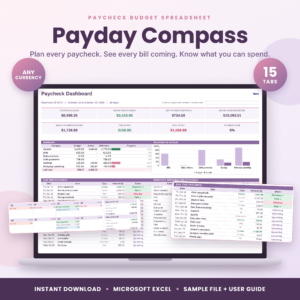
Payday Compass Paycheck Budget Spreadsheet
Price: $11.99 | Best for: anyone tired of bills landing before pay
Payday Compass is an Excel paycheck budget that schedules every bill, paycheck, subscription, debt payment and savings transfer across 12 months and drops each one into the right pay period. It shows what is due before your next payday, what is paid and how much is safe to spend. Mark bills paid with an x on the Paid Tracker. Add your paychecks and bills on one tab first, then open the paycheck dashboard.
Step three: the 20-minute night-before session
Pick the evening before payday. Make a cup of something, sit somewhere comfortable, and work through these steps in order.
- Write the paycheck amount at the top. The net figure from step one.
- Subtract the bills from step two. Every bill due before the next payday, plus anything due a few days after it.
- Set your savings amount. Even $25. It comes out before spending, not after.
- Set your debt payments. Minimums first, plus any extra you have planned.
- Divide the rest into spending categories. Groceries, transport, household, fun. Be honest about what two weeks of food really costs you.
- Check that it reaches zero. Every dollar has a job. If there is money left, give it one. If you are short, trim the spending categories first.
- Write the transfers you will make tomorrow. Which amount goes to which account, in which order.
The first time takes about 30 minutes. By the third payday, it takes 15. And there is a small, real sense of calm that comes from going to bed knowing exactly where tomorrow’s money is going.
If you like longer-range planning too, our guide on planning your money year with a budget and goal planner shows how each paycheck plan feeds bigger goals.
One paycheck, planned the night before
Here is a full example. Nadia is a dental nurse paid $1,560 every other Thursday. Her rent is due on the 1st and her next payday is on the 3rd, so rent comes out of this check.
| Job | Amount | Note |
|---|---|---|
| Rent (due the 1st) | $780 | Half her rent, the other half came from last check |
| Phone | $55 | Due the 24th |
| Streaming | $16 | Renews the 27th |
| Credit card minimum plus extra | $120 | Due the 29th |
| Emergency fund | $75 | Moved on payday morning |
| Holiday sinking fund | $50 | Trip in August |
| Groceries for two weeks | $230 | Two big shops and a top-up |
| Bus pass and fuel for a lift share | $65 | Fixed |
| Household and toiletries | $34 | Cleaning supplies running low |
| Fun money | $135 | Spend freely, no guilt |
| Total | $1,560 | Left to plan: $0 |
Notice that fun money is not an afterthought. It is a planned line with a real amount. Nadia knows she can spend $135 over the next two weeks however she likes, and that knowing is exactly what stops a payday splurge from eating into rent.
Planning on paper, with envelopes if you like
Some people plan best with a pen. Writing each bill next to the paycheck that pays it makes the plan feel solid in a way a screen sometimes does not. Paper also pairs well with cash stuffing, where your spending categories live in labelled envelopes. When the groceries envelope is empty, groceries are done until next payday. Simple, visual and surprisingly effective for people who overspend on cards.
If you go the paper route, keep the plan where you will see it. A printed page clipped to the fridge or tucked in your wallet works better than one in a drawer.
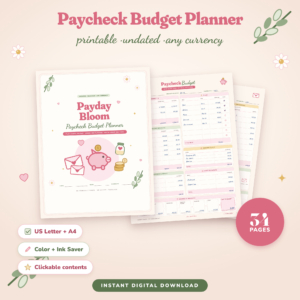
Payday Bloom Paycheck Budget Planner
Price: Original price was: $5.49.$2.49Current price is: $2.49. | Best for: paper planners and cash stuffers
Payday Bloom has 34 undated printable pages in US Letter and A4, in full color and an Ink Saver version. The core Paycheck Budget page splits each check across bills, spending, sinking funds, savings and debt until Left to Budget hits zero. A Bills Before Payday page shows which check covers which bill, and cash stuffing pages handle envelopes. Print the Paycheck Budget page and plan your next check tonight.
Automate the first hour after payday
A plan works best when you do not have to remember it. Once you know your numbers, schedule as much as you can to happen automatically on payday morning.
- Savings transfers: set a standing transfer for payday, so savings leave before you see the balance.
- Bill money: some people move bill money into a separate bills account on payday. When bills are pulled, they come from there, and your spending account only shows what you can actually spend.
- Debt payments: schedule extra payments for payday rather than the due date, so the money is gone before it can drift.
- Fun money: some people move fun money to a separate card or wallet, so when it is gone, it is clearly gone.
After automation, your main account balance on payday afternoon is roughly your groceries and transport money. That number feels smaller. It is also the true number, and that is a relief once you get used to it.
The payday urge, and why it is not a character flaw
Even with a perfect plan, payday can trigger a strong urge to spend. You worked hard. Money finally landed. A treat feels deserved. For some people, the urge is stronger still because money was tight growing up, or because spending is how they cope with a stressful job.
None of that makes you bad with money. It does mean that numbers alone may not be enough. Notice what you feel on payday and what you reach for. Is it relief, excitement, anxiety? A planned fun line helps. So does a simple rule like “no purchases over $50 for 48 hours after payday”. And sometimes it helps to look at where your money habits came from, because a pattern you understand is easier to change. Our article on money mindset workbook exercises has a few to try.
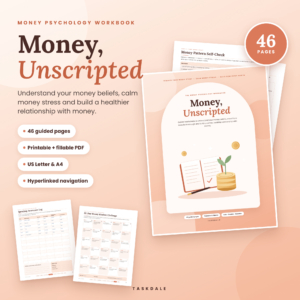
Money, Unscripted Money Mindset Workbook
Price: $6.49 | Best for: payday splurgers and money avoiders
Money, Unscripted is a 46-page printable and fillable money mindset workbook in US Letter and A4. Short teaching pages explain money scripts, the scarcity loop and emotional spending, and guided worksheets help you apply each idea to your own life. It opens with a check-in that gives you a starting score out of 100, which you retake at the end. Do the opening check-in the night before your next payday.
What to do if payday has already gone
If you are reading this halfway through a pay period with less money than you need, start where you are. Do not wait for the next check to start planning.
- Check your real balance, including anything pending.
- List every bill due before next payday. Mark the ones with late fees or service cut-offs first.
- Cover those first. Housing, utilities and minimum debt payments come before anything else.
- Shrink spending to the basics until payday. Use what is in the cupboard and freezer.
- Call early if you cannot pay a bill. Many providers will agree a short delay if you ask before the due date rather than after.
- Plan the next paycheck the night before it lands. This is where the cycle breaks.
The first planned paycheck after a rough stretch often feels like taking a deep breath. It does not fix everything at once, but it gives you a clear next step, and that is a good place to stand.
Frequently asked questions
How do I budget before my paycheck arrives?
The night before payday, write down your net pay, subtract every bill due before your next check, set savings and debt payments, then split the rest into spending categories until nothing is left unplanned.
Which bills should come out of which paycheck?
Each bill should come from the paycheck that lands before its due date. If a bill is due a day or two after your next payday, pay it from the current check to be safe.
How do I stop spending all my money right after payday?
Plan a fixed fun amount, automate savings and bills on payday morning, and try a 48-hour pause on bigger purchases. Knowing you have guilt-free fun money cuts the urge to splurge.
Is it better to budget by paycheck or by month?
If you are paid weekly or every two weeks, budgeting by paycheck is usually easier because it matches when money actually arrives. Monthly budgets suit people paid once a month.
What if my paycheck amount changes every time?
Plan on the lowest typical amount. When a bigger check arrives, send the extra to savings or debt first, then to fun.
Plan your next paycheck tonight
Find your next payday, set a reminder for the evening before, and run the 20-minute session above with a pen or a spreadsheet. If you want your bills sorted into the right pay period automatically, start with the Payday Compass Paycheck Budget Spreadsheet.