New keys, new bills, and a sudden list of costs nobody warned you about. Renters insurance. A shower curtain. A water bill that arrives every three months. Your first household budget is different from budgeting as a student or living with your parents, because now every light switch, every grocery run and every repair is yours.
This guide is for people setting up a home for the first time: a couple moving in together, a single person signing their first lease, new parents rethinking everything, or housemates who need to agree on shared costs. You will work through a budget worksheet one section at a time, see a filled-in example for a couple in a new apartment, plan for the costs that only show up in year one, and settle the question of who pays for what before it causes a fight.
Quick picks: worksheets and planners for a first home
| Product | Best for | Price | Link |
|---|---|---|---|
| Petalwise Budget Planner | A printable or tablet worksheet you write in | $3.20 | View |
| Bloom Budget Planner | Two people paid on different dates | Original price was: $2.79.$1.89Current price is: $1.89. | View |
| Ultimate Annual Budget Spreadsheet | A shared Google Sheets budget for the year | $6.00 | View |
| Seaglass Budget Planner | Excel users who want a guided start | Original price was: $19.99.$9.99Current price is: $9.99. | View |
What a household budget worksheet covers
A household budget worksheet is a single page, or a short set of pages, where you write down everything that comes into the home and everything that goes out. It is different from a spending log. The worksheet is the plan. The log records what happens. You fill in the worksheet once at the start, update it each month, and check it against reality.
A good one has five sections:
- Household income
- Fixed costs
- Variable costs
- Irregular and yearly costs
- Savings and goals
At the bottom, income minus all four spending sections should come to zero or a small positive number. If it comes out negative, the worksheet has done its job by telling you now, before the bank does.
Section 1: Household income
Write down every source of money that comes into the household each month, after tax.
- Each person’s take-home pay, with the pay date and how often it arrives.
- Regular side income you can count on.
- Anything else steady: child support, benefits, a housemate’s rent share if you hold the lease.
If someone is paid every two weeks, multiply one paycheck by 26 and divide by 12 to get a monthly figure. A $1,620 biweekly paycheck works out to $3,510 a month. Do not include bonuses, tax refunds or overtime you are hoping for. Those get a job when they arrive, not before.
Section 2: Fixed costs
These are the bills that stay roughly the same each month and usually come out automatically. In a first home, the list is longer than people expect:
- Rent or mortgage
- Renters or home insurance
- Electricity, gas, water and trash (some are monthly, some quarterly)
- Internet and phones
- Car payment and car insurance
- Loan minimums: student loans, cards
- Subscriptions: streaming, music, cloud storage, gym
- Childcare, if you have kids
For bills that arrive every two or three months, divide by the number of months and budget that amount monthly. A $96 quarterly water bill becomes $32 a month. That way it never lands as a surprise.
Section 3: Variable costs
These change from month to month and are where most of your day-to-day control lives:
- Groceries
- Household supplies: cleaning products, toilet paper, light bulbs
- Fuel, transit and parking
- Eating out and takeaways
- Personal care
- Pets
- Fun and hobbies
- Clothes
If you have never tracked these before, look at the last two months of bank statements and take an honest average. First-time households almost always guess groceries too low. A couple who estimates $400 often finds the real figure closer to $650 once household supplies and midweek top-ups are counted.
Section 4: Irregular and yearly costs
This is the section most first-time budgets leave out, and the reason most of them break in month three. Write down every cost that comes once or twice a year:
- Car registration and servicing
- Birthdays and holiday gifts
- Annual subscriptions and memberships
- Medical and dental visits
- Home repairs and replacing things that break
- Travel to see family
Estimate the yearly total for each, divide by twelve, and budget that amount every month into a savings pot. $600 of holiday gifts becomes $50 a month. When December arrives, the money is already there.
Section 5: Savings and goals
Last on the worksheet, but not least important. Give your savings specific jobs:
- Emergency fund. Start with $1,000, then work towards a few months of costs.
- Debt payoff. Anything above the minimums.
- Short-term goals. A sofa, a holiday, a wedding.
- Long-term goals. Retirement, a home deposit.
Even a small number is worth writing down. $100 a month into an emergency fund is $1,200 in a year. That is the difference between a broken fridge being a nuisance and being a crisis. If you like turning big goals into steps, our goal setting worksheet for a 90-day plan pairs well with this section.
A filled-in example: Sam and Priya’s first apartment
Sam and Priya just signed a lease on a one-bedroom. Sam takes home $2,950 a month, paid monthly. Priya takes home $1,620 every two weeks, which is about $3,510 a month. Combined: $6,460.
| Section | Lines | Monthly |
|---|---|---|
| Income | Sam $2,950, Priya $3,510 | $6,460 |
| Fixed | Rent $1,980, renters insurance $18, utilities $165, water $32, internet $70, phones $110, Priya’s car payment $320, car insurance $190, student loans $260, streaming $35 | $3,180 |
| Variable | Groceries $650, household supplies $80, fuel and transit $210, eating out $240, personal care $70, fun $200, clothes $90 | $1,540 |
| Irregular | Gifts $60, car servicing and registration $55, home items and repairs $70, travel to family $90 | $275 |
| Savings and goals | Emergency fund $700, sofa fund $150, extra student loan $300, retirement top-up $315 | $1,465 |
| Left to plan | $0 |
It balances. More importantly, Sam and Priya both looked at every line and agreed to it. Their sofa fund means they are not buying furniture on a store card in a rush. The home items line covers the curtain rails and the extension cords nobody remembers until moving day. And they feel quietly proud of that $700 emergency fund line, because neither of them has ever had one before.
Writing the worksheet by hand
For a first household budget, there is a lot to be said for pen and paper. Sitting at the table together with one printed sheet makes it a shared project. Nobody is hunched over a laptop while the other person watches.
A planner with a clear monthly budget page and separate bill, savings and expense pages gives you the structure without having to design the worksheet yourself.
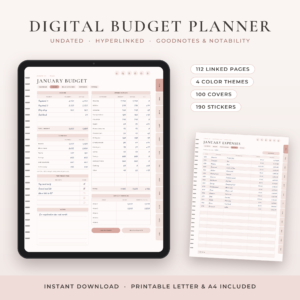
Petalwise Budget Planner
Price: $3.20 | Best for: couples who plan at the table
Petalwise is an undated budget planner with 112 hyperlinked pages for GoodNotes, Notability, Noteshelf and Xodo, plus a printable edition in US Letter and A4. Each month has its own calendar, budget, bills and savings, expenses and review pages, with color-in grids for debt and savings goals. Print the monthly budget page, fill it in together using the five sections above, then use the bills page to list every due date.
Keep the filled-in worksheet somewhere you both see it. Inside a kitchen cupboard door works well. You will look at it more than you think.
When paydays do not line up
Sam is paid on the 28th. Priya is paid every other Friday. Rent is due on the 1st. That means rent always comes from Sam’s pay, and in some months Priya’s first paycheck does not arrive until the 12th. A monthly worksheet balances on paper but hides that timing squeeze.
The fix is a paycheck plan: list each paycheck in the month and assign specific bills to it. Sam’s pay covers rent, insurance and utilities. Priya’s first check covers the car, phones and groceries. Her second covers savings, student loans and fun. Once each bill has a paycheck, the early-month panic disappears. Our guide to building a family budget planner covers more habits that keep a shared household on track.
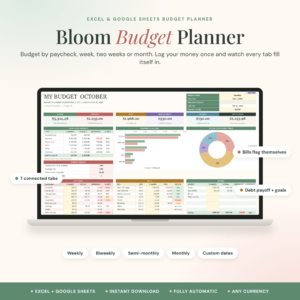
Bloom Budget Planner
Price: Original price was: $2.79.$1.89Current price is: $1.89. | Best for: households with different paydays
Bloom is a paycheck budget spreadsheet for Excel and Google Sheets that works from a single transaction list. You can budget weekly, every two weeks, twice a month, monthly or on your own dates, and it shows planned against actual, a safe-to-spend-per-day figure, and a bill tracker that marks each bill Paid, Partial, Overdue or Upcoming. Pick your pay period and start date, give each bill its due day, and the plan for each paycheck follows.
Who pays for what
For couples and housemates, the worksheet raises a question that is worth settling early: how do shared costs get split? There are three common answers.
- 50/50. Simple and fair when incomes are similar.
- By income. If one person earns 54% of the household pay, they cover 54% of shared costs. Sam and Priya chose this, so Sam covers 46% and Priya 54%.
- All in one pot. Both paychecks go into a joint account, everything is paid from it, and each person gets a set personal allowance.
None of these is the right answer for everyone. The right answer is the one you both agree to out loud, with the numbers in front of you. Write the split at the top of the worksheet so nobody has to remember it.
Moving your worksheet into a shared spreadsheet
After a month or two on paper, many households want something both people can update from their phones. A shared spreadsheet means Priya can log the grocery shop from the store and Sam sees it straight away. No more “did you already buy milk?” texts.

Ultimate Annual Budget Spreadsheet
Price: $6.00 | Best for: couples sharing one budget file
This annual budget workbook works in Google Sheets, Excel 2016 or later and LibreOffice, and syncs to your phones through the free Google Sheets app. It has 22 tabs, including 12 monthly dashboards with expected versus actual, an annual dashboard, a 50/30/20 view, sinking funds, a debt payoff calculator and a smart calendar. You only fill the gold cells. Copy your paper worksheet into the setup tab, then share the file with your partner.
First-year costs nobody mentions
The first twelve months in a new home carry costs that will not repeat, or not as often. Put a small first-year fund on the worksheet to catch them:
- Moving costs: van hire, boxes, a pizza for the friends who helped.
- Deposits for utilities, sometimes required for new accounts.
- Basics you did not know you lacked: a ladder, a toolkit, a vacuum, a first-aid kit.
- Curtains or blinds, often needed in the first week.
- Furniture you put off buying.
- A housewarming, if you are having one.
Even $300 set aside for this stretch stops small purchases from leaking into the grocery line. By month six, most of these are done, and the money can move to the emergency fund.
Mistakes to avoid in a first household budget
- Budgeting gross pay. Always use take-home.
- Forgetting quarterly bills. Water, some insurance and trash collection often bill every three months.
- Guessing groceries. Use two months of real numbers.
- Leaving no personal money. Each person needs some spending that does not need explaining.
- Never checking it again. Spend twenty minutes at the start of each month comparing the worksheet with what really happened.
Frequently asked questions
What should be on a household budget worksheet?
Household income, fixed costs, variable costs, irregular and yearly costs, and savings and goals. Income minus all spending should come to zero or a small positive amount.
How do I make my first household budget?
List take-home income, write down every fixed bill, average your variable spending from recent statements, add yearly costs divided by twelve, and give the rest to savings.
How should a couple split household bills?
The common options are 50/50, by share of income, or one joint pot with personal allowances. Pick together and write the split on the budget.
How much should a new household save each month?
Start with whatever fits, even $100, towards a $1,000 emergency fund. Increase it once the first-year costs are behind you.
Is a printable or spreadsheet budget better for a first home?
Printables are great for the first planning session together. Spreadsheets are easier for day-to-day tracking, especially when two people share the file.
Your next step
This weekend, sit down together with your last two bank statements and fill in all five sections of the worksheet. Agree on how shared costs are split before you close the page. If you would like the pages laid out for you, print the monthly budget page from the Petalwise Budget Planner and start with Section 1.