You wrote the goal in January. “Get fit.” “Save money.” “Finally start the business.” By April it was a sticky note under a pile of mail. The goal wasn’t bad. It was just too big, and nothing told you what to do on a Wednesday. A good goal setting worksheet fixes that by turning one big goal into a 90-day plan with weekly steps. This guide walks you through building one on paper, then shows two Taskdale tools, a printable workbook and a spreadsheet, that have the pages ready for you.
Quick picks
| Product | Best for | Price | Link |
|---|---|---|---|
| The Lit Path Goal Setting Workbook | A printable goal setting worksheet with a 90-day planner and daily prompts | $7.99 | View product |
| VisionKeeper Vision Board and Goal Tracker Spreadsheet | Tracking goals and habits in Google Sheets or Excel | $4.39 | View product |
Why a Goal Setting Worksheet Beats a Wish List
A wish list says what you want. A goal setting worksheet says what you’ll do first.
That difference is everything. When you write “lose weight” on a list, your brain nods and moves on. When you fill in a worksheet, you have to answer awkward questions. By when? How will I know? What do I do this week? The questions are a little annoying. They are also the reason it works.
There’s another benefit people don’t expect. Writing the plan down shrinks the goal. A scary, foggy thing becomes four or five small tasks. And small tasks are easy to start.
Ninety days is a sweet spot, too. A year is too far away to feel real. A week is too short to show change. Three months is long enough to see progress and short enough that you can still remember why you started.
Step by Step: Fill In Your Goal Setting Worksheet
Grab a pen and a blank page. Or print a worksheet. Either way, you’ll answer the same seven prompts.
1. Name one goal
One. Not three. If you have several, pick the one that would make the others easier. Write it as a sentence with a number in it: “Save $1,200 for a car repair fund” or “Finish a 5K without stopping.”
2. Write the reason
Why does this matter to you, not to anyone else? Write two sentences. When motivation drops in week six, this is the page you’ll reread. Keep it honest. “Because I’m tired of feeling out of breath on the stairs” is better than “to be healthier.”
3. Define done
What will be true on day 90 that isn’t true today? Make it something you could prove to a friend. A number, a finished page, a date on the calendar.
4. Break it into three milestones
Divide the 90 days into three blocks of thirty. What should be finished by day 30? Day 60? Day 90? For the 5K example: walk and jog for twenty minutes by day 30, run ten minutes straight by day 60, run the full distance by day 90.
5. List weekly actions
For each block, write two or three actions you can do each week. Make them so small they’re almost embarrassing. “Put on running shoes and go outside three mornings.” You can always do more. You can’t recover from a plan so big that you quit.
6. Spot the obstacles
Write the two things most likely to get in your way. Tiredness. A busy month at work. Forgetting. Then write one small response for each. “If I’m too tired, I walk for ten minutes.” This is the part nearly everyone skips, and it’s the part that saves the plan on a bad week.
7. Choose a check-in day
Pick one day each week, say Sunday, for a ten minute review. Look at what you did, what you missed, and what next week needs. Put it in your calendar like a meeting.
A Worked Example: A 90-Day Plan for One Big Goal
Let’s fill one in so it doesn’t stay abstract. Say the goal is “Build a $1,000 emergency fund by day 90.”
The reason: a surprise bill last spring caused a week of stress. Done means a balance of $1,000 in a separate account on day 90. The milestones are $300 by day 30, $650 by day 60 and $1,000 by day 90.
Weekly actions for the first block: move $75 on payday, cancel one subscription, and check the balance on Sunday. For block two: sell two items you don’t use and add the money straight in. For block three: keep the transfer going and top up with whatever is left from the month.
Obstacles: a bill comes in higher than expected, and a social event costs more than planned. The responses are a note to pause the second transfer only, never the first, and a cash limit set before the event.
See what happened? A vague wish turned into a dozen small steps. None of them is dramatic. All of them are doable.
Common Mistakes With Any Goal Setting Worksheet
Setting too many goals is the first. A worksheet works best with one. Two at most, and only if they don’t compete for the same hours.
The second is writing goals you secretly don’t want. If your reason reads like something your mother would say, rewrite it. If you can’t, pick a different goal.
Third, no check-ins. A worksheet filled in once and filed away is just a nice memory. The weekly review is where the plan stays alive.
Fourth, being strict about missed days. You’ll miss some. The rule that helps is simple: never miss twice in a row. One skipped day is life. Two is the start of a new habit you don’t want.
And fifth, measuring only the end result. Count your actions too. “I did my weekly actions four weeks out of five” is a win even if the final number isn’t there yet.
Goal Setting Worksheet Examples for Different Parts of Life
The same seven prompts work for almost anything. Here is how they look in three different areas, so you can borrow the shape.
For a career goal, say “Apply to ten jobs and land three interviews.” Milestones: update the resume by day 14, send four applications by day 45, finish all ten by day 75. Weekly actions: two applications on Tuesday and Thursday evenings, one message to a contact on Friday. The obstacle is a long workday, so the fallback is one application instead of two.
For a learning goal, try “Finish a beginner online course in 90 days.” Break the course into thirds, schedule three 30 minute sessions a week, and set a Sunday check-in to log what you covered. The obstacle is boredom in the middle, so you reward yourself after each third with something small and real, like a coffee out.
For a home goal, “Clear the spare room by day 60.” Weekly actions might be one shelf or one box at a time. Nobody clears a room in a weekend and keeps their sanity. A shelf at a time, though, is boring in the best way.
Notice that each example has a number, a date and a tiny first step. That is the pattern. If your own worksheet is missing any of the three, it probably still feels foggy.
A Ten Minute Weekly Review You Can Copy
The check-in day only works if it’s quick. Here’s a version that takes ten minutes. Set a timer, because otherwise it creeps to thirty.
First, count what you did. Look at last week’s actions and mark each as done, partly done or skipped. No judgment, just facts. Second, ask what got in the way, and write one short sentence. Third, choose next week’s actions. Keep the ones that worked, shrink the ones that didn’t. Finally, write one line about how you feel about the goal, from excited to dreading it. If the dread shows up three weeks in a row, the goal needs changing, not more willpower.
Two Taskdale Tools That Give You the Pages
You can make all of this with a notebook. Plenty of people do. If you’d rather not draw the grids yourself, these two have the structure ready.
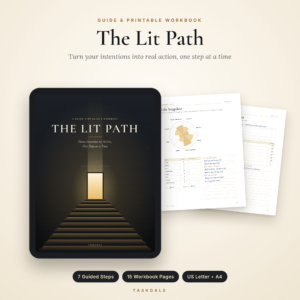
The Lit Path Goal Setting Workbook
Price: $7.99 | Best for: Anyone who wants a printable goal setting worksheet with a 90-day plan
The Lit Path is an intention to action guide and printable journal. It comes with a vision board, a habit tracker, daily prompts and a 90-day planner, as a PDF in US Letter and A4. If the steps above sound right but you don’t feel like drawing the pages, this is the one.
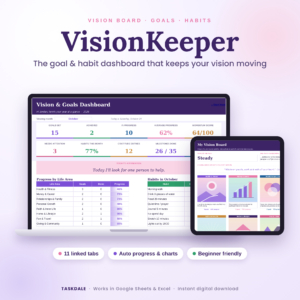
VisionKeeper Vision Board and Goal Tracker Spreadsheet
Price: $4.39 | Best for: People who prefer a dashboard and a habit tracker on screen
VisionKeeper is a goal planner dashboard for Google Sheets and Excel. It includes a vision board, a habit tracker, a gratitude journal and affirmations. Pick it if you check your phone or laptop more than your desk, and you like seeing progress in one view.
Printable Workbook or Spreadsheet: Which Goal Planner Fits?
| Product | Format | Price | Best for | Link |
|---|---|---|---|---|
| The Lit Path Goal Setting Workbook | Printable PDF journal, US Letter and A4, with 90-day planner | $7.99 | Writing by hand and working through daily prompts | View product |
| VisionKeeper Spreadsheet | Google Sheets and Excel goal planner dashboard | $4.39 | Tracking habits and goals on screen | View product |
My take: handwriting tends to make people think harder, so if you struggle to follow through, start with paper. If you already live in spreadsheets, the dashboard will feel natural, and a streak on screen is oddly motivating. They’re also cheap enough to pair. Plan on paper, track on screen.
How to Keep Going After the First Two Weeks
Week two or three is where most plans wobble. The excitement fades and the work is still there. That’s normal, and you can plan for it.
Make the first action ridiculously small on purpose. Five minutes counts. A tiny action keeps the chain unbroken, and once you’ve started, you often keep going.
Tie each action to something you already do. After coffee, review the page. After lunch, do the ten minute task. Habits stick to anchors better than to clock times.
Let someone see it. Tell a friend your goal and your check-in day. You don’t need a coach, just one person who might ask on Monday how it went.
And change the plan when it isn’t working. A worksheet isn’t a contract. If the 6 a.m. runs never happen, move them to the evening. Adjusting is not failing. Quitting is failing, and adjusting is how you avoid it.
Frequently Asked Questions
What should a goal setting worksheet include?
At minimum: one clear goal, your reason, a definition of done, milestones, weekly actions, likely obstacles and a check-in day. Extras like a habit tracker or a vision board are useful, but the first seven items do most of the work.
How long should a goal plan be?
Ninety days works well for most people. It’s long enough to see real change and short enough to stay focused. Longer goals can be split into several 90-day plans, each with its own milestones and review points.
How many goals should I work on at once?
One main goal is best, and two at most. Each goal needs weekly attention, and spreading yourself across five usually means finishing none. Finish one, then move to the next. It feels slower but gets more done.
Is a printable worksheet better than an app?
Neither is better for everyone. Paper encourages slower thinking and is hard to ignore on a desk. Apps and spreadsheets are always with you and track streaks. Choose what you’ll open most days, or use paper for planning and a spreadsheet for tracking.
What if I miss a week?
It happens. Don’t restart the whole plan. Look at your weekly actions, shrink them if needed, and pick up where you are. The rule that helps is never to miss twice in a row, so get back on track at the next check-in.
Your Next Step
So, here’s the short version. Pick one goal, give it 90 days, and fill in the seven prompts today, even if it takes twenty messy minutes. If you want the pages ready to print, The Lit Path Goal Setting Workbook is $7.99 and includes the 90-day planner. If you’d rather track on screen, VisionKeeper is $4.39. Start this week, while the goal still feels important.