Most of us have a drawer of plans marked “one day”. The business. The move. The book. The marriage that feels like a team again. And for believers, there’s often a quieter question underneath: is it okay to want these things this much, and to write them down like they’re already true?
Christian scripting is one answer to that question. It’s the practice of writing your future in present tense, in detail, as a written vision you bring to God and then walk toward. Not wishing at the universe. Writing with faith, praying over it, and taking the next step.
This guide explains what it is, how it differs from manifesting and from prayer, where the guardrails are, and how to start with a five-minute morning habit.
What scripting actually is
Scripting means writing about your life as if a hoped-for future has already arrived. Present tense, first person, specific. Instead of “I hope we’ll get out of debt”, you write “It’s a Saturday morning and I’ve just paid the last credit card. I’m sitting at the kitchen table with coffee, and the bank app shows zero.”
The detail is the point. Vague hopes stay vague. A written scene gives you something to pray over, measure decisions against and work toward.
Is Christian scripting biblical?
Many Christians are wary of scripting, and fair enough. Most of what’s written about it comes from manifestation circles that talk about “the universe” and “attracting” outcomes. That’s not a faith most believers share.
But writing down a vision has deep roots in scripture. Habakkuk 2:2 is the verse most people point to: “Write the vision, and make it plain upon tables.” Proverbs talks about committing your works to the Lord so your plans are established. Nehemiah planned the wall in detail before a single stone moved.
The difference is direction. Christian scripting is written toward God, not toward an impersonal force. You’re not trying to bend reality with your thoughts. You’re putting a God-given hope into words, offering it up, and committing to act on it.
How it differs from prayer
Prayer is conversation. You talk to God, listen, ask, give thanks. Scripting is a written picture of what you’re praying toward. Many people find the two work well together: pray, then write; or write, then pray over what you wrote.
One doesn’t replace the other. A script without prayer can drift into wishful thinking. Prayer without any written vision can stay so general that you never notice the answer when it arrives.
The guardrails
Any practice can go sideways. A few lines worth keeping:
- Hold it with open hands. James 4:15 reminds us to say “if the Lord will”. A script is a hope, not a contract.
- Don’t script other people’s choices. You can write about how you love your spouse. You can’t write their decisions for them.
- Watch for anxiety. If scripting makes you feel more afraid, more controlling or more disappointed, pause. That’s a sign it’s tipping into something unhealthy.
- Test it. Does what you’re writing line up with scripture? Would a wise friend or pastor see it as healthy?
How to start: a five-minute morning routine
- Pray briefly. Ask for clarity about what to write.
- Pick one area. Money, family, work, health or calling. Not all of them.
- Write one paragraph in present tense. Use the senses. Where are you? What time is it? What do you see?
- End with thanks. Thank God as though the answer is on its way.
- Write one action. The smallest step you’ll take today. Send the email. Open the savings account. Book the appointment.
Five minutes. A coffee’s worth of time. Done daily, it adds up quickly.
A short example
“It’s a Tuesday in October. I’m walking into the small shop I opened in the spring. The bell rings above the door. There are three customers inside and one of them is a regular who knows my name. I’m tired in the good way. Thank you, Lord, for every closed door that led here. Today I’ll call the landlord about the unit on Main Street.”
Notice the last line. That’s the step that turns words into footsteps.
When nothing seems to move
There will be weeks where the script feels silly. You’ve written the same scene 40 mornings in a row and nothing has changed. That’s normal. Keep a separate evidence list of small signs, like a conversation, a door that opened slightly, a chance meeting. And be willing to edit the script. Sometimes the vision needs revising, and that’s growth, not failure.
A guide if you want to go deeper
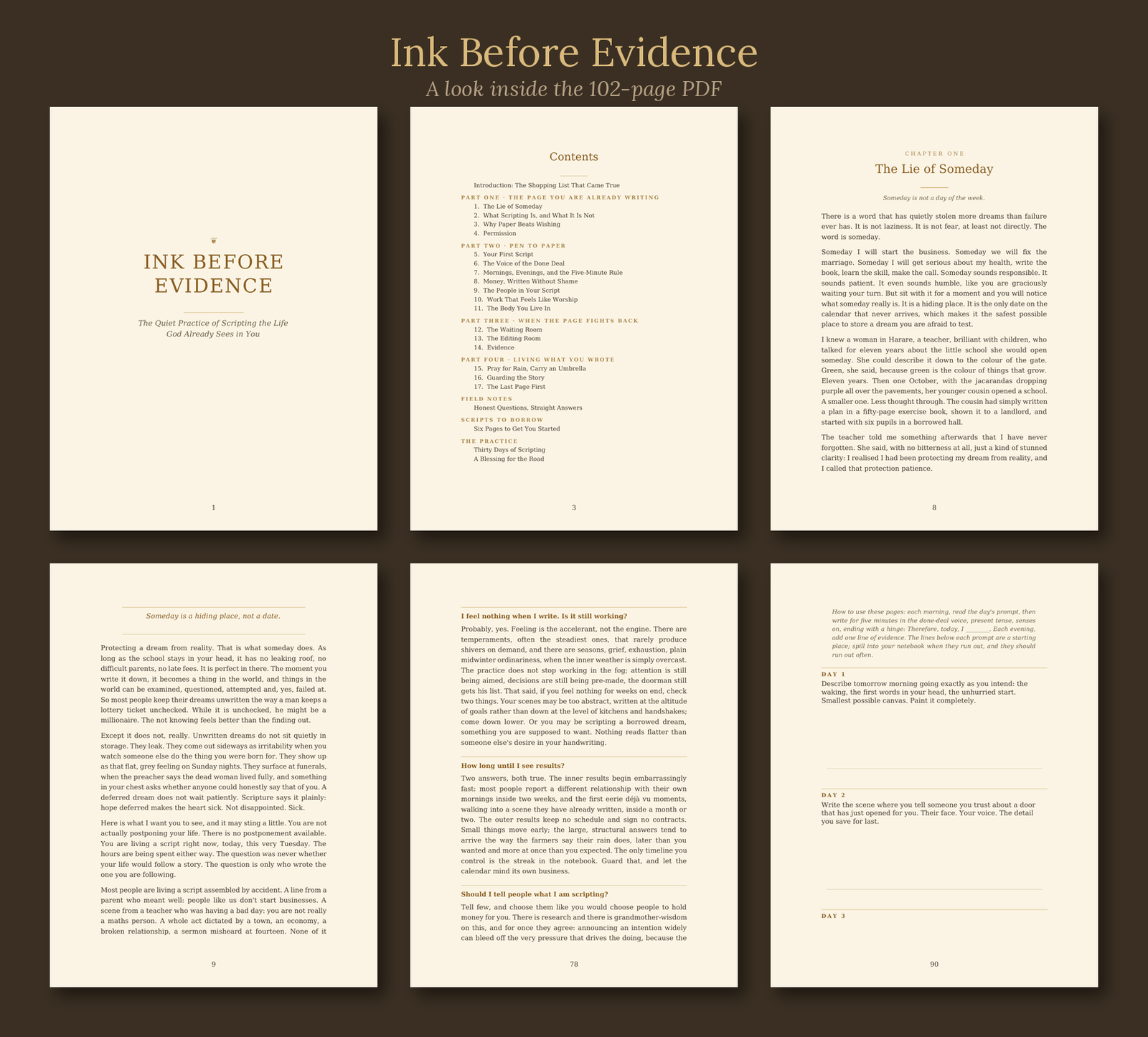
Ink Before Evidence is a 102-page book on Christian scripting written for believers who are tired of manifestation books that ask them to thank the universe. It’s in four parts: what scripting is and isn’t, a workshop with a first script and a five-minute morning routine (with chapters on money, relationships, work and the body), help for the hard weeks of waiting and editing, and turning scripts into action.
The back matter is where it gets practical. Field Notes answers twelve common questions, including handwriting versus typing, what to do after a missed fortnight, scripting for your children, and how scripting differs from prayer. Scripts to Borrow offers six complete sample scripts, and The Practice gives you thirty daily prompts with one rest day each week. It’s a single US Letter PDF on warm cream pages, readable on a phone or tablet, or you can print the 30-day section.
FAQ
Is scripting the same as manifesting?
The writing technique is similar, but the belief behind it differs. Manifesting usually points to the universe or the power of thought. Christian scripting is written as a vision brought to God in prayer and followed by action.
Should I handwrite or type my scripts?
Either works. Many people find handwriting slows them down and makes the words feel more personal. Typing is fine if it means you’ll actually do it every day.
Can I script for my children?
You can write about your hopes for them and pray over those hopes. Just be careful not to script their choices. Their lives are their own.
How long until I see results?
There’s no timetable, and it isn’t a formula. Treat it as a spiritual discipline, like journaling or prayer, and let God set the pace.