Everyone who searches for a lose weight fast meal plan wants the same thing: a list of meals that makes the scale move this week. There is a wedding in a month, a beach trip in six weeks, or just a morning when your jeans felt tight and you decided enough was enough. That urge is real, and it is a good starting point. What tends to go wrong is the plan that follows.
This guide gives you the honest version. What “fast” usually looks like on the scale, why crash plans tend to stall, what a realistic weekly meal plan for weight loss looks like in practice, and how to keep going after the first two weeks when motivation dips. You will also see three Taskdale planners that do the counting and tracking so you can focus on the food.
No promises of ten pounds in ten days. Just a plan you can stick with long enough to see results you keep.
Quick picks: planners for a realistic weight loss plan
| Product | Best for | Price | Link |
|---|---|---|---|
| SlimBloom Weight Loss & Fitness Planner Spreadsheet | Setting a calorie target and tracking food, workouts and weight | Original price was: $2.99.$1.19Current price is: $1.19. | View |
| Larkspoon Meal Planner Spreadsheet | Planning the week’s meals with calories and a grocery list | $12.99 | View |
| Milestone Digital Weight Loss Planner | A long-haul journal for plateaus, habits and progress on a tablet | $4.49 | View |
What “fast” really looks like on the scale
The first week of almost any new eating plan often shows a bigger drop than the weeks after it. A lot of that early change is water and the food sitting in your system, not only fat. People see four or five pounds gone in week one, then one pound in week two, and feel like something broke. Nothing broke. That is the usual pattern.
After the first couple of weeks, many health services describe a steady pace of around one to two pounds a week as a sensible target for most adults. That can sound slow. Do the sums, though. One and a half pounds a week for 12 weeks is 18 pounds. That is a visible change in how clothes fit, and it is the kind of change that tends to stay.
So the realistic answer to “how fast?” is: a quick-looking start, then a steady pace that adds up over a season rather than over a weekend.
Why crash plans backfire
Very low calorie plans, juice-only weeks and “eat nothing after 2 pm” rules all promise speed. Here is why most people do not last on them:
- Hunger wins. Skipping meals works until day four, when you eat half a loaf of bread standing at the counter.
- They do not fit real life. A plan that bans every food served at a work lunch or a child’s birthday party will break the first time you go to one.
- Energy drops. Tired people move less, sleep worse and snack more.
- There is no “after”. When the crash plan ends, old habits come straight back, and so does the weight.
That last point matters most. The best weight loss meal plan is one you could still be following in month four. If a plan makes you count the days until it is over, it is the wrong plan.
The building blocks of a realistic weight loss meal plan
A plan that works for most people has a few simple features. None of them are exciting. All of them help.
A modest calorie target
Eating a bit less than your body uses is what drives weight loss. A modest gap is easier to live with than a huge one. A spreadsheet or app that works out a target from your height, weight, age and activity saves you guessing.
Protein at every meal
Protein helps meals feel filling. Eggs at breakfast, chicken or beans at lunch, fish or tofu at dinner, Greek yogurt as a snack. Each one keeps you from rummaging in the cupboard an hour later.
Lots of vegetables
Vegetables add volume for very few calories. A big bowl of stir-fry with half a plate of veg is more satisfying than a small bowl of pasta with the same calories.
Planned treats
A square of chocolate after dinner, a Friday pizza slice. Planned treats beat secret ones, every time.
Turning that target into numbers you can follow is easier when the sums are done for you. That’s where a planner that connects your food, workouts and weigh-ins earns its place.
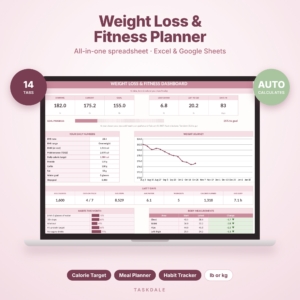
SlimBloom Weight Loss & Fitness Planner Spreadsheet
Price: Original price was: $2.99.$1.19Current price is: $1.19. | Best for: number lovers starting a weight loss plan
SlimBloom is a 14-tab Excel workbook. On the Settings tab you enter height, age, start weight and goal, pick a pace (Gentle, Steady, Faster or Bold) and a macro style, and it gives you a daily calorie target plus protein, carb and fat grams. Logged workouts feed your daily calories, planned meals turn into a grocery list and the dashboard shows weight lost, a progress bar and an estimated goal date. Choose the Gentle or Steady pace first and see how it feels for two weeks.
A sample week that is actually doable
Here is a week for one adult with a desk job and three short walks or workouts a week. Portions depend on your own target, so treat this as a pattern, not a prescription.
| Day | Breakfast | Lunch | Dinner |
|---|---|---|---|
| Monday | Greek yogurt, berries, a spoon of oats | Chicken salad wrap with extra lettuce and peppers | Turkey chili with a small portion of rice |
| Tuesday | Two eggs scrambled with spinach, one slice of toast | Leftover chili with a side salad | Baked salmon, potatoes, green beans |
| Wednesday | Overnight oats with milk and apple | Lentil soup and a small roll | Chicken and vegetable stir-fry, half portion of noodles |
| Thursday | Greek yogurt, berries, a spoon of oats | Stir-fry leftovers | Bean and veg quesadilla with salsa |
| Friday | Two boiled eggs and fruit | Tuna, sweetcorn and bean salad | Homemade burger, side salad, small portion of oven fries |
| Saturday | Veggie omelet | Soup and a sandwich out with a friend | Pizza night: two slices, big salad first |
| Sunday | Porridge with banana | Roast chicken, lots of vegetables | Light: cottage cheese, crackers, fruit |
Snacks: an apple, a yogurt, carrot sticks with hummus or a small handful of nuts, chosen to fit your target.
Notice the repeats. Monday and Thursday breakfasts match. Lunch on Tuesday and Thursday is last night’s dinner. That repetition is deliberate. It means fewer decisions, a shorter shopping list and less food going to waste. Notice the pizza too. It is on the plan, so it is not a slip.
For a full four weeks of budget-friendly meals with shopping lists, see our weight loss meal plan on a budget.
Plan, shop and prep so the plan survives Wednesday
Weight loss plans rarely fail at breakfast on Monday. They fail at 7 pm on Wednesday when you are tired and the fridge is empty. Three habits fix most of that:
- Plan the whole week, including lunches and snacks, before you shop.
- Shop from a list built from the plan, so the cupboard holds what the plan needs and not much else.
- Prep two things on Sunday: a batch protein (chili, roast chicken, boiled eggs) and washed, chopped vegetables.
If prep is new to you, our guide to meal prep for beginners lays out a first session hour by hour.
A meal planner spreadsheet that shows the calories for each day while you plan is a handy check. You can see on Sunday that Friday’s dinner pushes you over, and swap the side before you buy anything.
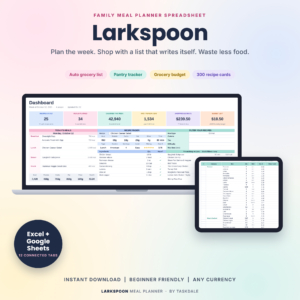
Larkspoon Meal Planner Spreadsheet
Price: $12.99 | Best for: planners who want calories shown per day
Larkspoon is one Excel and Google Sheets file with twelve connected tabs. You plan any seven days with breakfast, lunch, dinner and snacks, and it shows calories, protein, carbs, fat and fiber per meal, per day and per person, alongside cost per serving and a weekly total. It writes an aisle-sorted grocery list that subtracts your pantry, and prints a tidy menu for the fridge. Enter your three most-eaten dinners first and check their calories per serving.
The plateau and the weeks when it falls apart
Somewhere between week four and week ten, most people hit a stretch where the scale barely moves. It is frustrating. It is also normal. Your body is smaller now, so the same food has a slightly different effect, and daily weight jumps around with water, salt and sleep.
A few things help during a plateau:
- Look at the weekly average, not the daily number.
- Check portions again. A tablespoon of oil, a slightly bigger scoop of rice, an extra handful of nuts add up quietly.
- Measure other wins. Waist measurement, how your clothes fit, how far you can walk, how you sleep.
- Revisit your target if you have lost a good amount already.
And then there are the weeks that simply fall apart. A holiday, an illness, a family crisis. The plan goes out the window for a while. That is not failure. The only mistake is deciding it is all over. Pick up again at the next meal, not next Monday.
A planner that expects these weeks, with space to write down what happened and a fresh start page, makes it easier to come back.
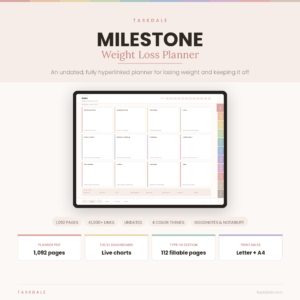
Milestone Digital Weight Loss Planner
Price: $4.49 | Best for: people planning for the long haul
Milestone is an undated digital weight loss planner of 1,092 pages with tabbed, hyperlinked sections, for GoodNotes and similar PDF apps, in four color themes. It comes with a live Excel dashboard that works out your weekly rate and a projected finish date from the dates and weights you type, a 112-page type-in edition, US Letter and A4 printable packs and a 14-page user guide. It covers plateaus, rough weeks and what to do after reaching your goal. Set up the Excel dashboard with your starting weight on day one.
Small mistakes that slow things down
Most stalled plans are not about willpower. They are about a handful of small, fixable habits.
- Drinking the calories. Fancy coffees, juice, soda and evening wine can add several hundred calories a day without filling you up. Swap one a day for water, tea or black coffee and see what changes.
- Weekend drift. Five careful days and two “off” days can cancel each other out. Plan Saturday and Sunday the same way you plan Tuesday, treats included.
- Eating too little early in the day. A coffee-only morning often leads to a huge evening. A real breakfast and lunch make dinner easier to keep sensible.
- Guessing oil and sauces. Measure cooking oil with a spoon for a week. Most people are surprised.
- Weighing every morning and panicking. Daily numbers swing. Weekly averages tell the truth.
- Changing ten things on day one. Start with three: plan meals, add protein, cut one drink. Add more once those feel normal.
Fix one or two of these and the scale often starts moving again within a fortnight. That moment, when the number shifts after a flat stretch, is a lovely bit of proof that the slow way works.
Who should not follow a fast weight loss plan alone
A practical, modest plan like the one above suits most healthy adults. Some people need more support. If you are pregnant or breastfeeding, have a medical condition, take medication that is affected by food, or have a history of difficult eating patterns, talk to your doctor before cutting calories.
The same goes for very low calorie plans of any kind. They are sometimes used under medical supervision for specific reasons, and that supervision is the point. Doing one solo from a list online is not the same thing. If you want to add exercise to your plan, our guide to fitness planners for women covers ways to track workouts, meals and habits together.
Frequently asked questions
How much weight can I realistically lose in a month?
Many people lose more in the first week or two, partly water, then settle into a slower pace. Around one to two pounds a week after that is a common sensible target, which works out to roughly four to eight pounds a month for many adults.
What is the fastest way to lose weight safely?
A modest calorie gap, protein and vegetables at each meal, regular movement, decent sleep and a plan you can stick to for months. Steady habits beat extreme short plans for results you keep.
Should I cut out carbs to lose weight fast?
You do not have to. Some people like lower carb eating, others do well with bread, rice and pasta in sensible portions. The plan you can keep is the one that works.
Why did I lose weight fast at first and then stop?
The early drop often includes water and food weight. After that, change is slower and daily numbers bounce around. Track the weekly average and other measures like your waist.
Do I need to count calories?
Not always, but it helps many people at the start. Even two weeks of tracking shows you where the hidden calories are, and then you can ease off.
Your next step
This week, plan seven days of meals with protein at each one and two repeat lunches, then shop from that plan only. Weigh in on the same morning each week, not every day. If you want a calorie target and a grocery list worked out from your own numbers, set up the SlimBloom Weight Loss & Fitness Planner Spreadsheet tonight and choose a steady pace.