Fear stops more businesses than bad ideas do. The fear is reasonable, too. Most people starting out have a mortgage or rent, maybe kids, and savings that took years to build. Losing it all for a dream is a real worry, not a lack of courage.
The good news is that you can start your own business with less risk by making a few careful choices up front. You keep your income for longer. You decide in advance how much you are willing to lose. You test before you buy. You protect your home life from your business life. None of it is glamorous, and all of it lets you sleep at night.
This guide walks through those choices one by one, with examples, a worksheet you can copy onto paper, and clear rules for when to go all in. It suits anyone thinking about a side hustle, a small service business or a product business, especially if you have people depending on you.
Quick picks for a lower-risk start
| Product | Best for | Price | Link |
|---|---|---|---|
| Business HQ Digital Business Planner | Side hustlers fitting work around a job | Original price was: $3.95.$0.99Current price is: $0.99. | View |
| Keystone Business Hub | Watching money, clients and tax set-aside | $6.99 | View |
| All-in-One Product Business Template | Makers keeping stock and costs under control | $10.20 | View |
Where business risk actually comes from
Risk sounds vague until you break it into pieces. For a small business, most of it comes from five places.
- Losing your income before the business can replace it.
- Spending too much up front on stock, equipment, premises or branding.
- Borrowing money the business cannot yet repay.
- Personal liability if something goes wrong with a customer, a product or a contract.
- Running out of cash even when sales look fine on paper.
Once you see risk as five separate things, it stops being one big scary cloud. You can tackle each piece with a specific step. That shift alone makes many people feel calmer about starting.
Keep your income while the business proves itself
The single biggest way to cut risk is to not quit your job on day one. Start on evenings and weekends. Let the business earn its right to more of your time.
Yes, it is tiring. Running a dog grooming business from 6pm to 9pm after an office job is hard work. But every month the business pays its own costs while your salary pays your bills, you are learning for free. A slow month is a disappointment rather than a crisis.
A few things make the double shift easier:
- Fixed business hours. Tuesday and Thursday evenings plus Saturday morning, for example. Protect them like appointments.
- A short daily check-in. Five minutes to reply to customers and note tomorrow’s task keeps things moving on busy days.
- One big task per session. Do not try to do everything. Pick the job that brings money closest.
- Check your job contract. Some employers have rules about outside work or competing services. Read yours before you start.
If your job allows it, cutting to four days a week can be a gentle middle step once the business picks up.
A planner built around a short daily rhythm makes the side hustle years far more manageable.
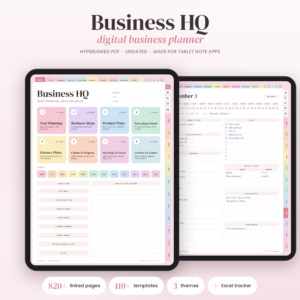
Business HQ Digital Business Planner
Price: Original price was: $3.95.$0.99Current price is: $0.99. | Best for: side hustlers with a day job
An undated, hyperlinked digital business planner for tablets, with an Excel workbook for the money side. It has menus for strategy, products, marketing, finance, clients and meetings, and each of the 12 months comes with a calendar, planning pages, week plans and daily pages, all linked. The Start Here page sets out a simple rhythm of 5 minutes a day, 15 a week and 30 a month. Set your fixed business hours on the week schedule first.
Set your loss limit before you spend a dollar
This is the step almost nobody takes, and it is the one that protects you most. Before you start, decide the most money you are willing to lose if the business does not work. Write it down. Tell someone you trust.
For one person that might be $1,500. For another, $10,000. The number depends on your savings, your family and your stomach. What matters is that you choose it calmly, now, rather than in a panic later.
A simple loss-limit worksheet
| Question | Example answer |
|---|---|
| Total savings | $14,000 |
| Emergency fund I will not touch | $9,000 (three months of bills) |
| Money available to risk | $5,000 |
| My loss limit | $3,000 |
| Checkpoint dates | Every 3 months |
Notice the loss limit is less than the money available. That gap is breathing room. If you hit the limit without real signs of progress, you stop, learn what you can and move on with most of your savings intact. That is not failure. That is a plan working exactly as designed.
Talk it through with the people it affects
A business started at the kitchen table affects everyone at that table. Your partner may be covering more of the school runs. Your evenings will be shorter. Money that might have gone on a vacation is now set aside for stock. Hiding any of that tends to cause more stress than the business itself.
Sit down with the people closest to you before you start. Share your loss limit, your weekly business hours and your checkpoint dates. Ask what worries them. A partner who knows the plan is far more likely to back you on a hard Thursday night than one who finds out about a $2,000 order from a bank statement.
It also helps you. Saying the plan out loud to someone who cares about you is a great test. If it sounds shaky when you explain it, it probably is, and you can fix it before any money moves.
Test small before you buy big
Big purchases made early are where many new businesses lose most of their money. A $6,000 coffee machine bought before you know if people will come. A van wrapped in your logo before you have regular customers. Five hundred units of stock before you know which color sells.
Test first. Sell at one market before signing a lease. Take five bookings before buying the professional kit. Order 30 units, not 500. Rent or borrow equipment for the first month if you can. Our guide on lean startup steps for testing ideas cheaply walks through cheap tests in detail.
Look at how a mobile service grows. Our piece on how to start a pressure washing business shows the same idea: start with modest equipment, prove demand, then upgrade from profit rather than savings.
Avoid debt in the early months
Borrowing turns a slow start into a stressful one. A loan payment arrives every month whether customers turn up or not. If you can start without debt, do.
Ways to avoid early borrowing:
- Pre-sales and deposits. Ask customers to pay part up front. Cake makers, furniture makers and event planners do this routinely.
- Grow from profit. Buy the next piece of kit when the business has earned it.
- Start with services. Services usually need less stock and equipment than products.
- Second-hand equipment. A used commercial mixer at half the price works the same.
If you do borrow, keep it small, know exactly what the monthly payment is, and make sure the business plan covers it even in a slow month. Avoid putting business costs on a personal credit card you cannot clear.
Protect your personal life from business problems
Some risks are not about money in the bank. They are about what happens if something goes wrong. A customer slips on a wet floor you just cleaned. A product causes a reaction. A client refuses to pay a large bill.
- Insurance. Ask about general liability, and product liability if you make things. Professional cover matters for advice-based services. Get two quotes.
- Business structure. Some owners form an LLC to separate business and personal assets. The protection has limits and depends on your state, so ask an accountant or attorney.
- Clear written terms. A short agreement covering price, deposit, cancellations and what is included heads off most disputes.
- A separate bank account. Mixing money makes problems harder to untangle and taxes harder to file.
These steps cost a little time and some money. They are worth it the first time something goes sideways.
Watch cash every week
A business can be growing and still run out of money. You buy materials on the 1st, finish the job on the 20th, invoice on the 21st and get paid on the 21st of next month. In between, your cash is stretched.
The fix is boring and effective: look at your cash every week. Note what is coming in, what is going out and when. Chase late invoices quickly. Set aside tax money in its own account as soon as payments land, so the tax bill never eats your working money.
A workbook that keeps clients, invoices and tax set-aside together makes the weekly check a ten-minute job.
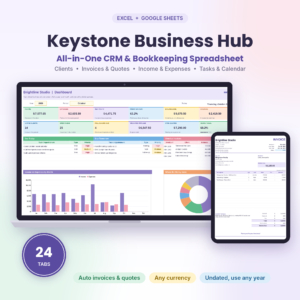
Keystone Business Hub
Price: $6.99 | Best for: service owners keeping cash in view
A 24-tab Excel and Google Sheets workbook linking a client CRM, quotes, invoices, income and expense logs, tasks and reports. Record a payment and the invoice marks itself paid while the client balance updates. Bank tools include account balances, a budget planner, a reconciliation tab and a quarterly tax set-aside planner. Enter your open invoices and set the tax set-aside rate first.
Lower-risk business models to consider
Some business types simply carry less risk at the start because they need little money up front. If you are cautious, these are worth a look.
- Services using skills you already have: bookkeeping, tutoring, cleaning, pet care, editing, handyman work.
- Digital products: templates, printables and guides. No stock, no shipping, mostly time.
- Made-to-order products: you buy materials only after an order is placed.
- Market stalls and pop-ups: a weekend presence with no long lease.
Higher-risk models include anything needing a lease, large stock, staff from day one or expensive equipment. They are not wrong. They just need more proof before you commit.
If you sell products, keep stock lean
Product businesses carry an extra risk: money tied up in stock that does not sell. Every unsold candle on a shelf is cash you cannot use. Buy materials in small batches until you know your bestsellers. Track stock so you reorder what moves and stop buying what sits.
Know your true cost per item, too. If materials go up 15%, your profit can vanish without you noticing. Recipe-style costing, where each product’s cost updates when a material price changes, is the safest way to keep an eye on it.

All-in-One Product Business Template
Price: $10.20 | Best for: makers who buy materials and sell goods
A single Excel file with 24 tabs. Purchases bring materials in, Production turns them into finished products using recipes you define, and Sales deduct stock and show true profit on each line. Low stock alerts, a printable invoice and receivables sorted by age are included. Set up your recipes first so every product cost updates when a material price changes.
Decide now when you will go all in
The last risk is the leap itself. Quitting too early is dangerous. Staying in a job you hate for years after the business could support you has costs too. Set clear rules now, while you are calm.
For example: “I will go full time when the business has paid me at least $3,000 a month for six months in a row, I have six months of household bills saved, and I have at least 15 regular customers.” Write your own version. When you hit it, you go, with confidence instead of hope.
The day you hit those numbers will feel wonderful. Not reckless. Earned.
Frequently asked questions
What is the safest way to start a business?
Keep your income, start small, set a loss limit, avoid debt and test demand before buying stock or equipment. Add insurance and a separate bank account early.
How much money should I risk on a new business?
Only money you could lose without harming your household. Protect an emergency fund first, then set a loss limit below what is left.
Should I quit my job to start a business?
Usually not at first. Build the business alongside your job until it reliably covers a set income for several months, then decide.
Does forming an LLC protect me?
It can separate business and personal assets in many situations, but the protection has limits and rules vary by state. Ask an accountant or attorney about your case.
What businesses have the lowest startup risk?
Service businesses using skills you already have, digital products and made-to-order goods usually need the least money up front.
What should I do if I hit my loss limit?
Stop spending, write down what you learned, and take a break before deciding anything. Many owners restart later with a sharper idea and a much clearer sense of what buyers want.
Your next step
Tonight, fill in the loss-limit worksheet above with your own numbers, and write your rule for going full time underneath. Then block your first three business sessions in your calendar. The Business HQ Digital Business Planner gives those sessions a home and a simple daily rhythm.