Most weekly planners give dinner a big box and forget the rest. Breakfast gets a thin line, lunch gets squeezed in, and snacks get nothing at all. Then Wednesday afternoon arrives, the kids come home starving, the cupboard holds one sad cracker packet, and the planned dinner gets spoiled by a bag of chips at 4:30.
A weekly food planner with space for every meal and snack fixes that small gap, and the small gap matters more than people think. This guide covers what a full-day layout should look like, how to fill the snack rows without overthinking them, a sample week for a family with school lunchboxes, how snacks change the shopping list, and three Taskdale planners (two printable, one spreadsheet) that give every eating moment its own space.
Quick picks: planners with room for snacks
| Product | Best for | Price | Link |
|---|---|---|---|
| Fresh Week Meal Planner Printable Bundle | Seven days of breakfast, lunch, dinner and snacks on one page | $2.99 | View |
| Blush & Sage Meal Planner Kit | Weekly and monthly pages plus a daily food log | $1.49 | View |
| Pantry to Plate Meal Planner | Five meal slots a day in a spreadsheet that writes the list | $14.99 | View |
| Plateful Weekly Meal Planner & Grocery List | An empty workbook that plans up to five weeks | $9.99 | View |
Why snacks deserve their own row
Snacks are where unplanned food sneaks in. A family of four can easily eat two snacks each a day. That is 56 eating moments a week, more than the 28 breakfasts and lunches combined if you only count the adults. Leave them off the plan and they still happen. They just happen with whatever is nearest.
A snack row on the planner does three useful things:
- It puts snack food on the shopping list. Apples, yogurt, cheese sticks and crackers get bought on purpose, not grabbed from the gas station.
- It protects dinner. A planned 4 pm snack is smaller and steadier than a starving raid on the cupboard at 5:30.
- It ends the “can I have something?” debate. The answer is on the fridge.
For anyone tracking what they eat, a full-day planner also gives a truer picture. A day that looks light on paper (toast, salad, pasta) might be carrying three biscuits and a latte that never got written down.
What a full-day weekly layout should include
Not every planner with “snacks” printed on it is useful. Check for these features before you print 52 copies.
Clear rows for each eating moment
At minimum: breakfast, lunch, dinner and snacks. Better: a morning and an afternoon snack, or a snack box big enough to write two things. Some families add a “lunchbox” row on school days.
Seven columns, not five
Weekends need planning too. Saturday breakfast and Sunday snacks are just as likely to go off track.
A shopping or notes box
Somewhere to jot “buy hummus” while you plan. Otherwise you forget by the time you write the list.
Room to actually write
Tiny boxes on a busy page look pretty and get abandoned. On A5 or Half Letter paper, keep it to a simple grid. On US Letter or A4 you can fit more detail.
A one-page week that holds all of this, plus a shopping box and a prep area, is the easiest place to start for most households.
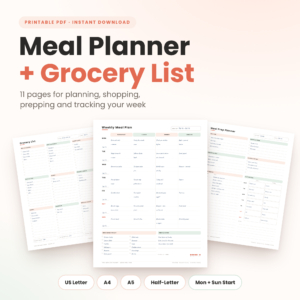
Fresh Week Meal Planner Printable Bundle
Price: $2.99 | Best for: families who plan on the fridge
Fresh Week includes 11 printable pages in US Letter, A4, A5 and Half Letter, with Monday and Sunday start versions. The Weekly Meal Plan gives all seven days rows for breakfast, lunch, dinner and snacks, with a shopping box, a prep and notes area and a cooked-at-home tracker. You also get a grocery list with nine store sections, a 72-item master shopping checklist, a meal prep planner and a food and water tracker. Print the weekly plan on Letter or A4 first so the snack boxes have room.
How to fill in the snack rows without overthinking
Snack planning should take two minutes, not twenty. The trick is a short, fixed menu.
- Write a snack list of eight to ten items your household already likes. Keep it on the back of the planner or on the fridge.
- Pair a quick item with a filling one. Apple and cheese. Crackers and hummus. Yogurt and granola. Banana and peanut butter.
- Rotate, do not reinvent. Monday and Thursday can match. Nobody minds.
- Use leftovers. Half a muffin from Sunday baking or cold pasta salad is a perfectly good snack.
- Leave one “treat” slot. Friday afternoon cookie, Saturday popcorn with a movie. Planned and enjoyed.
Here is a starter snack list many families can work from: apple slices with cheese, yogurt pouches, carrot and cucumber sticks with hummus, crackers and cream cheese, a banana, a small handful of nuts or seeds (if allowed at school), homemade popcorn, boiled eggs, frozen grapes and a slice of banana bread.
A sample week for a family with school lunchboxes
Two parents, a 7-year-old and a 10-year-old. School Monday to Friday with packed lunches. Swim club on Tuesday until 6. The table shows lunches and snacks, since dinners are often the easy part.
| Day | Morning snack | Lunch | Afternoon snack |
|---|---|---|---|
| Monday | Apple slices | Ham and cheese wrap, cucumber, yogurt | Crackers and hummus |
| Tuesday | Banana | Pasta salad with peas and tuna | Cheese stick and grapes, eaten in the car before swim |
| Wednesday | Carrot sticks | Leftover chicken in a pita with lettuce | Banana bread slice and milk |
| Thursday | Apple slices | Cheese and tomato sandwich, berries | Yogurt and granola |
| Friday | Frozen grapes | Mini pizza bagels made Thursday night | Cookie and a glass of milk (treat slot) |
| Saturday | Toast fingers | Soup and grilled cheese at home | Popcorn during the movie |
| Sunday | Boiled egg | Picnic: wraps and fruit | Smoothie made with frozen berries |
Notice the Tuesday snack. Swim club means dinner is late, so the afternoon snack is a bit bigger and planned for the car. That one decision prevents a meltdown at 6:15. Small win, big relief.
Kids enjoy this more when they help fill the snack boxes. Let each child pick two snacks for the week from the family list. Our guide to a meal planner for kids has more ways to get them involved.
Pairing the weekly page with a monthly view and a food log
Some households like to see the bigger picture: which nights are birthdays, when the in-laws visit, which week is half-term. A monthly page with breakfast, lunch, dinner and snack columns lets you rough out the month, then copy each week onto a weekly sheet with more detail.
A daily food log is useful too, especially for anyone noticing how meals and snacks make them feel. Writing the time you ate, how full you felt and a quick water count shows patterns fast. One person might find that the 10:30 snack is what stops the 3 pm slump. Another might see that evening snacking happens on days when lunch was skipped.
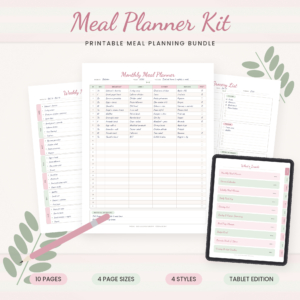
Blush & Sage Meal Planner Kit
Price: $1.49 | Best for: planners who like a monthly view too
Blush and Sage is a ten-page printable kit in Letter, A4, A5 and Half Letter. It has a Monthly Meal Planner with 31 numbered days and columns for breakfast, lunch, dinner and snacks, a Weekly Meal Planner with the same four rows each day and a grocery list beside it, and a Daily Food Log with meal times, a fullness rating, a water tracker and a fruit and veggie tracker. It also includes a grocery list in eight sections, pantry and freezer inventory, a meal prep planner and a recipe card. Fill in the monthly page first, then the week.
Snacks change the shopping list (and the budget)
Once snacks are planned, the grocery list grows, and that is a good thing. Planned snacks bought at the supermarket cost far less than unplanned ones bought on the go. A box of granola bars from the store works out much cheaper per bar than single bars from a vending machine, and a bag of apples beats a pastry from the coffee shop every time.
A few habits keep snack shopping tidy:
- Buy snack items in one section of the list, so you can see the total.
- Portion on Sunday. Fill small tubs with crackers, nuts or veg sticks. Grab-and-go beats open-the-big-bag.
- Keep a snack shelf. One shelf in the cupboard and one in the fridge. When it is empty, snack week is over.
- Check what is left before you shop, so you do not buy a third box of crackers. A simple pantry inventory list helps here.
If you want the list built for you, a spreadsheet planner with a slot for each eating moment can add up every ingredient across all meals and snacks.
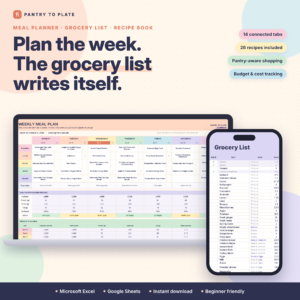
Pantry to Plate Meal Planner
Price: $14.99 | Best for: spreadsheet fans who hate writing lists
Pantry to Plate is a 14-tab Excel and Google Sheets workbook that plans seven days with five meal slots each, plus servings and prep notes. It builds the grocery list from the plan, subtracts what is in your fridge, freezer and cupboards, rounds to whole packs, prices the list against your weekly budget and sorts it by aisle. It also totals calories, protein, carbs and fat per person per day and flags food that is about to expire. Use two of the five daily slots for snacks from day one.
A 15-minute weekly routine for every meal and snack
Filling a full-day planner sounds like a lot of boxes. In practice, it goes fast if you fill it in the right order.
- Dinners first (5 minutes). They need the most thought and the most ingredients.
- Lunches next (3 minutes). Write “leftovers” under any dinner that makes extra. Fill school and work lunches from a short rotation.
- Breakfasts (2 minutes). Most families repeat two or three. Copy them across.
- Snacks last (3 minutes). Pull from the snack list, pairing something quick with something filling, and check the busy afternoons get a bigger one.
- Shopping box (2 minutes). Scan each row and jot what you do not have.
Doing snacks last matters. By then you can see which days have leftovers that would make a good snack, which afternoons run late, and which days already have a treat at a party or a school event. A working parent might also add an adult snack for the office, like a yogurt and an apple, so the 3 pm vending machine stops being part of the routine. Fifteen minutes on Sunday, and every eating moment of the week has an answer.
Printing and setup tips
A few practical details make a printable planner much easier to live with.
- Choose the paper size for where it lives. US Letter or A4 for the fridge, A5 or Half Letter for a binder or handbag.
- Print a month at a time. Four or five weekly sheets stapled together, so next week is always ready.
- Use a dry-erase sleeve if you plan the same snacks most weeks. Wipe and rewrite.
- Pick Monday or Sunday start to match the day you shop.
- Print the snack list on colored paper and stick it beside the weekly page so it is easy to spot.
- Keep a pen on a string by the fridge. A planner with no pen nearby stays blank.
Common mistakes with full-day food planners
- Filling every box on day one. If you are new to planning, start with dinners and afternoon snacks, then add the rest over a few weeks.
- Planning snacks nobody likes. A row full of celery sticks will be ignored. Stick to the family list.
- Forgetting weekend snacks. Saturday afternoons are prime grazing time.
- No drinks. If juice or soda is a big part of the day, note it in the snack row so it shows up on the list and the budget.
- Treating the plan as a rulebook. If someone is hungry at 11 and the snack was planned for 10:30, that is fine. The plan is there to help, not to police.
For more ways to keep the overall food bill down once snacks are on the list, our guide to meal planning on a budget has eight easy habits.
Frequently asked questions
What should a weekly food planner include?
Seven days with rows for breakfast, lunch, dinner and at least one snack, plus a notes or shopping box. A grocery list page and a pantry check make it much more useful.
How many snacks should I plan per day?
Most households plan one or two: a morning snack if lunch is late, and an afternoon snack to bridge the gap to dinner. Children often need both.
Is there a printable meal planner with snacks included?
Yes. Fresh Week and Blush and Sage both have breakfast, lunch, dinner and snack rows on their weekly pages, in several paper sizes.
Can I plan snacks in a spreadsheet meal planner?
Yes. Planners with five slots a day, such as Pantry to Plate, let you use spare slots for snacks so they land on the automatic grocery list.
How do I stop kids snacking all afternoon?
Plan one decent afternoon snack with something filling, serve it at a set time, and keep the snack shelf stocked only with the planned items for the week.
Your next step
Write your family snack list tonight: eight to ten items everyone likes. Then plan next week’s afternoon snacks before you plan anything else, and add those items to the grocery list. To get a full-day layout with snack rows for all seven days, print the Fresh Week Meal Planner Printable Bundle and stick the first week on the fridge.