Your friend swears by her color-coded spreadsheet. Your brother stuffs cash into envelopes every payday. You tried both and quit both inside a month. That does not mean you are bad with money. It means you tried someone else’s method.
The best way to budget for your personality is the one that fits how you already think and behave, not how you wish you did. This guide offers a quick self-check, five common money personalities with the budgeting style that suits each, the tools that match, and how to blend methods when two very different people share one household. Read the section that sounds like you and skip the rest if you like.
Quick picks: a budget tool for every style
| Product | Best for | Price | Link |
|---|---|---|---|
| Seaglass Annual Budget Spreadsheet for Excel | Detail lovers who want every dollar assigned | Original price was: $19.99.$9.99Current price is: $9.99. | View |
| Ultimate Annual Budget Spreadsheet | Big-picture people who like a 50/30/20 view | $6.00 | View |
| Petalwise Budget Planner | Hands-on writers with a tablet | $3.20 | View |
| Bloom Budget Planner | Spontaneous spenders who need a daily number | Original price was: $2.79.$1.89Current price is: $1.89. | View |
Why one budgeting method never fits everyone
Most budgeting advice assumes one kind of person: organized, patient, happy to log every purchase and review it on Sunday. Some people really are like that. Many are not, and forcing a detailed system on a big-picture thinker is like asking a night owl to run at 5 a.m. It might work for a week.
The method matters less than the fit. A loose budget you follow for two years beats a perfect one you drop in February. So instead of asking “what is the best budget?”, ask “what will I actually keep doing on a busy Wednesday?”
None of the personalities below are better or worse. They are just patterns. Most people are a mix of two, with one stronger than the other.
A quick self-check: which one sounds like you?
Read these six statements and note the ones that feel true. Do not overthink it.
- I enjoy seeing exactly where every dollar went. (Detail lover)
- I just want to know I am saving enough and not overspending. (Big-picture person)
- I remember things better when I write them by hand. (Hands-on writer)
- I often spend first and wonder later. (Spontaneous spender)
- I avoid checking my bank balance when I am worried. (Avoider)
- I get paid weekly or every two weeks and money feels tight before payday. (Spontaneous spender or avoider, often both)
Whichever label came up most is your starting point. If two tied, read both sections and borrow from each.
The detail lover: give every dollar a job
You like spreadsheets. You find categories satisfying. You probably already know roughly what you spent on groceries last month, and you would like to know exactly. A zero-based budget suits you well: every dollar of income is assigned to a category until nothing is left unplanned.
Detail lovers thrive on plan-versus-actual comparisons, charts and a bill calendar. The risk is going too far: 45 categories, logging every 80-cent purchase, burning out by spring. Set a limit of about 15 categories and give yourself one “misc” line under $50 so tiny things do not need decisions.
Picture Nadia, a lab technician who loves a tidy spreadsheet. She tried a loose 50/30/20 plan and felt lost because it did not tell her where the $380 in “wants” had gone. Switching to 14 detailed categories with plan and actual columns gave her the clarity she craved, and she now looks forward to her monthly review the way some people look forward to a crossword.
A good weekly rhythm: log spending twice a week, check categories on Sunday, and enjoy the monthly review where everything lines up. Our guide to the zero-based budget walks through assigning every dollar step by step.
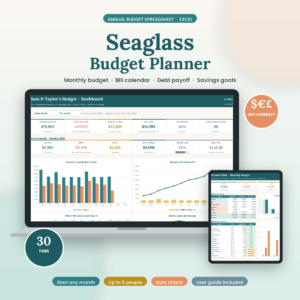
Seaglass Annual Budget Spreadsheet
Price: Original price was: $19.99.$9.99Current price is: $9.99. | Best for: detail lovers using Excel
Seaglass is a 30-tab annual budget spreadsheet for Excel. Each of its twelve monthly tabs compares budget and actual for income, bills, subscriptions, expenses, debts and savings, with a bills checklist and a daily spending chart. The dashboard shows the whole year, a top 10 spending chart and a list of things that need attention, and a bill calendar tracks every due date. It arrives blank, so set up your categories and log spending a couple of times a week.
The big-picture person: three buckets and done
You do not want to track every coffee. You want to know that savings are happening, bills are covered and you are not drifting into debt. Detailed categories bore you, and you have probably abandoned at least one budget because it felt like admin.
A bucket budget suits you. The 50/30/20 split is the classic version: about half of take-home pay for needs, 30 percent for wants and 20 percent for savings and debt. Another option is pay-yourself-first: automate savings on payday, pay bills automatically, and spend the rest freely. You only check two or three numbers a month.
On $5,000 a month take-home, 50/30/20 gives $2,500 for needs, $1,500 for wants and $1,000 for savings and debt. If your needs run higher, which is common with rent, adjust to 60/20/20. The point is a shape you can glance at, not a perfect fit.
Big-picture people do best with a dashboard that shows the split at a glance, so a quick monthly look tells you whether you are on course.
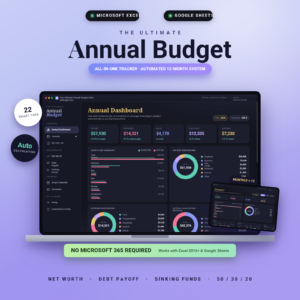
Ultimate Annual Budget Spreadsheet
Price: $6.00 | Best for: big-picture people who want a quick glance
The Ultimate Annual Budget Spreadsheet includes a 50/30/20 dashboard that shows your needs, wants and savings split, plus an annual dashboard with the whole year on one page. It runs in Excel, Google Sheets and LibreOffice across 22 tabs, including monthly dashboards with progress bars, sinking funds and debt payoff. You only fill the gold cells, and it syncs to your phone through the Google Sheets app. Set it up once, then check the 50/30/20 tab monthly.
The hands-on writer: pen first, numbers second
Typing numbers into cells feels abstract to you. Writing “$42, groceries, Tuesday” with a pen makes it real. You may love stationery, planners and the small ritual of sitting down with a page.
A handwritten budget suits you, either printed in a binder or in a digital planner on a tablet. The act of writing slows you down just enough to notice patterns. Many hands-on writers find they spend less without trying, because each purchase gets a moment of attention.
Look for a planner with clear monthly pages, a spending log with plenty of lines, and visual progress you can color in. Stickers and themes are not silly for this personality. If decorating a page makes you open it, that is a feature. Our comparison of printable planners, spreadsheets and apps can help if you are torn between paper and screen.
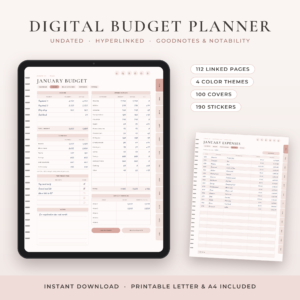
Petalwise Budget Planner
Price: $3.20 | Best for: hands-on writers who use a tablet
Petalwise is an undated, hyperlinked digital budget planner for GoodNotes, Notability, Noteshelf and Xodo on iPad and Android tablets, with 112 pages per version in four colors. Each month has a six-page routine covering Calendar, Budget, Bills and Savings, Expenses and Review, and color-in grids track debt and savings progress. It includes 100 covers, 190 stickers and a printable US Letter and A4 edition. Choose your color and start with this month’s budget page.
The spontaneous spender: one daily number
You are generous, fun and good in a crisis. You also tend to buy first and check the balance later. Long budgets do not stick, because they ask you to remember a plan at the moment you are excited about something.
What works is a single number you can check in two seconds: how much you can spend today, or this week, and still stay on track. Cash envelopes are one way to do it. Put this week’s spending money in an envelope, and when it is empty, you are done until next week. Our guide on cash stuffing for beginners shows how that works.
A digital version works too: a spreadsheet that takes your leftover money and divides it by the days left in the pay period. If today’s number is $28, a $60 dinner is a clear choice, not a vague worry. Spontaneous spenders paid weekly or every two weeks especially benefit, because each paycheck gets its own short plan.
One more trick: a 24-hour pause for anything over a set amount, say $75. You are still allowed to buy it. You just have to want it tomorrow too.
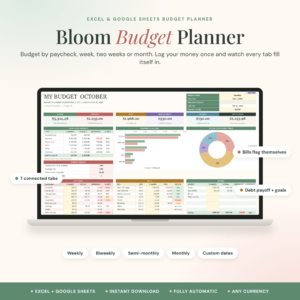
Bloom Budget Planner
Price: Original price was: $2.79.$1.89Current price is: $1.89. | Best for: spontaneous spenders paid by paycheck
Bloom is a paycheck budget spreadsheet for Excel and Google Sheets. You type each paycheck, bill and purchase once into a single transaction list, pick weekly, biweekly, twice a month or monthly, and set a start date. The dashboard shows six cards against your plan and a safe to spend per day figure, bills show Paid, Partial, Overdue or Upcoming, and categories turn amber at 80 percent and red once you go over. Check the daily number before you shop.
The avoider: small, gentle and mostly automatic
Money makes you anxious, so you look away. Statements pile up unopened. You know roughly what is happening and would rather not know exactly. This is very common, and very human.
The best budget for you is one that asks almost nothing. Automate bills and a small savings transfer on payday. Then check one number, once a week, for two minutes: the balance in your everyday account and how many days until payday. That is it. No categories at first.
Once that feels safe, add one more thing, like a list of your bills with due dates. Build up slowly. Every small step is a real win, and it is worth noticing. Many avoiders find the dread fades once they look regularly, because the real numbers are almost never as bad as the imagined ones.
A four-week starter routine
- Week 1: open your banking app every Friday and write the balance on a sticky note. Nothing else.
- Week 2: add the date of your next payday next to the balance.
- Week 3: list your fixed bills and their due dates on one page.
- Week 4: set up one automatic transfer to savings, even $25.
Four small steps in a month. By the end, you know your balance, your bills and your payday, and you have savings growing on their own. That is a real budget, built at a pace that did not frighten you.
A simple, calm tool helps. A minimal planner or a spreadsheet with a single “left to spend” figure suits avoiders better than anything with dozens of tabs.
When two personalities share one household
Couples are often opposites. A detail lover marries a spontaneous spender. A big-picture person lives with an avoider. That can work beautifully if each person gets a system that fits them inside a shared plan.
- Agree on the big numbers together: bills, savings rate and shared goals.
- Let the detail lover run the tracking, but in a file the other can glance at.
- Give the spontaneous spender a personal weekly amount with no questions asked.
- Keep check-ins short for the avoider: ten minutes, one or two numbers, then something fun.
The aim is not to turn one person into the other. It is to build a plan both of you can live with, using each person’s strengths. Many couples find the detail lover enjoys the role, and the spontaneous one is relieved to have a clear limit instead of vague disapproval.
How to tell if your method fits
Give any new method 30 days. Then ask yourself four honest questions:
- Did I check it at least once a week without forcing myself?
- Do I know roughly how much I have left this month?
- Did I save something, even a little?
- Does thinking about money feel calmer than it did a month ago?
Three or four yeses means the fit is good. Keep going. One or two means tweak it: fewer categories, a different tool, a different check-in day. Zero means try a different personality’s method. There is no failure here, only information. Each attempt gets you closer to a system that feels like yours.
Frequently asked questions
What is the best budgeting method for beginners?
The one that matches how you think. Big-picture beginners often start with 50/30/20, detail lovers with zero-based budgeting, and spontaneous spenders with a weekly cash or daily spending number.
Is zero-based budgeting too much work?
For detail lovers it is satisfying. For big-picture people it can feel heavy. If it feels like a chore after a month, switch to a bucket method.
What budget works for people who hate tracking?
Pay-yourself-first: automate savings and bills on payday, then spend the rest freely. You only check one or two numbers a month.
Can couples use different budgeting styles?
Yes. Agree on shared bills, savings and goals together, then let each person manage their personal spending in the way that suits them.
Can my money personality change?
Yes. Life events, a new job or a period of debt can shift how you handle money. Retake the self-check once a year and adjust your method if a different section now sounds more like you.
How do I stop impulse spending?
Use one daily or weekly spending number, keep a separate account or envelope for it, and wait 24 hours before buying anything over a set amount.
Your next step
Look back at the self-check and pick your strongest personality. Try that section’s method for 30 days, starting this week, then run the four-question test. If you are a spontaneous spender paid by the paycheck, the daily safe-to-spend number in the Bloom Budget Planner is a gentle place to begin.