Catering bills are rarely simple. The guest count moves three times before the big day, the client adds a dessert station in week two, and on the night someone asks the bar to stay open another hour. A catering invoice template for events and functions has to keep up with all of that and still give the client one clear number to pay.
This guide is for home caterers, small catering companies, food trucks that do private hire, and bakers who cater the odd function. You will see what belongs on a catering invoice, a fully worked wedding example, how to handle deposits and final headcounts, the difference between private and corporate clients, and a weekly routine that keeps the money side calm in a busy season.
Food is the fun part. Billing should not eat into it.
Quick picks: templates for catering quotes and invoices
| Product | Best for | Price | Link |
|---|---|---|---|
| QuoteBloom Price Quote Template | Event proposals that turn into invoices | $4.99 | View |
| Ledgerline Invoice, Quote & Receipt Template Kit | Deposits, final invoices and receipts that match | Original price was: $3.00.$1.50Current price is: $1.50. | View |
| PaidPath Client & Invoice Hub | Tracking a full season of events and costs | $9.49 | View |
| Rosewater Price Quote Template Kit | A pretty quote for weddings, with a matching invoice | $3.97 | View |
Why catering invoices are harder than most
A painter quotes a room and paints the room. A caterer quotes 100 guests, then serves 112, plus six vendor meals, plus a late-night snack nobody mentioned in March. The job changes shape right up to the day itself.
On top of that, a catering bill mixes very different things. Food priced per head. Staff priced per hour. Rentals priced per item. A service charge as a percentage. Sometimes a travel fee, sometimes a cake-cutting fee, sometimes tax on some lines and not on others. Put all of that into a basic one-column invoice and the client sees a jumble.
That’s why a good catering template groups the lines and shows the math. When the client can follow the bill, they pay it. When they can’t, they email you questions, and the payment waits until you answer.
What to put on a catering invoice
Beyond the usual business details, invoice number and dates, a catering invoice should show:
- Event details: event name, date, venue, start and end time. The client’s accounts team may not know which party this was.
- Menu and price per head: the package or menu name, the confirmed guest count and the per-head price.
- Children’s and vendor meals: listed separately if priced differently.
- Staffing: servers, chefs and bartenders, with hours and rates.
- Rentals and equipment: linens, chafing dishes, plates, glassware, if you supply them.
- Extras and changes: added stations, upgrades, overtime.
- Service charge and tax: clearly labeled, with the rate.
- Payments already received: each deposit with its date.
- Balance due and due date.
Write “service charge” and “gratuity” carefully. If your service charge covers staff costs and is not a tip, say so on the invoice. Clients often assume it goes to the servers, and a short note avoids hurt feelings on the night.
A worked example: a 120-guest wedding reception
Here is how the final invoice might look for a summer wedding, after the couple confirmed numbers two weeks out. The amounts are only an example.
| Line item | Qty | Rate | Amount |
|---|---|---|---|
| Buffet dinner, Garden Menu (confirmed adults) | 112 | 38.00 | 4,256.00 |
| Children’s meals, under 12 | 8 | 15.00 | 120.00 |
| Vendor meals (band, photographer, planner) | 6 | 15.00 | 90.00 |
| Dessert station add-on | 120 | 6.00 | 720.00 |
| Servers, 6 hours | 5 | 180.00 | 900.00 |
| Bartender, 6 hours | 2 | 180.00 | 360.00 |
| Linens and chafing dish rental | 1 | 250.00 | 250.00 |
| Service charge, 18% of food | 933.48 | ||
| Less booking deposit, paid 10 January | -1,500.00 | ||
| Less second payment, paid 1 May | -2,000.00 | ||
| Balance due 7 days before the event | 4,129.48 |
Notice how each group sits together: food, then staff, then rentals, then charges, then payments. The couple can check every line in a minute. They can also see the dessert station they added in April right there, so there is no “we didn’t order that” moment.
Tax depends on where you work and what you sell, so add your local sales tax line wherever it applies.
Start every event with a written quote
Catering invoices go wrong when the quote was a chat at a tasting. The client remembers a number. You remember a menu. Nobody remembers that the number was for 80 people, not 120.
A written quote fixes the starting point. List the menu, the estimated guest count, the per-head price, staffing, rentals, service charge, the deposit schedule and the date the final count is due. Add a valid-until date so prices from January don’t bind you in September. Our guide on how to write a price quote covers the wording, and our explainer on quote vs estimate vs invoice helps if a client asks for an “estimate” instead.
The best setup lets the accepted quote become the invoice with the same lines, so you only update the final numbers.
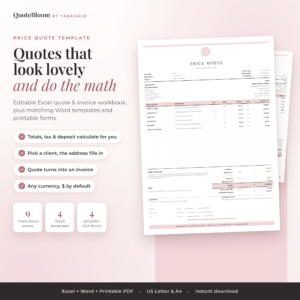
QuoteBloom Price Quote Template
Price: $4.99 | Best for: Caterers quoting events and menus
An Excel quote with saved clients and up to 200 saved items, so menus, staff rates and rentals drop in from a dropdown. It works out discounts, tax on taxable lines only, a deposit and the remaining balance, then copies everything onto a matching Invoice sheet once the client says yes. Word templates in US Letter and A4, printable forms and a quote tracker are included. Load your menus and staff rates into the item list first.
If your wedding clients love a softer, rose-toned look, the Rosewater Price Quote Template Kit does the same quote-to-invoice job and adds fillable PDFs.
Deposits, payment stages and the final headcount
Most caterers take money in stages. It protects you, because you buy food and book staff long before the event. A common pattern looks like this:
- Booking deposit when the client signs, to hold the date.
- Second payment a few months out, once the menu is set.
- Final headcount due 10 to 14 days before the event.
- Balance invoice sent the same day the count comes in, due before the event.
- Extras invoice after the event, for overtime or on-the-day additions, if any.
Give a receipt for every payment. It sounds fussy. It isn’t. A couple paying from three family members’ accounts will ask you, in July, what was paid in February, and a receipt with a number answers that in seconds.
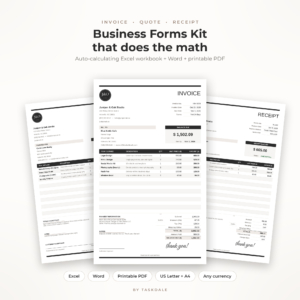
Ledgerline Invoice Quote and Receipt Kit
Price: Original price was: $3.00.$1.50Current price is: $1.50. | Best for: Caterers taking staged deposits
An Excel workbook with Quote, Invoice, Receipt, Statement, Invoice Log and Dashboard sheets, plus six Word templates and printable PDFs in US Letter and A4. The quote carries a deposit line and an acceptance signature, receipts show the payment method and balance remaining, and the statement lists every open invoice for a client. Set your deposit wording and payment terms on the Settings sheet before your next booking.
Private parties vs corporate functions
The food might be the same. The billing is not.
Private events
Weddings, birthdays, anniversaries and memorial gatherings. Clients pay from personal accounts, usually before the event, and they value warmth and clarity. Keep descriptions friendly (“Grandma’s 80th, garden lunch”) and payment instructions very simple.
Corporate functions
Office lunches, launches, training days and holiday parties. Here, the person who booked you rarely pays. The invoice goes to accounts, often needs a purchase order number, and may be paid 30 days after the event, not before. Some clients are tax-exempt and will send a certificate.
For corporate work, ask three questions at booking: who receives the invoice, is there a PO number, and what are their payment terms. Put the PO number on every quote and invoice. A missing PO number is one of the most common reasons corporate invoices sit unpaid for weeks.
Tracking a whole season of events
A wedding caterer might run 40 events between May and October. Each one can carry three or four payments. That is well over 100 payments to match to the right event, and a busy June leaves no time for detective work.
A client and invoice workbook puts every event, deposit and balance in one list, with overdue amounts at the top. Add your food and staff costs as expenses and you can see which events truly made money. A small caterer might find that 40-guest office lunches earn more per hour than big weddings. That kind of insight can shape next year’s pricing.
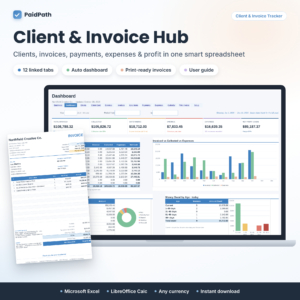
PaidPath Client and Invoice Hub
Price: $9.49 | Best for: Caterers running many events yearly
An Excel workbook with linked Clients, Services, Invoices, Line Items, Payments, Expenses and Calendar tabs and a dashboard showing invoiced, collected, outstanding, overdue and net profit. It handles split and instalment payments, up to three taxes and a separate list of everything due in the next 14 days, and prints invoices and client statements on US Letter or A4. Add this season’s bookings and deposits first.
Handling changes and on-the-day extras
Changes are normal in catering. What matters is that each one lands on paper.
- Guest count goes up after the final count: agree a per-head price for late additions in your terms, and add them to the balance or an extras invoice.
- Guest count goes down: state in your terms whether you charge for the final confirmed count or the number served.
- Overtime: note the agreed end time on the quote. Write down the actual end time on the night, and bill extra staff hours afterwards.
- Breakages and lost rentals: list them with the replacement cost.
Send any extras invoice within two days of the event, while everyone remembers the night fondly. A friendly note helps: “Thanks for a wonderful evening. Here is the small invoice for the extra hour of bar service you asked for.”
Sending the invoice: PDF, paper or both
Most catering clients now expect a PDF by email. It arrives fast, it can be forwarded to a parent or a finance team, and it never gets lost in a pile of cards on the gift table. Save each invoice as a PDF named with the invoice number, the client and the event date, such as “0412 Rivera wedding 14 June.pdf”. When a client searches their inbox in a panic two days before the wedding, that name helps them find it.
Paper still has a place. Some older clients like a printed copy handed over at the final tasting, and a printed receipt tucked into a folder feels reassuring for a family paying in cash. Keep a few blank receipt forms in the van for that reason. If a guest at the event asks about booking you for their own party, a printed price list in the same design does half the selling for you.
Whatever you send, keep a copy. One folder per year, one subfolder per month, every quote, invoice and receipt saved as a PDF. Tax time gets much calmer when the paperwork is all in one place.
Mistakes caterers make on invoices
- Billing from the original guest estimate instead of the confirmed count.
- Forgetting a deposit on the final invoice, which makes the client think you overcharged.
- Lumping everything into one line called “Catering services”.
- Calling the service charge a tip when it pays for staff costs, or the other way round.
- No PO number on corporate invoices.
- No event date on the invoice. Accounts teams match invoices to events by date.
A simple weekly routine for caterers
Pick one quiet morning, often Monday or Tuesday, after a weekend of events.
- Send extras invoices for last weekend’s events.
- Log every payment that arrived and send receipts.
- Check which events have final counts due this week and send gentle reminders.
- Send balance invoices for events whose counts came in.
- Look at the overdue list and follow up on anything more than a week late.
It takes about 30 minutes. Then you can get back to ordering produce with a clear head.
Frequently asked questions
How do caterers charge for events?
Most charge per head for food, plus hourly rates for staff, per-item fees for rentals and a service charge. Some use all-inclusive packages instead. Either way, the invoice should show how the total was reached.
When should a catering invoice be paid?
Private clients usually pay the balance before the event, often 7 to 14 days ahead. Corporate clients may pay on 30-day terms after the event. Agree this at booking and write it on the quote.
Should a catering invoice include a service charge?
If you charge one, yes, as its own clearly labeled line with the percentage and what it covers.
What if the final guest count changes after I send the invoice?
Issue a short extras invoice for additions, or a credit note for reductions if your terms allow refunds. Avoid editing an invoice you have already sent.
Can I use one template for weddings and office lunches?
Yes. Keep one layout and save different menus and rates in your item list. Add a PO number field for corporate clients.
Your next step
Before your next tasting, write your menus, staff rates, rental items and deposit schedule into one template’s item list. Then every quote, deposit receipt and final invoice will come from the same set of numbers. A good starting point is the QuoteBloom Price Quote Template.