Short answer: not always. An invoice asks for money. A receipt proves money was paid. If a customer pays on the spot, a receipt alone is enough. If you bill a client and they pay later, you send an invoice first, and a receipt afterward is a courtesy that some clients expect and others never read.
This guide is for freelancers, tradespeople and small shop owners who keep wondering whether they are doing double paperwork for nothing. You will get a clear rule for each common situation, a look at the “invoice receipt” as a single document, a worked example with a deposit, and a few templates that handle both from one file.
Quick picks: templates that handle invoices and receipts together
| Product | Best for | Price | Link |
|---|---|---|---|
| Ledgerline Invoice, Quote & Receipt Kit | Invoice and receipt in one Excel file | Original price was: $3.00.$1.50Current price is: $1.50. | View |
| PaidPath Client & Invoice Hub | Seeing who has paid at a glance | $9.49 | View |
| Ledgerline Business Forms Kit | Word forms for quote, invoice and receipt | $2.99 | View |
| Maker’s Business Forms Kit | Craft sellers with deposits and orders | $3.00 | View |
Invoice vs receipt: the one-line difference
An invoice comes before payment. A receipt comes after. That is the whole distinction, and almost every confusion about the two traces back to forgetting it.
| Invoice | Receipt | |
|---|---|---|
| When it is issued | When work is done or goods are supplied, before payment | When payment is received |
| What it says | “You owe this much, by this date” | “You paid this much, on this date” |
| Key details | Invoice number, due date, payment terms, bank details | Receipt number, payment date, payment method, amount paid |
| Who relies on it | The buyer’s accounts team, to approve and pay | The buyer, as proof of payment |
Both are business records, and you keep copies of both. But they do opposite jobs, so whether you need one, the other, or both depends on how and when the customer pays.
When a receipt alone is enough
If payment happens at the same moment as the sale, there is nothing to invoice. The customer has already paid. They just need proof.
That covers most retail and market sales. A potter sells a $42 bowl at a craft fair, takes a card payment, and hands over a receipt. A barber cuts hair and takes $30 in cash. A dog groomer finishes a wash and the owner pays at the door. In each case, an invoice would only be a receipt with a due date that has already passed. Skip it.
One small exception: some business customers ask for an invoice for their own records even when they paid on the spot. That is where the “invoice receipt” comes in, which we will cover shortly.
When an invoice alone is enough
If you bill clients and they pay by bank transfer, the invoice often does all the work. Your client’s bank statement shows the payment leaving. Your bank statement shows it arriving. The invoice explains what it was for. Many business clients never ask for a receipt in this setup, because they already have three records of the same payment.
A web designer billing a company $2,400 for a site build is a good example. The invoice goes out on the 1st, the transfer lands on the 20th with the invoice number as the reference, and the designer marks it paid in their log. No receipt needed unless the client asks.
Still, a short “payment received, thank you” email with a receipt attached costs you a minute and leaves a good last impression. For private clients especially, it is a nice touch.
When you need both
Some situations really do call for both documents. These are the common ones:
- Deposits and part payments. The invoice states the full amount. Each receipt confirms what has been paid so far and what is left.
- Cash payments against an invoice. There is no bank trail, so the customer needs a receipt as proof they settled the bill.
- The customer asks. Some clients need a receipt to claim expenses from their employer or to show a grant funder. If they ask, provide one.
- Disputes or high-value jobs. For a $5,000 kitchen fit, a clear receipt marked paid in full protects both sides if questions come up later.
- Payment by check or money order. A receipt confirms the check was received and for which invoice.
In all of these, the invoice and receipt should share the same invoice number. That one link lets anyone match them up months later in seconds.
Timing matters too. Send the receipt the same day the money arrives, ideally within an hour or two. A client who paid a $720 deposit on Tuesday morning and hears nothing until Friday may start to wonder whether it reached you. A quick receipt settles that worry before it starts.
The “invoice receipt”: one document that does both
An invoice receipt, sometimes called a receipted invoice or paid invoice, is simply your original invoice marked as paid. It shows everything the invoice showed, plus the payment date, the method and a clear “PAID” stamp or balance of zero.
It is handy in two situations. First, when a business customer paid on the spot but wants an invoice for their files. Second, when a client paid an invoice and asks for proof. Instead of drafting a separate receipt, you mark the invoice paid and send it again. One document, no retyping.
How to mark an invoice as paid
- Open the original invoice. Do not create a new number for it.
- Add a line for the payment: the date received, the method (transfer, card, cash, check) and the amount.
- Show the balance due as zero, or the amount still owed if it was a part payment.
- Add a clear mark near the total, such as “PAID IN FULL on 14 March 2026”.
- Save it as a new PDF named with the invoice number and “paid”, and send it to the client.
Keep the unpaid version too. Your file then shows both what you asked for and what you received.
The cleanest way to do this is with a template where the invoice updates itself once payment is logged. Type in the amount paid and the balance due falls to zero, and the invoice shows it has been settled.
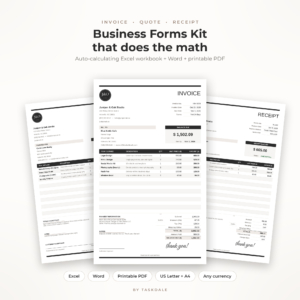
Ledgerline Invoice, Quote and Receipt Kit
Price: Original price was: $3.00.$1.50Current price is: $1.50. | Best for: anyone who wants one paperwork file
An Excel workbook with matching Word templates and printable PDF forms. The invoice has a big Balance Due box that turns green and reads PAID IN FULL once it is settled, and the separate receipt template records the payment method, change given or balance remaining, and a paid or partial status. A log of up to 300 invoices tracks status for you. Set up your client list first so invoices and receipts fill in quickly.
Worked example: a deposit, an invoice and two receipts
Here is how the paperwork flows on a typical custom job. A carpenter agrees to build a set of fitted shelves for $1,800, with a 40% deposit.
- Day 1: invoice for the deposit. Invoice 2026-087 for $1,800 total, with $720 due now and $1,080 due on completion.
- Day 3: receipt for the deposit. The client pays $720 by transfer. Receipt R-0212 shows $720 received against invoice 2026-087, balance $1,080.
- Day 15: job finished. The carpenter sends the updated invoice 2026-087, showing the deposit received and $1,080 now due.
- Day 16: final receipt. The client pays $1,080 in cash. Receipt R-0219 shows $1,080 received, balance $0, invoice paid in full.
Four documents, one invoice number tying them together. The client has proof of every dollar. The carpenter has a clean trail if anyone ever asks. And the moment that last receipt reads “balance $0” is a quietly happy one.
Keeping invoices and receipts in step
The real risk is not missing a document. It is the two sets of records drifting apart. You mark a receipt as paid but forget to update the invoice. Or you log an invoice as paid when only the deposit came in. A few weeks later you cannot tell who owes what.
A weekly matching routine
Every Friday, open your bank app and your invoice log side by side. For each payment that arrived this week, find the invoice it belongs to and log it. Then check any cash or check payments against the receipts you wrote. If every payment has a home and every receipt points to an invoice, you are done. If something does not match, you have caught it within days, while you still remember the job. Ten minutes, start to finish.
The fix is to treat the invoice as the master record and log every payment against it. Whether you then send a receipt, a paid invoice or a simple thank-you email, the invoice status always tells the truth. Late payers rise to the top, part payments show the right balance, and money you are expecting is easy to see. That last part matters when you are planning a month ahead, which is where a cash flow forecast template comes in handy.
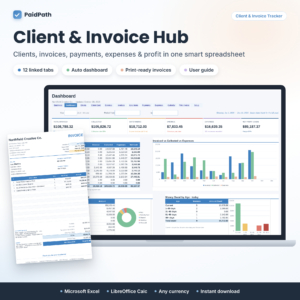
PaidPath Client and Invoice Hub
Price: $9.49 | Best for: freelancers juggling many open invoices
An Excel workbook where clients, invoices, quotes, payments and expenses are linked. Log a payment and the invoice status, the client’s balance, the calendar and the dashboard all update, with overdue invoices sorted by how late they are. It handles up to three taxes, prints invoices, quotes and client statements on US Letter or A4, and lets you set your own currency symbol. Start by entering your open invoices so the dashboard reflects today.
What each document should include
On the invoice
- Your business name and contact details
- The client’s name and address
- A unique invoice number and the invoice date
- What you supplied, with quantities, rates and line totals
- Any tax, discount or shipping
- The total, the due date and how to pay
On the receipt
- Your business name and contact details
- A receipt number and the date payment was received
- The invoice number it relates to, if there was one
- The amount received and the payment method
- Any balance still owed, or “paid in full”
Notice the overlap. That is why a kit with matching invoice and receipt forms saves so much effort: the shared details flow across, and only the payment parts change. If you are choosing a receipt template on its own, our guide to editable receipt templates compares the formats.
Craft sellers: orders, invoices and receipts
Handmade sellers often mix all three types of sale. A walk-up buyer at a market pays on the spot and gets a receipt. A wedding client orders 60 custom favors, pays a deposit, and gets an invoice and two receipts. A shop down the road buys wholesale and pays on 30-day terms against an invoice.
Each needs slightly different paperwork. The walk-up buyer needs a receipt and nothing else. The wedding client needs an order form with every detail, an invoice for the full $480, a receipt for the $200 deposit and a final receipt for the $280 balance. The wholesale shop needs a proper invoice with 30-day terms, and maybe a paid invoice once the money lands.
Juggling those by hand is how deposits go missing. A forms kit that includes order forms, invoices, receipts and a tracker keeps each kind of sale in its proper lane.
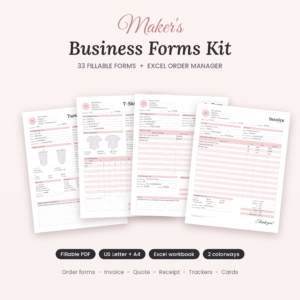
Maker's Business Forms Kit
Price: $3.00 | Best for: makers selling retail and custom orders
Thirty-three printable and fillable PDF forms in US Letter and A4, including an invoice, price quote, sales receipt and a custom order and deposit agreement, plus order forms for tumblers, apparel, mugs and signs. The Excel Order Manager has 13 linked tabs that turn orders into invoices and receipts and show sales on a dashboard. Print a stack of sales receipts for markets and use Excel for deposits and custom work.
Frequently asked questions
Is an invoice the same as a receipt?
No. An invoice requests payment and comes before it. A receipt confirms payment and comes after it. An invoice marked as paid can act as both.
Can a paid invoice be used as a receipt?
Yes. An invoice that shows the payment date, the amount received and a zero balance or “paid” mark works as proof of payment for most customers.
Do I have to give a receipt if the client paid by bank transfer?
Usually not, since both bank statements record the payment. If the client asks for one, send it, or send the invoice marked as paid.
Should the receipt number match the invoice number?
Keep separate number series for invoices and receipts, but always show the invoice number on the receipt. That link is what lets you match them later.
How long should I keep invoices and receipts?
Keep copies of both for as long as your tax authority asks you to keep business records, which is several years in most countries. A dated digital folder for each year makes this easy.
What do I give a customer who pays cash on the spot?
A receipt. There is no need for an invoice unless the customer asks for one for their own records, in which case send an invoice marked as paid.
Your next step
Look at your last ten sales and sort them into three piles: paid on the spot, paid later by transfer, and paid in parts. Use a receipt for the first, an invoice for the second, and both for the third. To run all three from a single file, start with the Ledgerline Invoice, Quote and Receipt Template Kit.