Small business owners tend to keep three separate lists without meaning to. Goals live in a notebook from January. Clients live in an inbox and a phone. Cash lives in the banking app, checked nervously on a Friday. None of them talk to each other, which is why a great month for new clients can still end with a scary bank balance.
A business planner for goals, clients and cash flow pulls those three into one view. This guide shows you how to set one up, what to track in each part, how they connect, and a 30-minute weekly routine that keeps it alive. It suits freelancers, consultants, makers, salons, coaches and any small team where the owner still does the books.
You do not need fancy software. You need a place for each of the three, and a habit of looking at them together.
Quick picks for planning goals, clients and cash
| Product | Best for | Price | Link |
|---|---|---|---|
| Orchid Business Hub | Goals, budget and profit in one workbook | $6.99 | View |
| Keystone Business Hub | Clients, quotes, invoices and follow-ups | $6.99 | View |
| Small Business Finance HQ | Cash flow forecast and tax set-aside | $7.99 | View |
Why these three belong on the same page
Goals, clients and cash are really one story told three ways. Your goal says how much you want to earn. Your clients are where that money comes from. Your cash flow shows when it actually lands. Look at one without the others and you get a half-truth.
Take Priya, a freelance web designer. Her goal for the quarter was $24,000. By mid-February she had signed $26,000 of work and felt fantastic. Then she checked her cash. Two clients paid on 60-day terms and one project was billed in stages. She had $3,100 in the account and a tax bill due in March. Her goal was fine. Her cash was not.
If she had seen goals, clients and cash side by side, she would have spotted it in January. Maybe asked for a deposit. Maybe shortened her terms. That is the whole point of putting them together.
Part one: goals you can actually track
Most business goals fail because they are wishes, not numbers. “Grow the business” cannot be tracked. “Bring in $8,000 a month by June from six retainer clients” can. So the first job is turning your big goals into a few measurable ones.
Start with the year, then cut it into quarters
Pick one money goal for the year and two or three supporting goals. A dog groomer might choose $72,000 revenue, 40 regular clients and one new service. Then split each into quarters. Ninety days is long enough to make progress and short enough to stay real.
Give every goal a weekly action
A goal needs something you can do this week. For 40 regular clients, the weekly action might be: ask every happy customer to rebook before they leave. For the new service, it might be: two hours on Thursday building the price list.
Work backward from the money goal
Turn the revenue goal into clients and sales. If the groomer’s average visit is $60 and she wants $6,000 a month, that is 100 visits. Forty regulars coming every five weeks give her about 32 a month, so the other 68 need to come from new and occasional customers. Suddenly the goal is not a vague hope. It is a number of bookings she can count each Friday.
Review progress monthly
On the first of each month, mark each goal as on track, behind or done. If something has been behind for two months, change the plan or drop the goal. Carrying a dead goal around is tiring.
A workbook that puts goals right next to your profit and loss makes that monthly check quick.
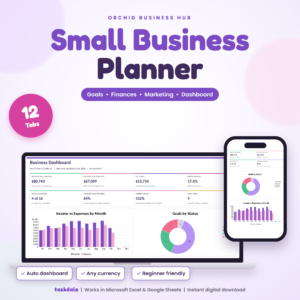
Orchid Business Hub
Price: $6.99 | Best for: owners who want goals beside numbers
A 12-tab small business planner spreadsheet for Excel and Google Sheets. It has a one-page business plan, goals and tasks, a budget, income and expense logs that feed a monthly profit and loss, and marketing campaigns, all summed up on a dashboard with eight live numbers and four charts. It arrives blank. Fill in your three goals for the quarter first, then log last month’s income so the dashboard has something to show.
Part two: clients, follow-ups and who owes you
Clients are where goals turn into money. The client part of your planner needs to answer four questions at a glance.
- Who are my current clients? Name, contact, what they buy, how often.
- Who might become a client? Leads, where they came from, and the next step with a date.
- Who do I need to follow up with? The quote you sent on Monday. The past client you have not heard from in four months.
- Who owes me money? Every unpaid invoice, how old it is, and when you last chased it.
That fourth question is where client tracking meets cash flow. An invoice that is 45 days late is not a client problem. It is a cash problem with a client’s name on it.
The second question matters more than people expect. A pipeline of leads is your future cash flow. If a bookkeeper has eight leads at different stages and usually wins one in four, she can expect about two new clients from that list. If the list drops to three leads, she knows next quarter will be thin long before it arrives.
A simple habit helps a lot here. Every time you finish a call, write one line: date, what was said, next step. A month later you will not remember who asked about the bigger package. Your log will. If you want to build a basic version yourself, our guide to a simple CRM in Google Sheets shows how.
If you would rather have the client list, quotes and invoices already linked, a ready workbook saves the setup.
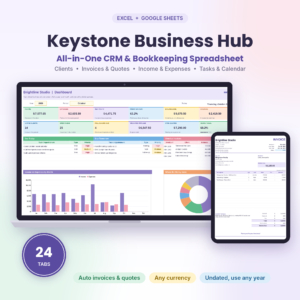
Keystone Business Hub
Price: $6.99 | Best for: freelancers and service businesses
A 24-tab Excel and Google Sheets workbook with a client directory, client profiles, a leads pipeline with win chances, and a log of calls, emails and meetings with follow-up reminders. Quotes and invoices pull from your own price list, and recording a payment marks the invoice paid and updates the client balance. Add your ten most active clients first, then enter any open invoices so you can see who owes what.
Part three: cash flow and your low point
Cash flow answers one question: will there be enough money in the account on every day of the next few months? Profit cannot tell you that. Cash flow can.
A 12-week forecast is enough
You do not need a five-year model. A 12-week forecast catches most problems. For each week, list cash expected in (invoices due, regular sales), cash going out (rent, software, wages, tax, supplier bills) and the running balance.
A worked example
| Week | In | Out | Balance |
|---|---|---|---|
| Start | $5,000 | ||
| 1 | $1,800 | $2,400 | $4,400 |
| 2 | $600 | $900 | $4,100 |
| 3 | $0 | $3,200 | $900 |
| 4 | $4,500 | $700 | $4,700 |
Week three is the low point. Rent and a quarterly tax payment land together, and no invoices are due. The business is healthy overall, but $900 is uncomfortably close to zero. Seeing it in week one gives you time to chase an invoice early, move a bill, or hold off on that new laptop.
Our guide to the cash flow forecast template walks through setting this up step by step.
A finance workbook with the forecast built in will warn you about the low point for you.
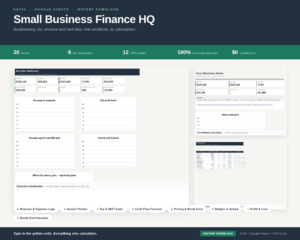
Small Business Finance HQ
Price: $7.99 | Best for: owners who dread the tax bill
A 20-sheet Excel workbook that also opens in Google Sheets, LibreOffice and Numbers. You log revenue and expenses, and it updates profit and loss, an invoice tracker that turns overdue rows red, a cash flow forecast with a lowest-point warning, and a tax reserve plan. It comes with a 15-page illustrated guide. Enter your recurring costs first, since those are the bills that sneak up.
How the three parts talk to each other
Here is where the planner earns its keep. Look at the three parts together once a week and patterns jump out.
- Goal behind, pipeline thin: you need more leads. Spend this week on outreach, not admin.
- Goal on track, cash low: clients are paying slowly. Tighten terms or ask for deposits.
- Cash healthy, goal behind: you are comfortable but not growing. Pick one goal action and do it first each morning.
- All three healthy: enjoy it. Then set aside a slice of cash for the next quiet month.
That last one matters. Small wins deserve a moment. Seeing three green lights after a hard quarter is a quiet kind of pride, and it keeps you coming back to the planner.
Setting it all up in one afternoon
The first setup is the only slow part. After that, the weekly upkeep is short. Give yourself one afternoon, say three hours on a Sunday, and work in this order.
- Gather your numbers. Last three months of bank statements, your list of unpaid invoices, and your regular monthly bills.
- Enter recurring costs. Rent, phone, software, insurance, loan payments. These rarely change, so you only type them once.
- List your clients and leads. Start with the people who paid you in the last six months, then add anyone you have quoted.
- Write three goals. One money goal and two supporting ones, each with a weekly action.
- Build the first 12-week forecast. Use invoice due dates for money in and your bill dates for money out.
By the end you will know your low point, your top five clients and your three goals. Many owners say that first afternoon is the clearest they have felt about their business in a year.
Paper, digital or spreadsheet?
The best format is the one you will open every week. Each has a place.
- Spreadsheet: best for cash flow and invoices, because it does the sums. Works on a laptop and, with Google Sheets, on a phone.
- Printable planner: good for goals and weekly thinking. Writing by hand slows you down in a useful way.
- Digital planner on a tablet: handy if you already plan in GoodNotes or a similar app and like handwriting without paper.
Plenty of owners mix them: a spreadsheet for money and clients, a paper page for the weekly plan. That is fine. Just keep the numbers in one place so you never wonder which version is right.
A 30-minute weekly planning session
Pick a fixed slot. Friday at 3pm works for many people, because the week is fresh in your mind. Then run through these steps in order.
- Five minutes on cash. Update the bank balance. Check the next four weeks for the low point.
- Ten minutes on clients. Mark paid invoices. Chase anything over terms. List three follow-ups for next week.
- Five minutes on goals. Did you do this week’s goal actions? Note one win.
- Ten minutes on next week. Block time for the most important task first, then fill around it.
Thirty minutes. Most weeks it will feel like nothing much happens. Then one Friday you will spot a cash dip three weeks out and fix it with a single email, and the whole habit pays for itself.
Mistakes that make planners go stale
- Too many goals. Seven goals means none get attention. Three is plenty.
- Tracking clients but not invoices. A lovely client list is no help if you cannot see who owes you.
- Forecasting once. A cash forecast from March is fiction by May. Update it weekly.
- Mixing personal and business money. It makes cash flow guesswork. A separate account fixes it.
- Skipping the review when busy. Busy weeks are exactly when invoices slip and follow-ups get missed.
- Building the perfect system first. Color coding and custom charts can wait. A plain list you update beats a beautiful one you abandon in week three.
Frequently asked questions
What should a small business planner include?
At minimum: yearly and quarterly goals, a client and lead list, an invoice tracker, a monthly budget and a cash flow forecast. Add a weekly planning page to tie them together.
How far ahead should a small business forecast cash flow?
Twelve weeks is a practical rolling window for most small businesses. Many owners also keep a rough 12-month view for seasonal dips.
Can I use one spreadsheet for clients and bookkeeping?
Yes. A linked workbook where invoices, payments and client balances update together saves a lot of retyping and catches unpaid invoices sooner.
How often should I review my business goals?
Check actions weekly and progress monthly. Reset goals each quarter based on what you learned.
Is a paper business planner still worth it?
For thinking and weekly planning, yes. For money and invoices, a spreadsheet is safer because it does the arithmetic for you.
What do I do if my cash forecast shows a shortfall?
Act early. Chase overdue invoices, ask new clients for a deposit, move a non-urgent purchase, or talk to a supplier about timing. A shortfall spotted six weeks out is usually fixable.
Your next step
Block 30 minutes this Friday. Write your three goals for the quarter, list every unpaid invoice, and sketch the next four weeks of cash. If you want the goals, budget and profit pages ready to go, start with the Orchid Business Hub.