You have a trait you can’t stand in other people. Maybe it’s bragging, or neediness, or the way someone fishes for compliments. It makes your jaw tighten. That reaction is information. Shadow work prompts are simply questions that help you look at what sits behind it. If you have never tried any, this guide gives you 60 shadow work prompts for beginners, a simple way to set up the journal, and two Taskdale journals that already have a shadow work section built in.
Quick picks
| Product | Best for | Price | Link |
|---|---|---|---|
| Radiant Becoming Digital Manifestation Journal | GoodNotes or Notability users who want shadow work next to a vision board | $4.75 | View product |
| Daydream Digital Manifestation Planner | A very low cost start in GoodNotes, with a printable version too | $1.19 | View product |
What Shadow Work Prompts Actually Do
The idea behind shadow work is old and simple. Everyone has parts of themselves they push away because those parts felt unwelcome once. Anger. Envy. Needing help. The “shadow” is just the pile of things you decided were not okay to show.
Shadow work prompts give you a gentle way in. You don’t have to sit and stare at yourself. You answer one question, on paper, for ten minutes. That’s it.
Here’s what a good prompt does. It is specific enough that you can answer it with a real memory, not a vague feeling. “Why am I like this?” is useless. “When was the last time I felt jealous, and what did I want?” is something you can actually write about on a Tuesday night.
One honest note before we go further. This is self-reflection, not therapy. If a prompt stirs up something heavy, stop, take a breath, and talk to a qualified professional. These are general self-help tools and not a replacement for a therapist.
How to Set Up a Shadow Work Journal in Ten Minutes
You don’t need a fancy system. You need a place that feels private and a habit you can repeat. Here is the setup I’d suggest for beginners.
Pick a format you will open
Paper is fine. A tablet app like GoodNotes is fine too, and it has one big advantage: nobody can read your handwriting over your shoulder if the file lives on your own device. Choose the one you will actually open. A beautiful journal you avoid is worse than a scrappy notebook you use.
Choose a fixed time and a short window
Fifteen minutes, three evenings a week. That is plenty. People quit shadow work because they treat it like a marathon, writing for an hour on night one and then feeling wrung out on night two.
Write the prompt, then answer fast
Copy the question at the top of the page. Set a timer for ten minutes. Write without editing. If you get stuck, write “I’m stuck” and keep going until something else shows up. It usually does.
End with something kind
Close each session with one line of gratitude or one thing you did well that day. It sounds small. It stops the session from ending in a bad mood, and that matters if you want to come back.
60 Shadow Work Prompts for Beginners
Don’t try to do all of these in a week. Pick one group, work through it slowly, and skip any question that feels too raw today. You can come back.
Triggers and reactions (1 to 10)
- What trait in other people irritates me most, and where might I have it?
- When did I last snap at someone, and what was I really upset about?
- Whose success makes me feel small, and why that person?
- What do I judge harshly in strangers?
- Which comment from someone still stings after a week?
- What makes me defensive fastest?
- When do I go quiet instead of saying what I think?
- Who do I avoid, and what would happen if I stopped?
- What did I overreact to this month?
- What am I pretending not to care about?
Childhood messages (11 to 20)
- What did I learn about anger growing up?
- What was I praised for as a kid, and what did I stop doing because of it?
- Which feelings were not allowed in my house?
- What did my family say about money?
- What rule did I absorb about being a good person?
- Who was I told I should be more like?
- What did I do to get attention when I was small?
- What did I want to hear as a child and never did?
- What was never talked about at home?
- Which of those old rules do I still follow without choosing to?
Masks and people pleasing (21 to 30)
- What version of me do I show at work?
- What do I hide from close friends?
- When do I say yes while meaning no?
- What would I do differently if no one could judge me?
- Who am I afraid of disappointing?
- What part of me feels fake?
- When did I last change my opinion just to fit in?
- What am I performing right now?
- What would people be surprised to learn about me?
- Which mask is the most tiring to wear?
Envy, shame and fear (31 to 40)
- What do I secretly want that I’m embarrassed to admit?
- When did I feel ashamed this year?
- What am I most afraid people will find out?
- What does my envy say I want?
- What failure do I still replay?
- Which compliment is hardest for me to accept?
- What do I fear would happen if I succeeded?
- What do I hide behind: busyness, humor, silence, perfection?
- What did I do once that I haven’t forgiven myself for?
- What would I do if I weren’t afraid of looking foolish?
Relationships and boundaries (41 to 50)
- Where do I give more than I get?
- Who drains me, and why do I keep showing up?
- What boundary do I need and keep putting off?
- What pattern shows up in every relationship I’ve had?
- When do I expect people to read my mind?
- What do I blame others for that I also do?
- Who do I need to forgive, even if they never apologize?
- What do I want from the people closest to me that I haven’t asked for?
- How do I act when I feel unwanted?
- What would a healthier version of this relationship look like?
Integration and self-acceptance (51 to 60)
- What part of myself am I ready to stop fighting?
- What strength is hiding inside my biggest flaw?
- If my anger could speak, what would it ask for?
- What would I say to myself at age seven?
- What do I need to hear today?
- What am I proud of that no one has noticed?
- What small thing would make me feel safer?
- Which of my “bad” traits has actually protected me?
- What would it feel like to be fully myself on an ordinary Wednesday?
- What is one thing I can do this week to treat myself with more respect?
Mistakes That Make Shadow Work Feel Awful
Most of the pain comes from how people do it, not from the questions.
First mistake: going too deep too fast. Beginners often start with the hardest childhood prompts. Start with triggers instead. They are closer to the surface and far easier to answer.
Second: using the journal to beat yourself up. If your answers sound like a prosecutor, rewrite them as a curious friend would. “I’m jealous of her because I want more freedom” is honest. “I’m a terrible person for being jealous” is just noise.
Third: doing it only when you feel awful. Then the journal becomes a dumping ground, and you start to associate it with bad days. Mix in some calm evenings.
And fourth, skipping the finish. Always end on something steady, a line of gratitude, an affirmation, a cup of tea. You’re teaching your mind that looking inward is safe.
Turn Shadow Work Prompts Into a Habit You Keep
Writing a few answers once feels good. The real change shows up when you repeat the practice and look back. After a month you’ll spot the same names, the same fears, the same sentence starting up in different clothes. That pattern is the whole point.
A journal that already has structure helps here. You don’t spend your ten minutes building pages. You open it, find the section, and write. Two Taskdale journals do exactly that, and both have shadow work pages next to a vision board and gratitude pages, so the inner work and the forward-looking work live in one file.
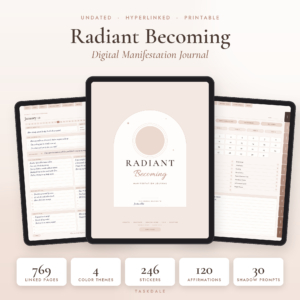
Radiant Becoming Digital Manifestation Journal
Price: $4.75 | Best for: GoodNotes and Notability users who want shadow work, a vision board and gratitude pages together
This is an undated, hyperlinked law of attraction planner for GoodNotes and Notability. It includes the 3-6-9 method, shadow work pages, a vision board and a gratitude journal, plus a printable version and stickers. Since it is undated, you can start any day and skip a week without a pile of blank, guilty pages.
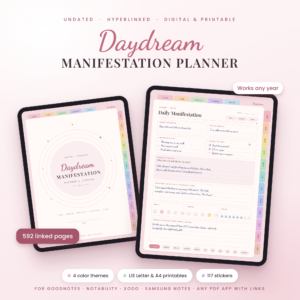
Daydream Digital Manifestation Planner
Price: $1.19 | Best for: A low cost way to try shadow work and manifestation pages in GoodNotes
Daydream is an undated, hyperlinked law of attraction journal for GoodNotes. It covers a vision board, the 3-6-9 method, shadow work, gratitude and affirmations. A printable version in US Letter and A4 is included, so you can work on paper if you prefer.
Which Shadow Work Journal Fits You?
Both products cover the same core areas. The choice mostly comes down to app, price and how much extra you want.
| Product | Format | Price | Best for | Link |
|---|---|---|---|---|
| Radiant Becoming Digital Manifestation Journal | Undated hyperlinked digital journal for GoodNotes and Notability, plus printable and stickers | $4.75 | Shadow work, vision board and gratitude in one place | View product |
| Daydream Digital Manifestation Planner | Undated hyperlinked digital planner for GoodNotes, plus printable US Letter and A4 | $1.19 | Trying shadow work and affirmations on a tiny budget | View product |
If you already use GoodNotes every day and want the extras, Radiant Becoming is the fuller pick. If you’re not sure shadow work is for you, Daydream costs about the price of a gumball. Try it for two weeks and see.
A Four Week Plan for Your First Shadow Work Prompts
Here is a plain schedule, so you don’t have to decide each night what to write.
Week one: triggers. Use prompts 1 to 10, one per session, three sessions a week. You’ll finish early, so repeat your favorite one on the weekend. Notice which question made you want to close the book. That one is probably worth another try.
Week two: masks. Use prompts 21 to 30. Most people find these easier than they expect, because they are about everyday life, not old wounds.
Week three: envy and fear. Use prompts 31 to 40, and go slower. If one feels too heavy, switch to a gratitude page and come back later.
Week four: integration. Use prompts 51 to 60. By now you have a few weeks of pages to flip through, and rereading them is part of the exercise. Underline anything that repeats.
That’s a month, about two hours of total writing a week. Not a huge ask. And you’ll end it knowing yourself a little better than you did on day one.
Frequently Asked Questions
What are shadow work prompts?
They are journal questions that help you notice the traits, feelings and habits you tend to hide or deny. You answer them in writing, usually for about ten minutes. The goal is understanding yourself better, not fixing yourself. They are a self-help tool, not therapy.
How often should I do shadow work journaling?
Two or three short sessions a week works well for beginners. Fifteen minutes is enough. Doing it every day can feel heavy, and skipping for weeks makes it hard to build a pattern. Choose a rhythm you can keep up even in a busy week.
Can shadow work make me feel worse?
It can stir up uncomfortable feelings, especially around old memories. Start with easy prompts about everyday triggers, and stop if something feels too heavy. If strong emotions stay with you, talk to a qualified professional. Shadow work journaling does not replace therapy.
Do I need a special journal for shadow work?
No, a plain notebook works. A prepared journal just saves setup time and keeps related pages together. The Taskdale journals above include shadow work pages alongside a vision board and gratitude pages, which some people find helps them stay consistent.
What is the difference between shadow work and manifestation?
Manifestation looks forward: what you want and how you plan to move toward it. Shadow work looks inward: what’s blocking you and why. Many people like doing both, since understanding your fears can make your goals feel more honest.
Your Next Step
So, the short version: pick one group of prompts, set a ten minute timer tonight, and write the first answer badly. That counts. If you want a ready-made place to keep it all, start with Daydream for $1.19, or choose Radiant Becoming for the fuller set of pages. Either way, begin this week, not someday. This article is general information and not professional advice.