So you said yes to hosting the baby shower. Lovely. Now there’s a guest list to chase, food for an unknown number of people, games you vaguely remember from your cousin’s shower, and a group chat with 14 opinions about the cake.
A baby shower planner, whether it’s a notebook or a spreadsheet, turns that into a sequence of small jobs. Here are the eight steps I’d follow, in order, with rough timings and the bits people usually forget.
It works for a living-room brunch for ten or a rented hall for forty. Scale up or down as you go.
Step 1: Talk to the parent-to-be (8 to 10 weeks out)
Before anything else, ask. Do they want a surprise or not? A big party or something small? Co-ed or not? Are there people who must be invited, or people who definitely shouldn’t be? Any foods to avoid?
Five minutes of questions now saves you planning the wrong party. Most showers happen 4 to 8 weeks before the due date, when the parent-to-be is still comfortable but the baby feels real.
Step 2: Set the budget
Decide on a total and who’s paying. If you’re co-hosting, agree how costs will be split before anyone buys anything. A rough split for a home shower: food and drink 40 to 50%, decor 15 to 20%, cake 10 to 15%, invitations and favors 10%, games and prizes 5 to 10%. Keep a little back for the inevitable last-minute run to the shop.
Step 3: Pick the date and venue
Weekend afternoons work for most guests. Brunch or a 2pm start keeps the food simpler than a full dinner. For the venue, a home is cheapest, but check you can seat everyone. If you’re hiring a space, compare on total cost, including any cleaning or kitchen fees.
Step 4: Build the guest list and send invites (4 to 6 weeks out)
Get names and contact details from the parent-to-be or their partner. List households rather than individuals so you’re not sending three invites to one house. Send invitations 4 to 6 weeks ahead, with an RSVP date about two weeks before the shower.
In Little Bloom, the guest list has one row per household with RSVP, party size, diet and table, plus a “Next step” column that shows Send invite, Chase RSVP or All set. That last column makes chasing late replies a two-minute job.
Step 5: Choose a theme and plan the decor
A theme isn’t required, but it makes decisions easier. Once you’ve chosen “garden party” or “little bear”, the balloons, napkins and cake almost pick themselves. Choose a palette of three or four colours and stick to it.
Little Bloom has 16 theme ideas with palettes, plus Decor and Shopping tabs with costs and a running total.
Step 6: Plan the food and drink
For an afternoon shower, plan on finger food rather than a full meal. A rough guide is 6 to 8 savoury bites per guest for a two-hour party, plus cake and something sweet. Always include a non-alcoholic option that feels special, since the guest of honour can’t drink.
Check dietary needs from the RSVPs. Little Bloom’s menu planner scales portions to your headcount with a food buffer, and runs a dietary check that tells you if a guest’s need isn’t covered by anything on the menu. If you’d rather have exact quantities, Little Nest has a food and drink calculator that reads your headcount and shower length and tells you how many appetisers, drinks, cake slices, plates, cups and pounds of ice to buy.
Step 7: Games and the run of the day
Two or three games is plenty. More and people start checking their phones. Good options: guess the baby’s due date and weight, baby photo match, a “don’t say baby” clothespin game, or advice cards for the new parents.
Then write a simple run sheet. For a two-and-a-half-hour shower:
- 0:00 Guests arrive, drinks, mingling
- 0:30 Food is served
- 1:00 Games
- 1:30 Gift opening (if doing it)
- 2:00 Cake
- 2:30 Wrap up
Little Bloom has 20 game ideas with a time check, a baby guessing pool that finds the winners, and a minute-by-minute plan for the day. Little Nest’s Run of Show times itself as you type minutes for each part and warns you if the programme runs past your end time.
Step 8: Gifts, helpers and thank-yous
Assign one person to log gifts as they’re opened: who gave what. This is the job everyone forgets, and the parent-to-be needs it for thank-you cards.
Give helpers clear jobs too: one on the door, one on food, one running games, one on gift logging. Little Bloom’s Helpers tab shows how many tasks each helper owns, so nobody ends up doing everything.
Keeping it all in one place
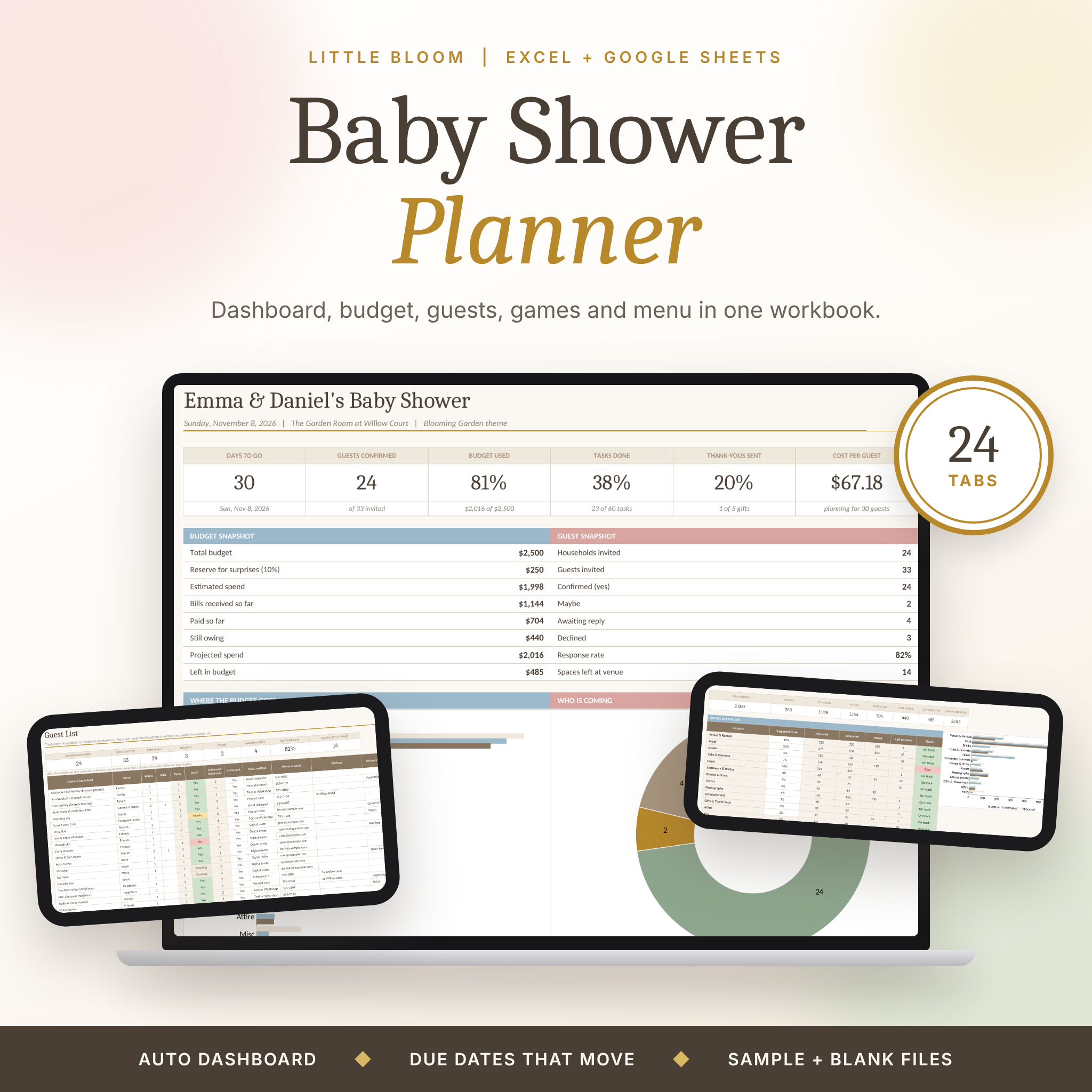
You can plan a shower on paper. But with guests, budget, food and gifts all linked, a spreadsheet saves real time. Little Bloom is an Excel workbook with 24 connected tabs that also opens in Google Sheets. Enter the date once and its 60-task checklist dates itself, with overdue and due-this-week flags. The dashboard shows days to go, guests confirmed, budget used, tasks done, thank-yous sent and cost per guest. It also comes with a sample-filled copy, so you can see every tab working before you start.
If you’re co-hosting with friends and sharing costs, look at Little Nest. Its Co-Host Cost Split shows each host’s fair share and a plain “owes” or “is owed” figure, which keeps money conversations friendly.
Baby shower planner FAQ
How far in advance should you plan a baby shower?
Start 8 to 10 weeks before the shower. Send invitations 4 to 6 weeks before, and lock in food and numbers about a week out.
Who usually hosts a baby shower?
Often a close friend, sister or relative, sometimes several people co-hosting. These days it’s also common for parents-to-be to plan their own.
How long does a baby shower last?
Two to three hours is typical. Long enough to eat, play a couple of games and open gifts without anyone flagging.
Do you have to open gifts at the shower?
No. Many showers skip it to save time. If you do open them, keep someone logging gifts as they go.