Most budgets are written for a person who does not exist. Someone who never gets tired, never forgets a birthday, never has a week where the car, the dentist and a school trip all land at once. Then real life shows up, the plan cracks by the 12th, and you decide budgeting is not for you. It is. You just need a budget that fits real life instead of an imaginary one.
This guide shows how to build one. You will start from your actual week rather than an ideal one, add the flex every real budget needs, connect your money to your calendar and your meals, and learn how to reset when life changes shape. There are two worked examples from very different lives, and a few all-in-one planners for people who want money, plans and habits in one place.
Quick picks: life planners with a budget built in
| Product | Best for | Price | Link |
|---|---|---|---|
| Linden Life Organizer | Busy parents linking bills, calendar and meal plans | $20.00 | View |
| Linen Life OS | One spreadsheet for budget, habits and goals | $17.00 | View |
| Evergrove All-in-One Digital Life Planner | An offline app that balances time and money | $12.99 | View |
| Noir Life OS | A dark-mode life planner with a budget and dashboard | $3.00 | View |
Why most budgets do not survive real life
When a budget fails, people usually blame willpower. Look closer and the cause is almost always the plan, not the person. Here are the five most common cracks.
- It ignores energy. The plan says cook every night. But on Thursdays you get home at 7:15, exhausted, and a $32 takeout order is the only thing standing between you and tears.
- It has no room for joy. Zero dollars for fun works for about two weeks. Then a friend’s birthday drinks turn into a $60 “failure”.
- It forgets the calendar. Three birthdays in March, a wedding in June, back-to-school in August. The budget treats every month the same. Life does not.
- It lives somewhere you never look. An app you open once a month cannot guide choices you make daily.
- It never changes. You got a new job, moved, had a baby. The budget is still from two years ago.
Every fix in this guide targets one of these. None of them needs more discipline. They need a better-designed plan.
Start from your actual week, not an ideal one
Before you write a single budget number, map a normal week. Not your best week. Not the week you wish you had. The real one, with the late meeting and the gym class you skip half the time.
The one-week money and energy map
Take a sheet of paper and draw seven columns, one per day. In each, note three things: when you leave and get home, how tired you usually are by evening (low, medium, wiped out), and what you typically spend money on that day. Use last week’s bank statement to fill in the spending.
Patterns jump out fast. Most people find one or two “leak days” where tiredness and spending line up. For many, it is Thursday and Friday. For shift workers, it is the first day after a run of nights. For parents, it is the evening with three activities to drive to.
Now you can plan for those days instead of fighting them. A freezer meal waiting for Thursday. A fixed $25 takeout budget for Friday, guilt-free. Snacks packed for the activity night. The spending is still there, but it is planned, and planned spending does not wreck a month.
Time is part of the budget too
Money and time trade off constantly. An overbooked week costs money: convenience food, rush delivery, taxis when you are late. A planner that shows how much free time you actually have each day, compared with what you have planned, helps you see an expensive week coming before it starts.
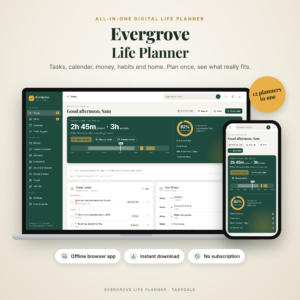
Evergrove All-in-One Digital Life Planner
Price: $12.99 | Best for: overbooked people who want time and money in one
Evergrove is an offline digital life planner that runs in your browser with no account or subscription. Tasks, calendar, money, habits, meals, chores, journal, birthdays and trips all link together, and the home screen compares time planned against time available, with Repair my day and Balance my week buttons that move lower-priority tasks to days with room. Add your bills and next two weeks of appointments first, then look at which days show red.
Build in flex: fun money, a buffer and a bad-week line
A real-life budget has give in it. Three lines do most of the work.
1. Fun money you do not have to justify
Give every adult in the house a personal amount each month, spent on anything, no questions. Even $40 or $60 makes a difference. It turns small treats from guilty slips into part of the plan. People who keep a fun line stick with their budget far longer than people who cut it to zero, because the plan stops feeling like a punishment.
2. A buffer for small surprises
A forgotten school fee. A parking ticket. A friend’s last-minute leaving gift. Set aside $75 to $150 a month in a buffer line. If it is still there at month end, roll it into savings and enjoy that small win.
3. A bad-week line
This one is less common, and it is a lifesaver. Some weeks just go wrong: a sick kid, a deadline crunch, a family emergency. Those weeks cost more, mostly in convenience. Budget for one a month. For a family, $80 to $120 covers a few easy dinners and some extra gas. If the month goes smoothly, that money goes to savings too.
Together these three lines might add $200 to $350 to a budget. That can feel like a lot. But compare it with the alternative: a plan that breaks every month and a credit card that quietly fills the gap. Flex is cheaper than failure.
Connect your money to your calendar
Months are not equal. December is not March. A budget that fits real life looks ahead at the calendar and plans for the heavy months before they arrive.
The 12-month money calendar
Sit down once with a year’s calendar and note every event that costs money: birthdays, holidays, school trips, weddings, renewals, the annual car service, summer camp. Put a rough amount next to each. Then add up each month.
Most families find two or three months that cost hundreds more than the rest. Knowing that, you can save a little each month in advance. If your heavy months add $1,800 across the year, setting aside $150 a month means they arrive already paid for.
The trick is keeping calendar and budget in one view. When a birthday dinner sits on the same screen as your eating-out balance, you make better choices without trying.
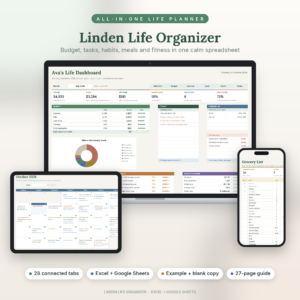
Linden Life Organizer
Price: $20.00 | Best for: busy parents juggling bills, dates and dinners
Linden Life Organizer is a 28-tab life planner spreadsheet for Excel and Google Sheets. Paying a bill marks it paid in the budget; an appointment lands on the Smart Calendar and in Week Ahead; a planned meal adds ingredients to the grocery list minus what is in your pantry. It also covers savings and debt, an annual overview, habits and workouts. Start on the Setup tab with your pay dates, then add the year’s birthdays and events.
Let your meal plan carry the food budget
Food is the biggest flexible cost in most households and the one most tied to daily life. It is also where a small amount of planning saves the most money, because unplanned food is expensive food.
You do not need a perfect meal plan. You need four things:
- Plan dinners only. Breakfasts and lunches tend to be repeats. Dinners are where the money goes.
- Match meals to your energy map. Quick or freezer meals on leak days. Bigger cooking on calm days.
- Shop from the plan. One list, one main shop, one top-up.
- Plan one takeout night. Put it in the budget. It stops the unplanned ones.
A household that moves from five unplanned takeout meals a month to one planned one can easily save $100 or more, depending on family size. And the evenings get calmer, which is its own reward. If you plan on an iPad, our comparison of digital meal planners shows four options side by side.
Keep money, habits and plans in one place
This is the fix for the “lives somewhere you never look” problem. If your budget is in one app, your calendar in another, your habits in a third and your meal plan on a sticky note, the budget gets the least attention. It is the least fun.
Put them together and the budget gets looked at every time you check what is on today. You log a coffee while ticking off a habit. You see the electric bill due next to Friday’s plans. It becomes part of the day rather than a monthly chore.
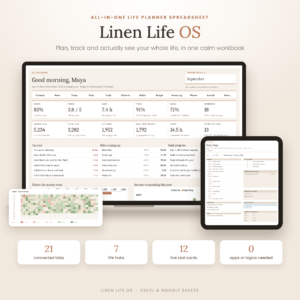
Linen Life OS
Price: $17.00 | Best for: professionals and students who want one home for planning
Linen Life OS is a 21-tab life planner spreadsheet for Excel and Google Sheets, grouped into seven life hubs. The Home Dashboard shows 12 live stat cards, including habits, sleep, tasks, income, spending, savings and bills, plus four charts and upcoming bills. Log a purchase once and it appears in your budget, dashboard and year review. Begin with the two-minute Start Here setup, then log one week of spending and habits.
If you prefer a darker screen for evening planning, the Noir Life OS in the quick picks table has the same all-in-one idea with a dashboard of 16 live tiles. Our guide to running your life from a dark mode life planner explains why some people find it easier to stick with.
Two real-life budgets, side by side
Here is how the same ideas look in two very different lives.
Jess, night-shift nurse, single, take-home $4,100
Jess works three 12-hour nights a week. Her leak day is the first afternoon after a run of shifts, when she wakes up starving and too tired to cook. Her plan: two freezer meals always ready, $30 set aside for a post-shift treat each week, and groceries bought on her first day off. Fun money is $120 a month, because she has fewer evenings free and likes one good dinner out. Buffer: $100. Her calendar shows two weddings in summer, so she saves $60 a month for them from January.
Dan and Priya, three kids, take-home $6,900
Their leak days are Tuesday and Thursday, with soccer, swimming and piano stacked back to back. Plan: slow-cooker dinners on both days, $20 a week for activity-night snacks, and one planned pizza night. Each adult gets $60 in fun money. Bad-week line: $120, because with three kids, someone is always sick. Their heavy months are August (school costs, two birthdays) and December, so they set aside $220 a month for those.
Neither budget looks like a textbook example. Both work, month after month, because they were built around the people living them. Dan said the first month they did not argue about money felt like a small miracle.
When life changes, reset the budget
A budget that fits real life has to change when life does. Any of these is a reason to sit down for an hour and rebuild:
- A new job, a lost job or a big change in hours
- A new baby, or a child starting school or college
- A move, even across town
- A partner moving in or out
- A health change that affects work or costs
- Caring for a parent
You do not need to start from nothing. Copy last month’s plan, redo the one-week energy map, and adjust the lines that changed. Give the new version two months before judging it. The first month of any big change is messy for everyone.
Mistakes that make a budget feel unreal
- Using your best month as the template. Plan for a normal month with a normal amount of chaos.
- Cutting all treats at once. Trim gradually. Keep the treats that matter most.
- Tracking to the cent. Round to the nearest dollar. Precision is not the goal; awareness is.
- Comparing with someone else’s budget. Their life is not yours.
Frequently asked questions
How do I make a budget I can actually stick to?
Build it from your real spending and your real week, include fun money and a buffer, and keep it somewhere you look every day. Check it weekly for 10 minutes.
How much fun money should be in a budget?
Whatever you can sustain without stress. Even $30 to $60 per adult each month helps a budget last, because small treats stop feeling like failures.
Why does my budget always fail by mid-month?
Usually because it ignores tired days, irregular costs or fun. Map a normal week, plan for your leak days, and add a buffer.
Should my budget be the same every month?
No. Use a 12-month money calendar to spot heavy months and save for them in advance. Most households have two or three expensive months a year.
Is it better to use a life planner or a separate budget app?
If you already use a planner daily, keeping your budget in it means you see it more. If you only want to track money, a dedicated budget tool is simpler.
Your next step
This week, draw your one-week money and energy map. Seven columns, three notes each, filled in from last week. Circle your leak day and plan one change for it: a freezer meal, a set takeout amount, packed snacks. When you want your bills, calendar and meal plan to work together, set them up in the Linden Life Organizer and add the year’s birthdays first.