Most family chore charts follow the same arc. Week one: enthusiasm, stickers, a child who asks if they can empty the dishwasher again. Week three: the chart is under a takeaway menu and you’re doing everything yourself.
A chore chart for kids works when it’s simple, visible and the same every week. Not perfect. Just predictable. Here’s how to build a family chore system that’s still running in month six, with chores by age, a reward approach that doesn’t turn into a negotiation, and the small habits that keep it alive.
Chores by age: what kids can actually do
Kids can usually do more than we expect, but not to adult standards. Pick from the list for their age and accept “done” over “perfect”.
- Ages 2 to 3: put toys in a basket, put clothes in the laundry basket, help feed a pet, wipe up small spills
- Ages 4 to 5: make the bed (roughly), set the table, match socks, water plants, put away their own clothes
- Ages 6 to 8: empty the dishwasher cutlery, sweep a small area, pack their school bag, fold towels, clear the table
- Ages 9 to 12: load the dishwasher, vacuum a room, take out bins, make a simple snack, clean the bathroom sink
- Teens: do their own laundry, cook a simple meal once a week, mow the lawn, clean a whole bathroom
Start with two or three chores per child. You can always add more. Starting with eight is how charts die.
Building the chore chart for kids, step by step
- List what the household actually needs. Walk through a normal week and write down every repeating job.
- Split into daily and weekly. Daily: make bed, clear plate, tidy toys. Weekly: change sheets, vacuum bedroom, sort recycling.
- Assign by age and preference. Let kids pick from a shortlist. A child who chose “feed the cat” complains less than one who was told to.
- Put adults on the chart too. Kids notice fast if the chart only applies to them.
- Keep it where everyone sees it. The fridge, the back of a door, by the school bags.
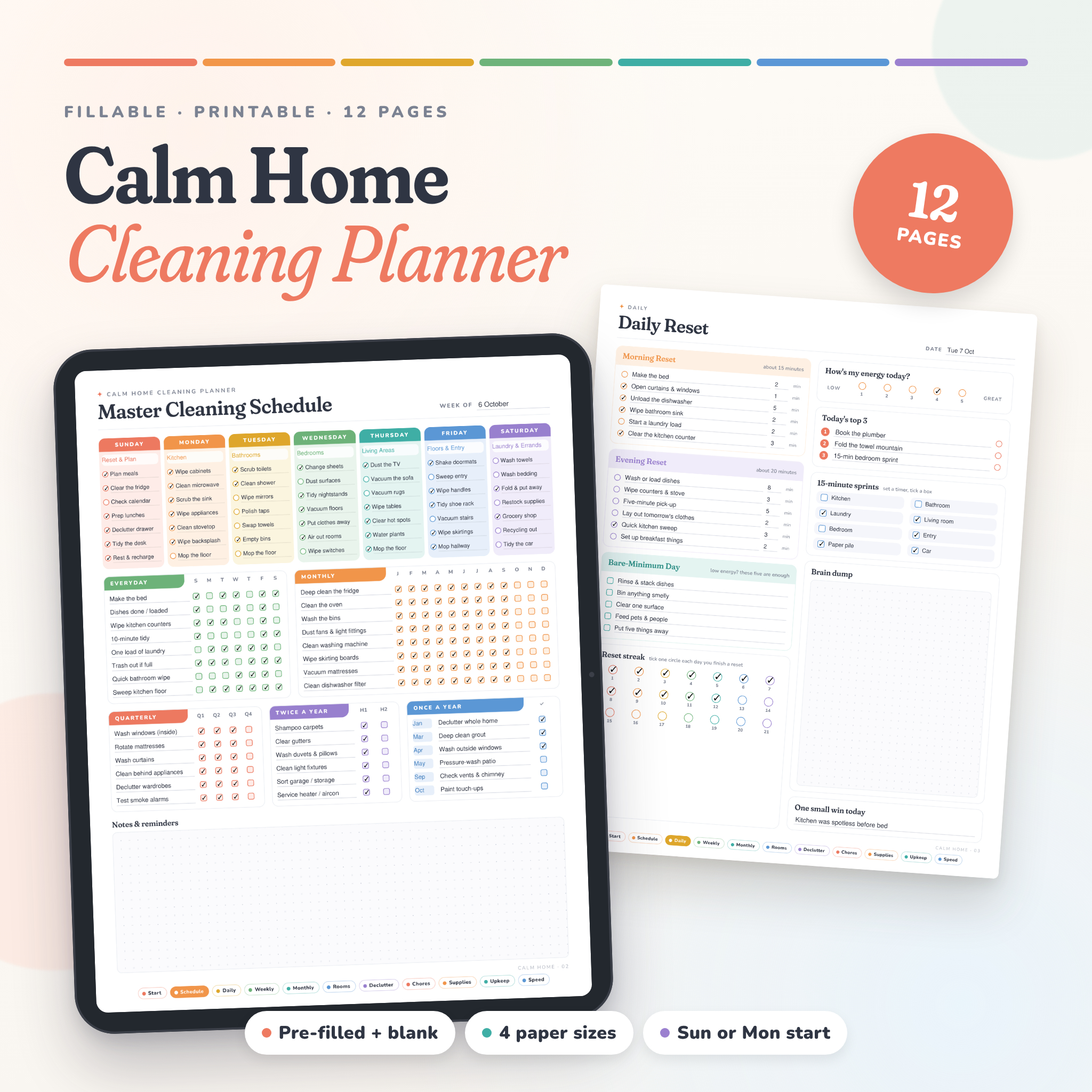
The Calm Home Cleaning Planner has a Family Chore Chart page for four people with up to nine chores each, a tick for every day of the week and a reward line. You can type into it on a computer, tablet or phone, or print it for the fridge. Every task is editable, so you can swap in your own family’s jobs.
Rewards: keep them simple and consistent
There are three common approaches, and any of them can work if you stick to it:
- Pocket money tied to chores. Good for older kids learning about money. Pay weekly, on the same day.
- Privileges. A full week of ticks earns a later bedtime on Saturday, choosing the family film, or a trip to the park.
- Just part of family life. Some chores are simply what everyone does, with no reward. Many families mix this with paid “extra” jobs.
Whatever you choose, write it on the reward line and don’t renegotiate mid-week. “Can I have the reward if I do it tomorrow?” is a slippery slope.
Make it fit your week, not an ideal week
Busy families do better with themed days than with long daily lists. Monday is kitchen day, Tuesday is bathrooms, and so on. Everyone knows what’s happening without checking.
Home Reset is built around this idea. Each day has a small theme, so you stop asking what to clean and just open the page. It includes a chore chart so everyone knows their part, a zone rotation for moving through the house one area at a time, and 5, 15 and 30 minute lists for low-energy days. It’s a fillable PDF you can type and tick in Adobe Acrobat Reader, or print.
The Calm Home planner has a similar idea for rough days: a five-task Bare-Minimum list for when everyone’s tired. Kids benefit from that too. On a bad day, the bare minimum still counts.
Habits that keep the system running
- Same time every day. Chores after school snack, or straight after dinner. Routine beats reminders.
- A weekly 10-minute check-in. Sunday evening, look at the chart together. Celebrate the ticks, adjust what isn’t working.
- Rotate jobs every month. Nobody gets stuck with bins forever, and kids learn more skills.
- Show, then do it together, then let them do it. Three steps for any new chore. Skipping the middle step is why the towels end up in a ball.
- Don’t redo their work in front of them. If the bed is lumpy, it’s made. Fix it later if you must.
When the parent is the one who needs structure
Here’s a quiet truth: chore charts often fail because the adult running them is overloaded. If you’re juggling work, meals, bills and remembering whose turn it is, a digital system can carry some of that.
The Calm Chaos ADHD Notion planner has a Home & Meals space with a chore rotation where chores reschedule themselves, plus a meal calendar and a grocery list sorted by aisle. It was made for ADHD brains and anyone who has quit a planner after a week, and it doesn’t scold you for missing a few days. It runs in Notion on the free plan, on phone or computer. It won’t replace the paper chart on the fridge for the kids, but it can run the household side for you.
Chore chart for kids FAQ
At what age should kids start doing chores?
As early as 2 or 3, with simple jobs like putting toys away. The habit matters more than the quality at that age.
Should kids be paid for chores?
It’s a family choice. Many parents keep everyday chores unpaid and pay for bigger extra jobs, which teaches both responsibility and the link between work and money.
How many chores should a child have?
Start with two or three daily jobs and one weekly job. Add more once those are a habit.
What if my child refuses to do chores?
Keep calm and consistent. Make the next fun thing come after the chore (“we’ll go to the park when the toys are away”) rather than arguing about it.