Most cleaning plans are written by the version of you who just had a great week. Mop every floor daily. Wipe the fridge every Wednesday. Dust the skirting boards every Friday. Then a kid gets sick, work runs late, and by Thursday the whole thing is in the bin along with your good intentions.
A cleaning schedule that sticks is built for your worst week, not your best. It’s small, it decides things for you, and it has a lighter version for days when you’re running on fumes. Here’s how to make one, step by step.
Why most routines fall apart
Three reasons, usually.
Too much. A list with 40 daily tasks is a list nobody finishes. Not finishing feels like failing, so you stop looking at it.
Too many decisions. “Clean something today” means standing in the hallway wondering what. Decision fatigue is real, and it’s often the thing that sends you to the sofa.
All or nothing. Miss Monday and the week feels ruined. So you wait for next Monday. Then the one after.
The fixes below tackle each one.
Step 1: A daily reset, not a daily clean
Pick a short morning routine and a short evening one. Ten to fifteen minutes each. Not deep cleaning. Resetting.
- Morning: make the bed, open windows, empty the dishwasher, quick wipe of the bathroom sink.
- Evening: clear the kitchen counters, load the dishwasher, put things back where they live, set out tomorrow’s stuff.
This alone keeps a home from sliding. Everything else builds on it.
Step 2: Give each day one theme
Instead of cleaning everything a little, clean one area properly each day. Here’s a common setup:
| Day | Focus |
|---|---|
| Monday | Kitchen |
| Tuesday | Bathrooms |
| Wednesday | Dusting and living areas |
| Thursday | Floors |
| Friday | Bedrooms and bedding |
| Saturday | Outdoor, car or catch-up |
| Sunday | Rest and plan the week |
The point isn’t the exact days. It’s that you never have to decide. It’s Tuesday, so it’s bathrooms. Done thinking.
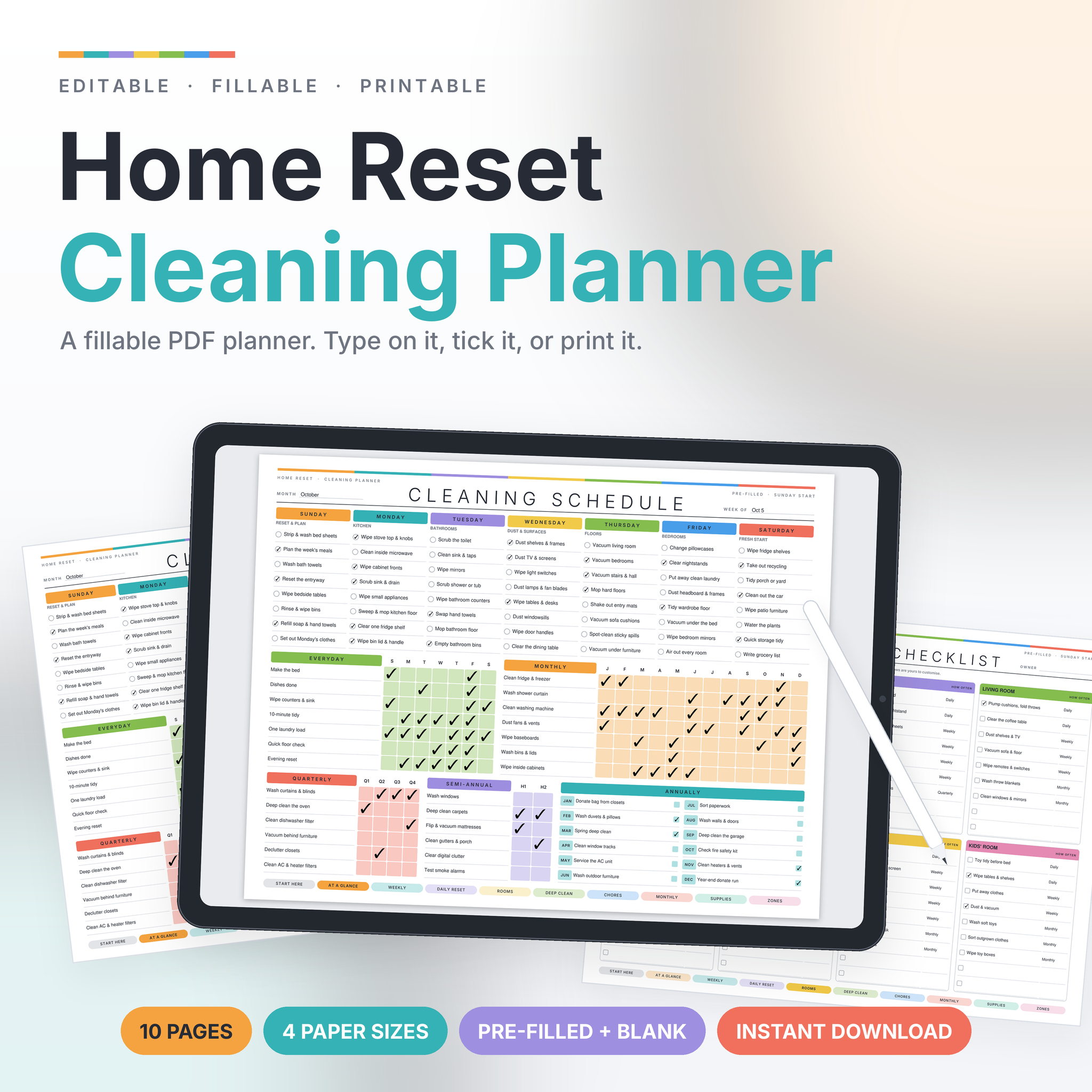
The Home Reset Cleaning Planner is built on this idea. Each day has a small theme, like kitchen on Monday and bathrooms on Tuesday, so you just open the page.
Step 3: Have a lighter version for bad days
This is the step most routines skip, and it’s the one that keeps them alive. Write three versions of each day:
- 5 minutes: the bare minimum. Dishes, counters, done.
- 15 minutes: the normal day.
- 30 minutes: the good-energy day.
On a rough day, doing the 5-minute version still counts. You kept the habit. Home Reset has 5, 15 and 30 minute lists for exactly this, plus a weekly plan where you pick your energy level and sort tasks into must do, should do and bonus.
Step 4: Spread the big jobs across the year
Oven cleaning, washing curtains, defrosting the freezer, clearing gutters. These don’t belong in a weekly routine. Put them on monthly, quarterly or yearly lists and do one or two a month. The house stays on top of itself without a dreaded spring-cleaning weekend.
Step 5: Share it out
If you live with other people, a cleaning schedule only one person follows isn’t a schedule. It’s a grievance. Use a chore chart with names and days. Kids can handle more than you’d expect: a 7-year-old can match socks and wipe a table, and a teenager can own the bathroom on Tuesdays.
Step 6: Track supplies so you’re never stuck
Nothing kills a cleaning session faster than finding the spray bottle empty. Keep a simple list of what you have, what’s running low and what to buy. Check it once a week.
Your first week: do less than you think
Don’t launch the whole plan on Monday. For week one, do only the morning and evening resets. Week two, add the day themes. Week three, start the monthly list. Building it in layers means each habit has time to settle before the next one arrives, and you won’t burn out by Wednesday.
Two planners that do this for you
Home Reset
A 10-page fillable PDF built for bad Tuesdays. You get the day themes, the 5/15/30 minute lists, morning, afternoon and evening routines, room-by-room checklists with a frequency dropdown on every line, a deep clean list, a chore chart, a monthly tracker, a supplies list and a zone rotation. Every task is pre-filled but rewritable, and there’s a blank version too. It comes as 16 PDFs in four paper sizes, Sunday or Monday start.
Calm Home
The Calm Home Cleaning Planner is a little bigger at 12 pages. It has a master schedule with a zone for each day, timed morning and evening resets, a five-task Bare-Minimum Day list and a 21-day streak tracker. Its room-by-room deep clean covers 84 tasks with last-cleaned and next-due dates. It also adds a 30-day declutter challenge, a family chore chart for four people, a supplies inventory for 24 products, a home upkeep log and a 20-minute guest-ready speed clean.
Quick pick: Home Reset if you want the lightest possible routine with energy-based planning. Calm Home if you also want the declutter challenge, a streak to chase and a repair log.
Both work in the free Adobe Acrobat Reader on a computer, iPad, iPhone or Android, or you can print them for the fridge.
Cleaning schedule FAQ
How often should each room be cleaned?
Kitchens and bathrooms need a quick daily wipe and a proper clean weekly. Bedrooms and living areas are fine with a weekly clean and a daily tidy. Bedding is usually changed every one to two weeks.
How long should daily cleaning take?
For most homes, 15 to 30 minutes a day split between morning and evening keeps things under control. Use a shorter list on tough days.
How do I get my family to help?
Give everyone named jobs on a chart, keep them age-appropriate, and make the chart visible. Vague requests like “help tidy” rarely work.
Is it better to clean a little every day or all at once?
A little every day is easier to keep up and stops mess from building. One big session works for some people, but it’s the first thing dropped when a weekend fills up.