A crypto trading journal is the least exciting tool a trader can own, and probably the most useful. Charts tell you what the market did. A journal tells you what you did. Those are very different things, and most traders only ever look at the first.
Ask a trader how their month went and you’ll usually hear about the best trade and the worst one. Ask for their win rate on short trades, or what their fees added up to, or how their Friday-evening trades perform compared with Monday mornings, and you’ll get a shrug. That’s not a knock on anyone. Memory just isn’t built for this.
This guide covers why logging trades matters, exactly what to record, and how to review it. It’s about record-keeping, not about what to buy or sell. Nothing here is financial advice.
Why keep a crypto trading journal?
Your memory is biased
We remember big wins and painful losses. The dozens of small, ordinary trades in between blur together, and those are where most of your results actually come from.
Costs hide in plain sight
Trading fees and, on perpetual futures, funding payments are small per trade. Over 200 trades they can add up to a large share of what you made. You won’t feel that unless you write it down.
Patterns only show up in data
Maybe one setup consistently loses. Maybe you trade worse after a loss. Maybe late-night trades go badly. None of this is visible trade by trade. It shows up after 50 or 100 entries.
Tax time gets easier
Rules differ by country, so check what applies to you. But a clean record of every trade, with dates, prices and fees, is far easier to work from than a pile of exchange exports.
What to record for every trade
Here’s a solid starting set. It looks like a lot, but most of it is a dropdown or a number you already have on screen.
The basics
- Entry and exit date and time
- Coin or pair, and the exchange
- Spot or futures, long or short
- Entry price, exit price and quantity
- Fees, and funding if it’s a perpetual
The plan
- Stop loss and take profit levels, decided before entry
- Position size as a percentage of your account at risk
- The setup or reason for the trade, in a few words
- Timeframe you were trading
The human side
- How you felt going in: calm, rushed, bored, chasing
- Whether you followed your plan
- Any mistake: moved the stop, entered late, took profit early
The human side is the part people skip, and it’s usually the most revealing. A trader who tags every trade truthfully for a month often finds one habit that costs more than all the others combined.
The numbers worth calculating
Once you have 30 or more trades logged, these figures start to mean something:
- Net profit or loss after fees and funding, not just gross
- Win rate: the share of trades that made money
- Average win vs average loss: a 40% win rate can still work if wins are much bigger than losses
- R-multiple: result measured against what you risked, so trades of different sizes compare fairly
- Profit factor: gross profit divided by gross loss
- Max drawdown: the biggest drop from a peak in your balance
None of these predicts the future. They describe your own past behavior, which is the one thing you can change.
How to review your journal
Logging without reviewing is just typing. Set two habits:
Weekly, 15 minutes. Look at the week’s trades. What went well? Which trades broke your own rules? Write one thing to keep doing and one thing to fix.
Monthly, 30 minutes. Sort results by setup, coin, direction and day of the week. Look for anything clearly better or worse than average. Look at what your tagged mistakes cost in total. Then decide on one rule change for next month, and only one.
A crypto trading journal that does the maths
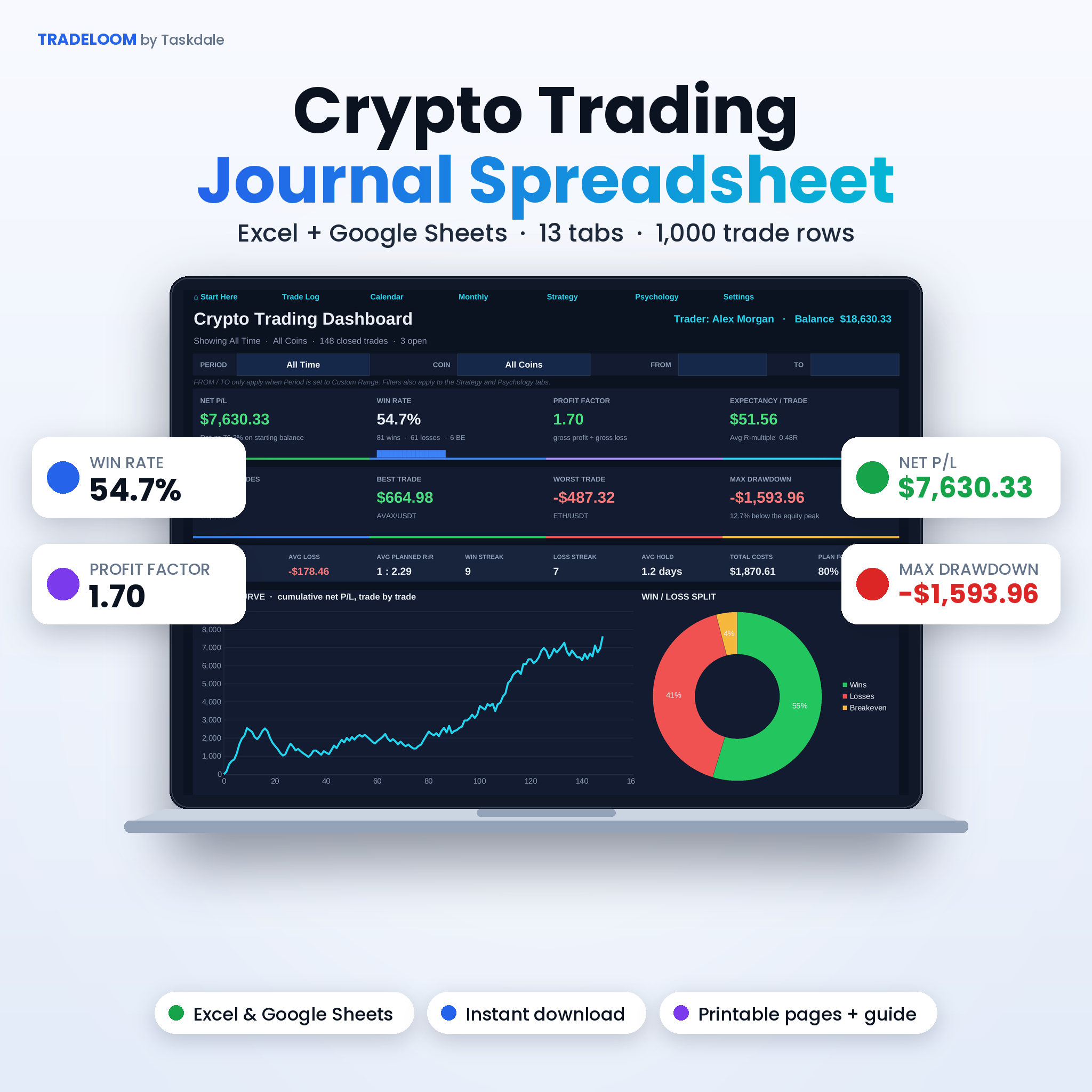
A blank spreadsheet works if you enjoy writing formulas. If you don’t, the Tradeloom Crypto Trading Journal is an Excel and Google Sheets workbook that covers everything above.
Every trade goes on one row of the Trade Log, with room for 1,000 trades. Pick the coin, exchange, setup and direction from dropdowns and type the prices and quantity. The journal works out fees (from your default fee % if you leave it blank), position value, margin, risk amount, risk %, planned R:R, gross and net P/L, R-multiple, days held and your balance after. Trades with no exit price show as OPEN. Futures traders get columns for the position multiplier and funding.
From there, 12 other tabs turn the log into answers:
- A Dashboard with net P/L, win rate, profit factor, expectancy, average R, max drawdown, an equity curve and your top coins and setups, filterable by period and coin
- A P&L calendar showing every green and red day, plus a 12-month overview
- Strategy and Psychology tabs breaking results down by setup, session, day of the week, emotion, mistake and plan discipline
- A Weekly Review with auto stats and space to grade your week
- A position size calculator, a holdings tracker, a pre-trade checklist and a daily risk guard that tells you when to stop
You also get a sample workbook with 151 example trades, a printable journal PDF in US Letter and A4, and a 20-page guide. It doesn’t connect to exchanges; you type trades in yourself, which keeps your data private. It also works for stocks or forex if you add those tickers.
It suits spot and futures traders who want honest numbers. It’s not for anyone hoping a spreadsheet will tell them what to trade. It won’t, and nothing should promise that.
Crypto trading journal FAQ
What should I write in a trading journal?
For each trade: dates, coin, direction, entry, exit, size, fees, your stop and target, the setup, and how you felt. Then add whether you followed your plan.
How many trades before a journal is useful?
Patterns start to show after about 30 trades and get clearer after 100. Keep logging even when results are boring.
Can I use a spreadsheet as a crypto trading journal?
Yes. Excel or Google Sheets works well. A template saves you building the P/L, R-multiple and dashboard formulas yourself.
Is a trading journal financial advice?
No. It’s a record-keeping tool. It shows what you did, so you can make your own decisions with better information.