If you are applying for work in another European country, someone will probably mention Europass. Some people swear by it. Others say recruiters roll their eyes at it. The truth sits in the middle, and it depends on where you are applying and who you are applying to.
This guide explains the CV format European style in plain terms. You will learn what Europass is, what goes in it, how the language levels work, when it is the right choice and when a clean, tailored A4 CV will serve you better. There is also a step-by-step method for building a European-style CV in Word and a worked example of one person using both.
It is written for job seekers moving within Europe, students applying for exchanges or traineeships, and anyone outside Europe applying to a European employer for the first time.
Quick picks: A4 CV templates for European applications
| Product | Best for | Price | Link |
|---|---|---|---|
| Sloane Resume Template | A4 CV with photo and language level dots | $4.49 | View |
| Marlowe Resume Template | Photo and no-photo versions for different countries | $4.79 | View |
| Hollis Resume Template | Photo or monogram, opens cleanly in any editor | $8.99 | View |
| Alder Resume Template with Photo | Photo CV plus a tracker for cross-border searches | $4.79 | View |
What Europass is, and what it is not
Europass is a free set of online tools run by the European Union. Its best-known part is the Europass CV, a standard format for describing your work, education and skills in a way that can be understood across countries and languages. You build it on the official Europass website, where you can also store your details in a profile, write a cover letter and download the result as a PDF.
The idea behind it is simple. A nurse from Lisbon, a welder from Gdańsk and a teacher from Turin should all be able to describe their skills in the same structure, so an employer in Dublin or Vienna can compare them without guessing what each qualification means.
What Europass is not: a legal requirement for most jobs. Private employers in most European countries accept any clear, professional CV. Europass is one option, sometimes requested, often not.
What goes into a Europass CV
A Europass CV follows a fixed set of sections. You can leave out the ones that do not apply, and you can reorder some, but the general shape stays the same.
- Personal information. Name, contact details, and optional items such as nationality, date of birth and a photo.
- Work experience. Job title, employer, location, dates and main activities, newest first.
- Education and training. Qualifications, institutions, dates and, where useful, the level of the qualification.
- Language skills. Your mother tongue, then each other language rated on the European language levels.
- Digital skills. Software and tools you use.
- Other sections. Driving licence, publications, projects, volunteering, awards, memberships and similar.
The format is thorough. That is both its strength and its weakness. Every relevant fact has a place, but a CV built this way can run to three or four pages if you are not careful.
The language levels, explained in plain words
The part of Europass most people find useful is the language grid. It uses the Common European Framework of Reference for Languages, usually shortened to CEFR. You rate yourself on listening, reading, spoken interaction, spoken production and writing, using six levels.
| Level | Name | What it means day to day |
|---|---|---|
| A1 | Beginner | Simple phrases, introducing yourself, ordering a coffee |
| A2 | Elementary | Short everyday conversations, shopping, directions |
| B1 | Intermediate | Handling most travel situations, simple work emails |
| B2 | Upper intermediate | Working meetings, following a debate, writing clear reports |
| C1 | Advanced | Working fluently in the language, including complex topics |
| C2 | Proficient | Close to a highly educated native speaker |
Even if you never use a Europass CV, these levels are worth borrowing. German B2 means far more to a recruiter than good German. If you hold a certificate such as a DELF, Goethe or Cambridge exam, name it next to the level.
Be honest. If you write C1 Spanish, expect part of the interview to happen in Spanish. Several recruiters do this as a matter of routine.
When Europass is the right choice
Europass works best when the reader expects it or when comparison across countries matters.
- EU institutions and agencies. Some application processes ask for it or are built around a similar structure.
- Exchange programmes and traineeships. Student exchanges, EU-funded traineeships and volunteering schemes often request it.
- Public sector and academic roles. Where completeness counts more than design, the full structure can help.
- When the job ad asks for it. If a posting says send a Europass CV, send one. That part is simple.
It also helps if your qualifications are hard to explain abroad. A trade certificate from one country may mean little to an employer in another, and the education section gives you space to describe the level and content.
When a tailored A4 CV works better
For most private-sector jobs, a well-designed, tailored CV on A4 paper will make a stronger impression than a standard Europass document. The reasons are practical.
A Europass CV looks like every other Europass CV. That is the point of it, and it is also why it can blend into a pile. It tends to run long, which works against you when a recruiter has 60 applications to read before lunch. And the fixed structure makes it harder to lead with your strongest material, such as a key result or a sought-after skill.
A tailored CV lets you choose. Put your most relevant job first, show results in short bullets, add language levels in the CEFR style, and keep it to one or two pages. You still give the reader everything they need, in a format that reads faster.
Sloane is a good fit here. It comes in A4, has a photo frame for countries where photos are common, and includes simple language level dots you change by typing one symbol.
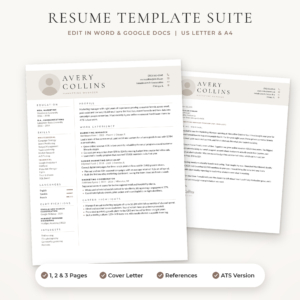
Sloane Resume Template
Price: $4.49 | Best for: A4 CVs with language skills
Sloane includes a 1-page resume with and without a photo, a 2-page resume, a 3-page CV, an ATS version, a cover letter and a references page, in Stone, Sage and Navy and in both A4 and US Letter. Language dots change by typing one symbol, and the round photo frame keeps its shape. Open the A4 folder, pick the photo version if your target country expects one and add your CEFR levels next to each language.
European CV habits that differ by country
There is no single European CV. Habits vary from country to country, and they keep changing. Treat these as general patterns, then check the job ad and a few local examples before you send anything.
Photos
Photos are common in German-speaking countries and in parts of southern and eastern Europe. They are less expected in the UK and Ireland, where many employers prefer no photo at all. Our guide to the resume with photo or without question goes into more detail.
Personal details
Some countries still see date of birth, nationality or marital status on CVs. Many others have moved away from it. Include only what the ad asks for or what local examples show as normal. Nationality can help when it relates to the right to work.
Length
One to two pages is the safe range across most of Europe. Academic CVs can run longer because they list publications and research.
Paper size
Always A4. A US Letter file printed in Europe may crop at the bottom or leave odd margins.
Marlowe gives you separate A4 and US Letter folders with photo and no-photo versions of each layout, which makes country-by-country changes quick.
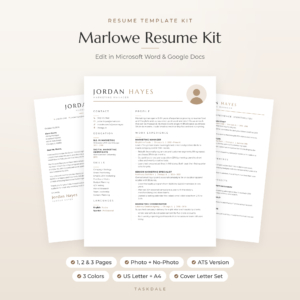
Marlowe Resume Template
Price: $4.79 | Best for: applying to more than one country
Marlowe includes 10 editable Word templates in Sand, Sage and Slate, each in A4 and US Letter: 1, 2 and 3 page CVs with and without a photo, an ATS version, a cover letter, references page and thank-you letter. Fonts are embedded so the layout holds when a recruiter opens the file. Keep one photo and one no-photo version ready so you can switch by country in a minute.
How to build a European-style CV in Word, step by step
- Set the page to A4. Layout, Size, A4. Do this before you type anything.
- Write a clear header. Name, phone with country code (for example +49), email, city and country. Add a LinkedIn URL if your profile is current.
- Decide on the photo. Use one if your target country expects it. Pick a plain background and a recent, professional shot.
- Add a short profile. Three lines on what you do, your years of experience and the kind of role you want in the new country.
- List experience newest first. Give the employer’s city and country, since the reader may not know it.
- Explain your qualifications. Add a short note if a degree or certificate is from another system, such as a three-year bachelor’s degree or a level 4 vocational qualification.
- Add languages with CEFR levels. Mother tongue first, then each language with its level and any certificate.
- Mention mobility and work rights. If you are an EU citizen or already hold a work permit, say so in one line.
- Save as PDF. Name it clearly, for example Marta-Kowalska-CV-2026.pdf.
Hollis is useful if you move between Word, Google Docs and LibreOffice, which is common on shared or borrowed computers abroad. Its fonts are built into every file, so nothing swaps out when you open it somewhere new.
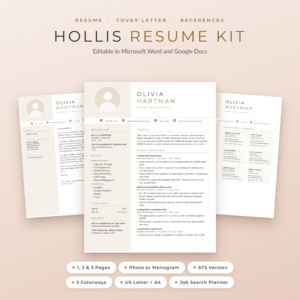
Hollis Resume Template
Price: $8.99 | Best for: job seekers working on many devices
Hollis comes in Champagne, Rosewood and Graphite, in A4 and US Letter, with photo and monogram CVs in 1, 2 and 3 pages plus a 1 and 2 page ATS version. It includes a cover letter, a references page with six reference cards, a thank-you letter and a Job Search Planner for Excel and Google Sheets. Start with the 2-page photo version if you are applying in a country where headshots are usual.
A worked example: one engineer, two CVs
Marta is a Polish process engineer with seven years of experience, applying to a food manufacturer in Germany and an EU-funded research traineeship in Belgium.
For the traineeship, the application form asked for a Europass CV. She built one on the official site, filled in every section, rated her languages on the full grid (Polish mother tongue, English C1, German B2) and kept it to three pages. Complete, standard and exactly what was asked.
For the German manufacturer, she used a two-page A4 CV with a professional photo. Her profile named the type of plant she had worked in and her German level. Her first job showed three results with numbers, including a line change that cut waste by 9 percent. Languages sat in a small sidebar with CEFR levels and her Goethe certificate.
Same person, same facts, two formats. Each one matched what its reader expected, and she felt more confident sending both because she knew why each looked the way it did.
Mistakes to avoid with a European CV
- Using Europass when nobody asked for it. For a private company, a tailored CV usually reads better.
- Letting it run to four pages. Cut older jobs to one line each and remove sections you do not need.
- Vague language levels. Replace fluent and basic with CEFR levels.
- Unexplained qualifications. A recruiter abroad may not know your national system. Add a short note.
- Forgetting references. Some European employers ask early. Have names ready, and see our references page guide for how to lay them out.
- Sending US Letter files. Switch to A4 before you export.
Frequently asked questions
Is Europass CV still used?
Yes. It is still offered free by the EU and is often requested for EU institutions, exchange programmes and some public sector roles. Many private employers accept any clear CV.
Do European CVs need a photo?
It depends on the country. Photos are common in German-speaking countries and parts of southern and eastern Europe, and less expected in the UK and Ireland.
How do I show language skills on a European CV?
Use CEFR levels from A1 to C2, list your mother tongue first and add any certificate, such as a Goethe or DELF exam, next to the level.
How long should a European CV be?
One to two pages for most jobs. Academic and research CVs can be longer because they include publications.
Can I make a Europass-style CV in Word?
Yes. Use an A4 template, add CEFR language levels and give clear context for your qualifications. If an employer asks specifically for Europass, build it on the official Europass website.
Your next step
Check the job ad for the words Europass or CV format. If it asks for Europass, build one on the official site. If it does not, set up an A4 CV with your CEFR language levels in the Sloane Resume Template and tailor the first job entry to the role.