Freelancers get asked for a CV more often than they expect. A recruitment agency wants one before putting you forward for a six-month contract. A large client’s procurement team needs one on file. A tender form says “attach CVs of key staff”. And sometimes, after years of invoices, you simply want a salaried job again.
The trouble is that a standard CV template is built for one employer at a time. Paste in 14 clients from the last three years and it looks like you cannot hold a job. The fix is mostly structure: how you group the work, where the projects go, and what you lead with.
This guide shows you how to lay out a freelance CV, with a worked example for a designer and a bookkeeper, plus the template features that make the job easier.
Quick picks: templates with room for project work
| Product | Best for | Price | Link |
|---|---|---|---|
| Sloane Resume Template | Freelancers who need a projects and talks page | $4.49 | View |
| Marlowe Resume Template | Consultants listing selected projects and tools | $4.79 | View |
| Hollis Resume Template | A monogram header instead of a photo | $8.99 | View |
| Alder Resume Template with Photo | Contract workers who want a job tracker too | $4.79 | View |
Why a freelance CV needs a different shape
An employed person’s CV tells a simple story: job, job, job, each one a step up. A freelancer’s story is a body of work. Lots of short engagements, overlapping dates, some clients you worked with for a week and one you have served for four years.
If you list every client as a separate job, three things go wrong. The page fills up with dates. The reader sees a pattern of short stays and assumes the worst. And your best work, the project you are proud of, gets the same two lines as a one-day fix.
So you flip it. You become the employer. One entry covers your whole freelance period, and the detail sits underneath it as projects and results.
The core structure, step by step
1. Header and links
Name, phone, email, location, and one link to your work. A portfolio site, an online gallery, a code repository, or a single PDF of case studies. One link that works beats three that half work. Test it on your phone before you send anything.
2. A profile that names your niche
Three sentences. What you do, who you do it for, and how long you have done it. For example: Freelance brand and packaging designer with seven years of independent practice, working mostly with small food and drink producers. Projects range from a single label to full ranges of 40 products. Looking for a senior in-house design role or a long-term contract.
3. One umbrella entry for your freelance work
Write it like a job: Freelance Packaging Designer, self-employed, 2019 to present. If you trade under a business name, use that: Owner, Northfield Studio. Then a one-line summary of the work, followed by four to six bullets that cover your best projects.
4. Selected projects
This is where freelancers shine. Pick three to five projects and give each one a short block: client type (or name, if you have permission), what you were asked to do, what you delivered, and a result if you have one.
5. Earlier employed roles
Any salaried jobs before you went independent still count. Keep them brief if they were long ago.
6. Tools, qualifications and memberships
Software, certifications, professional bodies. For many freelance fields this is where an agency recruiter checks for keywords.
If you are building this in Google Docs, our step-by-step guide to making a resume in Google Docs covers the formatting side, from tab stops to saving a clean PDF.
Worked example: a freelance designer
Here is how the umbrella entry and projects might read for the designer above.
Freelance Packaging Designer, self-employed, 2019 to present
Brand, label and packaging design for around 35 small and medium food and drink producers.
- Redesigned a 22-product sauce range for a family producer, moving it from farmers’ markets into two regional supermarket chains.
- Built label templates that clients can update for seasonal flavors without a new design fee.
- Prepared print-ready artwork and managed proofs with six different printers.
- Kept a repeat client rate high enough that most new work now comes from referrals.
Selected project: craft brewery rebrand
Brief: a new look for a brewery’s core range of four beers and two seasonal cans. Delivered: logo refresh, can artwork, tap badges and a simple brand guide. Timeline: ten weeks from first call to cans on shelves.
Notice the result in the first bullet. You do not need exact sales figures. “Moved it into two regional chains” is a real outcome a reader understands at once.
A design like this needs room for a projects page. That is where a 2 or 3 page format earns its keep.
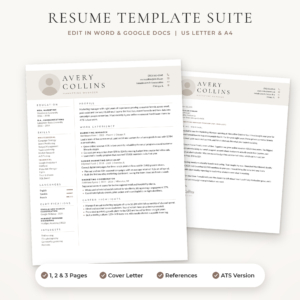
Sloane Resume Template
Price: $4.49 | Best for: freelancers with project-heavy careers
Sloane includes a 3-page CV with sections for projects, talks and references, alongside a 1-page and 2-page resume, an ATS version, a cover letter and a references page. Every file comes in Stone, Sage and Navy, in US Letter and A4, and opens in Word or Google Docs. Freelancers can rename the projects section to Selected Work and drop their three best case studies straight in.
Worked example: a freelance bookkeeper
Not every freelancer has a portfolio of pictures. A bookkeeper, translator, virtual assistant or IT contractor shows their worth through reliability and scope. The structure stays the same. The bullets change.
Self-employed Bookkeeper, 2020 to present
Monthly bookkeeping, payroll and year-end preparation for a steady list of 18 small businesses.
- Took over messy books for a café with 14 months of unreconciled bank lines and brought them up to date in five weeks.
- Ran monthly payroll for clients with between 2 and 25 staff.
- Prepared year-end packs that clients’ accountants accepted without rework.
- Set up simple cloud bookkeeping for six clients moving off paper and spreadsheets.
Client names are often confidential in this kind of work. That is fine. “A café with 14 months of unreconciled bank lines” tells the story without naming anyone. Ask before you name a client, every time.
Consultants and contractors in fields like this often need a page for tools and certifications, which a 2-page layout handles well.
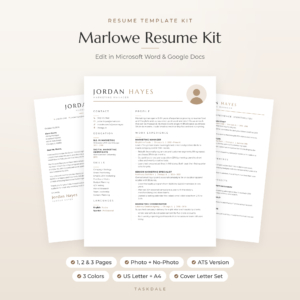
Marlowe Resume Template
Price: $4.79 | Best for: consultants, contractors and self-employed pros
Marlowe’s 2-page resume adds a second page for tools, certifications, awards, key achievements and selected projects, and the 3-page version adds references, memberships and professional development. You get 10 templates in Sand, Sage and Slate, in US Letter and A4, plus an ATS version and matching letters. The bonus Job Search Tracker in Excel and Google Sheets helps if you are pitching for several contracts at once.
Handling the awkward bits
Quiet months
Every freelancer has them. You do not need to explain a slow spring inside a single umbrella entry, because the entry runs continuously. That is one of the quiet advantages of the structure.
Overlapping clients
Do not list overlapping dates. Clients who ran at the same time all sit under the same entry. If one client took most of your time for a long stretch, mention it in a bullet: “Main contract for 18 months: weekly reporting for a regional charity.”
Very short gigs
Leave them out unless they show something unusual. Nobody needs to know about the logo you tweaked in an afternoon in 2021.
Going back to employment
Some hiring managers worry a freelancer will get bored or leave. Answer that quietly in your profile: say what you want from a permanent role (a team, bigger projects, steady work) and the worry fades. No need to apologize for having run your own business. You found clients, priced work and got paid. That is a real skill set.
If you have written quotes and proposals for clients, mention it. Pricing work is something most employees never do. Our guide on how to write a price quote is a useful refresher if you need to describe that process in an interview.
One CV, two audiences: agencies and direct clients
Freelancers usually send their CV to two very different readers, and it pays to keep a version for each.
The agency version
A recruitment agency is matching you against a client’s checklist. They search their database by keyword, then skim. Give them a 2-page CV with the skills section near the top, plain headings, and the exact tool names from the advert. Many agencies paste your CV into their own branded template, so a single-column ATS layout in Word saves them time and keeps your formatting from breaking.
The direct client version
A business owner hiring you directly cares less about keywords and more about whether you have solved their kind of problem before. Lead with the projects. Put a short line about your process under the profile: “I work in two-week rounds with a call at the end of each.” Keep it to one or two pages and send it as a PDF with your portfolio link live.
Keep both files in the same folder with clear names, such as CV-agency-2026.docx and CV-clients-2026.pdf. When an agency rings at 8 a.m. asking for an updated CV by lunch, you will be glad the work is already done.
References when you have no boss
Freelancers often panic about references. You have no line manager to ask. You do have clients, though, and long-standing clients often make better referees than a manager would, because they paid you with their own money.
- Ask two or three clients you have worked with for over a year.
- Tell them what role you are applying for so they can speak to the right skills.
- Include a subcontractor or agency you worked through, if you had one.
- Keep their details on a separate references page rather than on the CV itself.
Our guide to the resume references page covers who to list and how to format their details.
Photo, monogram or neither
Freelancers sell themselves as a brand more than most applicants, which makes the header a small design decision worth a minute of thought. A photo works where it is expected and where you meet clients in person. A plain name works everywhere. A monogram sits in between: it gives the page a finished, studio feel without putting your face on it.
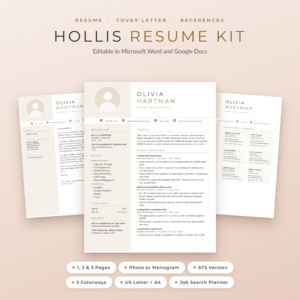
Hollis Resume Template
Price: $8.99 | Best for: freelancers wanting a branded header
Hollis comes with a photo version and a monogram version of its 1, 2 and 3 page resumes, so you can show your initials in a neat badge instead of a picture. The set includes an ATS resume, cover letters in both styles, a references page with six reference cards, a Job Search Planner and a Resume Writing Guide. Colorways are Champagne, Rosewood and Graphite, in US Letter and A4, with the fonts built into each Word file.
Mistakes freelancers make on CVs
- Listing every client as a job. Group them. Always.
- Using a trading name nobody recognizes. Add your role next to it: “Northfield Studio (freelance packaging design)”.
- Linking to a portfolio that is out of date. If your best piece is from 2018, the reader will assume you have stalled.
- Writing like a sales page. A CV is not your website. Cut the slogans and keep the facts.
- Forgetting the keywords. Agency recruiters search by skill. If the advert says “Excel” and “month-end close”, those words need to be on your page.
A last habit worth building: put a 30-minute slot in your calendar on the first Friday of each quarter to add new projects while they are fresh. Freelancers forget their own wins fast. That brewery job will feel like old news in six months, and you will struggle to remember the timeline or how many cans went out.
Frequently asked questions
How do I list freelance work on a CV?
Use one entry, such as “Freelance Copywriter, self-employed, 2020 to present”, then add bullets and a short selected projects section underneath. This keeps dates tidy and puts your best work up front.
Should I name my freelance clients?
Only with permission. Otherwise describe them by type and size, such as “a regional dental group with nine clinics”. The reader learns the scale without you breaking a confidence.
Is a freelance CV longer than a normal one?
Often it runs to two pages because of the projects section. That is fine. Keep page one strong enough to stand alone, since some readers stop there.
Do freelancers need a cover letter?
For contract roles through agencies, a short email often replaces it. For permanent jobs, yes. Use it to explain why you want to join a team after working independently.
What file format should a freelance CV be?
PDF in most cases, so the layout stays fixed. Some agencies ask for Word so they can add their logo, and an ATS-friendly Word version is handy to keep for that.
Your next step
Open a blank page and write your umbrella entry first: title, “self-employed”, start year, and a one-line summary of who you work for. Then pick your three best projects and give each one four short lines. Once that is done, pour it into a layout with a projects page, such as the Sloane Resume Template, and you will have a freelance CV you are happy to send.