A diet planner is only as good as the pages you actually fill in. Plenty of people buy a beautiful planner, log every bite for nine days, then leave it in a drawer with the rest of February. The problem is rarely the planner. It is trying to track too much, too often, in too much detail.
This guide shows you how to track the three things that matter most on a diet (meals, water and progress) without turning your evenings into data entry. You will learn what to log daily, weekly and monthly, see sample entries, get a two-minute routine, and find out which kind of planner suits the way you live.
It is for anyone following a diet or a weight goal who wants a simple paper or digital record, whether that is a single daily page on the fridge or a full year of weigh-ins in a binder.
Quick picks: planners for meals, water and progress
| Product | Best for | Price | Link |
|---|---|---|---|
| Calm Day Daily Planner | One page a day with meals, water and mood | Original price was: $2.49.$1.17Current price is: $1.17. | View |
| Petal & Pace Printable Weight Loss Planner | Food, workouts, water and weigh-ins in one journal | $1.33 | View |
| Scale Story 52-Week Weight Loss Tracker | A full year of weekly weigh-ins and a progress graph | $1.67 | View |
| Milestone Digital Weight Loss Planner | Tracking everything on a tablet | $4.49 | View |
The three layers of a good diet planner
Think of tracking in three layers, each with its own rhythm. Mixing them up is the main reason people quit. You do not need to measure your waist every morning, and you do not need to wait a month to log lunch.
| Layer | What you track | How long it takes |
|---|---|---|
| Daily | Meals and snacks, water, one or two habits, a quick mood or energy check | About 2 minutes |
| Weekly | Weigh-in, a short review of what worked, next week’s plan | About 15 minutes |
| Monthly | Body measurements, a progress graph, a look at the bigger trend | About 20 minutes |
Once you see it laid out like this, a planner stops feeling like homework. Most days you write a few lines and close it. The bigger look-backs come around on a calm schedule.
Tracking meals without driving yourself mad
The daily meal log is the heart of any diet planner, and also where most people overdo it. You have three levels to choose from. Pick one and stick with it for a month.
Level 1: Just write what you ate
Breakfast, lunch, dinner, snacks. No numbers. This alone makes many people eat more mindfully, because writing “three cookies from the break room” feels different from eating them.
Level 2: Add portions and how you felt
Note roughly how much, and a word on hunger or fullness. “Lunch: chicken salad, big bowl, still hungry at 3.” That one comment tells you lunch needs more protein or a planned snack.
Level 3: Add calories or macros
Useful if you are following a specific target, or if progress has stalled and you want to see why. It takes longer, so many people do it for two weeks, learn their portions, then drop back to Level 2.
A sample daily entry
- Breakfast: 2 eggs, 1 toast, coffee with milk. Full until 11.
- Snack: Apple.
- Lunch: Leftover chili with rice. Good.
- Snack: Yogurt at 3:30.
- Dinner: Fish tacos x2, slaw. Ate slowly.
- Extras: 2 squares chocolate.
That takes under a minute to write. A daily page with set boxes for each meal makes it even faster, because you are not staring at a blank page wondering where to start.
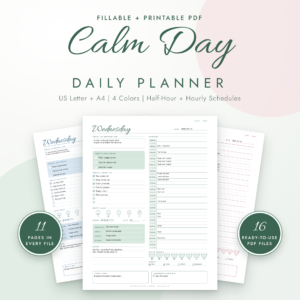
Calm Day Daily Planner
Price: Original price was: $2.49.$1.17Current price is: $1.17. | Best for: people who like one page per day
Calm Day is a printable and fillable daily planner with boxes for breakfast, lunch, dinner and snacks, an eight-glass water tracker, a habit tracker for four habits, three main goals, a to-do list, a mood and energy check, a sleep log and an hourly or half-hour schedule. You get 16 PDFs in US Letter and A4, in four colors including an ink-saving gray. Print a week of pages and keep them on a clipboard in the kitchen.
Tracking water the easy way
Water tracking sounds trivial, but many people are surprised how little they drink until they write it down. Picture an office worker who has one coffee at 8, a few sips at lunch and another coffee at 3. That is often the whole day.
Keep it simple:
- Use circles or drops. Most planners give you eight. Fill one in for each glass. Done.
- Tie glasses to moments. One on waking, one with each meal, one at each snack, one in the evening. That is already seven.
- Use the same bottle. If your bottle holds two glasses, fill in two circles each time you finish it.
- Do not chase a perfect score. Six circles on a busy day is still a good day.
Many people find that drinking a glass of water before reaching for a snack helps them notice whether they are hungry or just thirsty or bored. Logging it means you see the pattern over a week.
Tracking progress beyond the daily scale
Progress is where most diet planners either motivate you or crush you. Weighing every morning shows a jumpy line that moves with salt, water and sleep. Weighing once a week shows a clearer trend.
Weekly weigh-in
Same day, same time, similar clothes. Write the number, the change from last week and the running total. Then close the page and get on with your day.
Monthly measurements
Waist, hips, chest, and one thigh or arm. Measurements often move when the scale does not, especially if you are walking more or lifting weights. A flat scale week with a smaller waist is still a good week.
Non-scale wins
Write down one each week. Climbing the stairs at work without stopping. A belt on a new notch. A friend asking if you have done something different with your hair. These small wins are what keep people going through slow months.
For more on measurements and why they matter, our guide to fitness journal ideas: what to write, track and skip covers what is worth logging and what is just noise.
A planner built specifically for weight loss puts all of these in one place: food, water, workouts, weekly weigh-ins and monthly reviews.
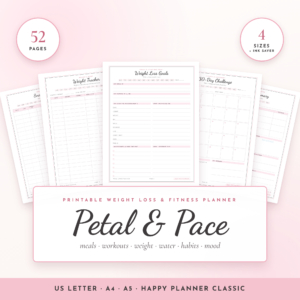
Petal and Pace Weight Loss Planner
Price: $1.33 | Best for: people tracking food and workouts together
Petal and Pace is a 52-page undated printable weight loss planner with a BMI and goal calculator, food and workout logs, water and sleep trackers, a 12-week weight graph, pound and kilogram counters, a fasting tracker, fitness tests, a weekly check-in and a monthly review. It comes in US Letter, A4, A5 and Happy Planner sizes, with a gray ink-saver version included. Print the weekly check-in first and set your weigh-in day.
Seeing the whole year at a glance
Weekly weigh-ins become much more useful when you can see a whole year of them in one place. A single week up by a pound looks like a disaster in isolation. On a graph with 20 weeks of steady downward drift, it looks like what it is: a blip.
Here is a worked example. Over 16 weeks, a person logs these changes: down 2.4, down 1.8, up 0.6, down 1.2, flat, down 1.4, down 0.8, up 0.4, down 1.6, down 1.0, flat, down 1.2, down 0.6, down 1.0, up 0.2, down 0.8. Read week by week, three of those weeks feel discouraging. Added up, it is a loss of 13.2 pounds in four months. The graph tells the honest story the individual weeks hide.
A dedicated 52-week tracker turns those numbers into a picture, and pairs nicely with a daily page for meals and water.
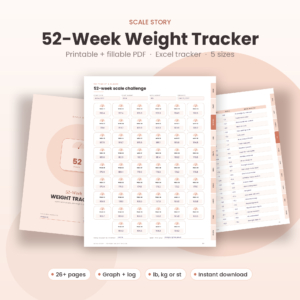
Scale Story 52-Week Weight Loss Tracker
Price: $1.67 | Best for: weekly weigh-in fans planning a full year
Scale Story gives you a full year of weekly weigh-ins as a printable PDF, a fillable PDF with clickable tabs and an Excel tracker that does the math. It includes a one-page 52-week scale challenge, a weekly log with change and running total, a progress graph, monthly body measurements, ten milestones with non-food rewards, a 100-bubble countdown, habit tracking, quarterly check-ins and a year in review. Sizes cover Letter, A4, A5, Half Letter and Classic. Log your starting weight and measurements on page one.
Paper, fillable PDF, spreadsheet or tablet?
The best format is the one you will open every day. Here is how they compare.
- Printed pages: Great for people who like to see the planner on the counter. Easy for the whole family to glance at. No battery, no notifications.
- Fillable PDF: Type into it on a laptop at lunch. Neat and searchable, and you can still print a page for the fridge.
- Spreadsheet: Best for people who love numbers, graphs and totals. Our guide to calorie and macro tracking in Google Sheets shows a no-app way that lasts.
- Tablet planner: Ideal if your iPad is always nearby. Tabs and links make it fast to jump between today’s log and the monthly review.
Some people mix formats: a printed daily page on the fridge for meals and water, and a spreadsheet or tracker for weekly weigh-ins. That works well as long as each thing lives in only one place.
Set up your planner in 30 minutes
A little setup on day one saves a lot of fiddling later. Here is a simple order.
- Write your why and your first goal on the first page. Keep the goal small and close, like the next five pounds or four weeks of logging.
- Record your starting point. Weight, measurements, and perhaps a photo you never have to show anyone.
- Choose your daily level for meal tracking: just food, food and feelings, or full numbers.
- Pick your weigh-in day and write it at the top of the weekly page.
- Print or open one week of daily pages only. Not the whole year. A small stack is less intimidating.
- Put it where you eat. A clipboard on the kitchen counter beats a binder on a bookshelf.
The two-minute daily routine
The secret to tracking for months is keeping the daily part tiny. Try this rhythm.
- Morning (30 seconds): Fill in the first water circle and write breakfast.
- Midday (30 seconds): Log lunch and any snacks so far.
- Evening (60 seconds): Log dinner, finish the water circles, tick your habits, and write one line about how the day went.
If you miss a day, leave it blank and carry on. A planner with a few gaps that you use for six months is far more useful than a perfect one you abandon in week two. There is real pride in flipping back through months of pages and seeing how far you have come.
Adjusting the planner to your way of eating
The same planner can serve very different diets. You just change what goes in the boxes.
Calorie counting
Add a small number next to each meal and a daily total at the bottom. Keep the water and habit boxes as they are. Review the weekly average rather than any single day, since a birthday dinner will always skew one day high.
Low carb or keto-style eating
Write a rough carb note beside each meal and use one habit slot for “vegetables at two meals” so the plate does not turn into just meat and cheese.
Intermittent fasting
Use the schedule column or a habit box to note your eating window, such as 11 am to 7 pm. Log meals as normal inside that window.
No rules, just eating better
Track meals in words, water in circles, and two habits like “cooked dinner at home” and “walked 20 minutes”. Many people find that simple combination enough to see real change over a few months.
Common tracking mistakes
- Logging only good days. The tough days hold the most useful information.
- Tracking ten habits. Pick two or three. Water and a daily walk are a great start.
- Weighing daily and reacting to every change. Weekly is calmer and clearer.
- Using the planner as a judge. It is a notebook, not a report card. Write facts, not guilt.
- Never looking back. The weekly and monthly reviews are where tracking pays off. Skip them and the daily logs are just a diary.
Frequently asked questions
What should I track in a diet planner?
Daily meals and snacks, water and one or two habits. Then a weekly weigh-in and review, and monthly body measurements. That covers most of what you need without overload.
How do I track water intake on paper?
Use a row of eight circles or drops and fill one in per glass. Linking glasses to moments, like waking, meals and snacks, makes it automatic.
Is it better to track food on paper or in an app?
Either can work. Paper suits people who like a visible, quiet record without notifications. Apps and spreadsheets suit people who want automatic totals and graphs.
How often should I weigh myself when tracking progress?
Once a week, on the same day and time, is enough for most people. Pair it with monthly measurements for a fuller picture.
What if I forget to fill in my planner?
Leave the gap and start again with the next meal. Consistency over months matters more than a perfect record.
Your next step
Print or open one week of daily pages tonight and put them where you eat. Tomorrow, log breakfast, lunch, dinner and water, nothing more. After seven days, do your first weekly review and add a weigh-in. If you want a calm single page with meals, water and habits already laid out, start with the Calm Day Daily Planner.