A home budget template for rent, utilities and food starts with the three costs that eat most of a household’s money. Get those three right and the rest of the budget usually falls into place. Get them wrong and no amount of skipping lattes will fix it.
Each of the three behaves differently. Rent is fixed and huge. Utilities bounce around with the seasons, so a $70 electric bill in May can turn into $190 in January. Food is the one you can steer week by week, which makes it the most useful line to manage and the easiest one to let slide.
This guide shows you how to set up each line, smooth out seasonal bills, set a grocery number you can stick to, and split costs fairly if you share a home. There is a worked example for three housemates, a section on what to do when the big three are simply too big, a short weekly check-in and a list of mistakes. Your own numbers will differ; the method is what carries over.
Quick picks for a rent, bills and food budget
| Product | Best for | Price | Link |
|---|---|---|---|
| PennyPetal Budget Planner Spreadsheet | Rent and utility bills by paycheck, with a bill tracker | $4.99 | View |
| Pantry to Plate Meal Planner | A weekly food budget tied to your meal plan | $14.99 | View |
| Fresh Week Meal Planner Printable Bundle | A paper grocery list with budget and total boxes | $2.99 | View |
Why a home budget starts with the big three
For many renters, housing, utilities and food together take well over half of take-home pay. That means a small change in one of them, like moving to a cheaper plan for internet or cutting takeout from three nights to one, often matters more than trimming a dozen small purchases.
So build your template in this order: income first, then rent, then utilities, then food. Only after those four are in do you add transport, debt payments, savings and everything else. You will see straight away how much is left for the rest of life, and whether the big three need work.
If you have never set up a budget before, our walkthrough on how to make a budget when you have never made one covers the very first steps.
Line one: rent or mortgage
This one looks simple, but there is usually more in it than the rent check. Add every housing cost that comes with the place:
- Rent or mortgage payment
- Renter’s or home insurance
- Property tax, if not included in the mortgage
- HOA or building fees
- Parking space or garage
- Storage unit, if you keep one because the apartment is small
A renter paying $1,350 might find the true housing cost is $1,465 once insurance and a $90 parking spot are counted. That $115 matters.
Is your rent too high?
A common rule of thumb is to keep housing near 30 percent of gross income. Plenty of people in expensive cities pay far more, and that is a fact of life, not a personal failure. The point of the template is to show the real share, so you can plan around it: if rent is 45 percent of take-home pay, the food and utility lines have to be tighter, and you know that going in.
Line two: utilities, smoothed across the year
Utilities trip people up because they change month to month. List each one separately:
- Electricity
- Gas or heating oil
- Water, sewer and trash
- Internet
- Phone
- Streaming, if you count it as a household bill
How to smooth seasonal bills
Find your last 12 months of electric and gas bills. Add them up and divide by 12. That monthly average goes in the template. In cheap months, the difference goes into a “utilities buffer” pot. In expensive months, you draw from it.
| Month | Electric bill | Budgeted | To or from buffer |
|---|---|---|---|
| May | $70 | $115 | +$45 |
| August | $140 | $115 | -$25 |
| October | $85 | $115 | +$30 |
| January | $190 | $115 | -$75 |
Many utility companies offer a “budget billing” or level-pay plan that does this for you. Worth a phone call. Either way, January stops being a shock.
Small utility wins
- Call your internet provider once a year and ask about current plans; prices for new customers are often lower.
- Wash clothes on cold and run the dishwasher only when full.
- Check whether your phone plan’s data allowance is far more than you use.
Tracking bills by due date in a spreadsheet, with each one marked paid or due soon, takes the worry out of the month. A planner that works by paycheck also helps when rent leaves on the 1st and pay lands on the 15th and 30th.
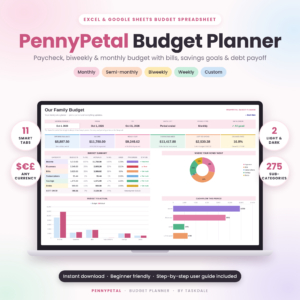
PennyPetal Budget Planner Spreadsheet
Price: $4.99 | Best for: renters juggling bills and paydays
A budget planner for Excel and Google Sheets that works with monthly, semi-monthly, biweekly, weekly or custom pay periods. Plan income and spending per period, log real transactions, and the Bill Tracker sorts every bill, subscription and debt payment by due date and marks each one Paid, Due soon or Overdue. It also has sinking funds, a debt payoff plan and starter categories. Choose your pay period first, then add rent and each utility to the Bill Tracker.
Line three: food, the line you can steer
You cannot cut rent this month. You probably cannot cut the water bill much either. But you can change what you spend on food by next Saturday. That makes it the most powerful line in the template.
Find your real number
Add up groceries, takeout, delivery, work lunches and coffee for the last two months. Divide by two. Split it into “groceries” and “ready-made food.” That split shows you where to start. A household spending $580 a month on food, with $190 of that on delivery, has an easy first target.
Set a weekly grocery number
Monthly grocery budget divided by 4.33 gives a weekly shop. Write that number at the top of every grocery list. It is hard to overspend a number you can see.
Plan meals before you shop
A meal plan is a budget tool. When you know what is for dinner, you buy for those meals and nothing else, and the takeout menu stays in the drawer. Plan dinners that share ingredients, use what is already in the cupboard, and put the cheapest meals in the week before payday.
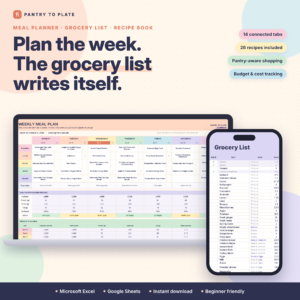
Pantry to Plate Meal Planner
Price: $14.99 | Best for: households who want a food budget that holds
An Excel and Google Sheets meal planner with 14 tabs. Plan 7 days by 5 meal slots, and it builds the grocery list, subtracts what is already in your fridge, freezer and cupboards, rounds to whole packs and prices the list against your weekly food budget before you leave home. It also flags food about to expire on the dashboard. Enter your weekly food number first, then plan one week.
A worked example: three housemates, one home budget
Sharing a home adds a layer: who pays what. Here is one way three housemates might run it. Rent is $2,400 for a three-bedroom flat. One room is bigger with its own bathroom.
| Cost | Monthly total | Alex (big room) | Sam | Jordan |
|---|---|---|---|---|
| Rent | $2,400 | $900 | $750 | $750 |
| Electric and gas (12-month average) | $150 | $50 | $50 | $50 |
| Water and trash | $60 | $20 | $20 | $20 |
| Internet | $66 | $22 | $22 | $22 |
| Shared groceries (staples, cleaning) | $90 | $30 | $30 | $30 |
| Each person’s share | $2,766 | $1,022 | $872 | $872 |
Personal food sits in each person’s own budget. Only shared basics like oil, salt, toilet paper and dish soap go in the shared pot. That keeps arguments about who ate the last yogurt to a minimum.
Rules that keep shared budgets friendly
- Agree the split in writing on day one, including what counts as shared.
- Pay shared bills from one account or one person, then settle up on the same date each month.
- Use the 12-month utility average so nobody pays more just because they moved in during winter.
- Review the split if someone starts working from home full time; their heating and power use goes up.
Couples face a similar question with different stakes. Our guide on how to budget as a couple compares 50/50 with splitting by income.
Keeping the grocery line steady week to week
The monthly template sets the food number. The weekly grocery list is where you hit it or miss it. A few habits make a real difference.
- Write the budget at the top of the list. Then an estimate next to each item.
- Check the cupboard first. Two minutes at the pantry saves buying duplicates.
- Keep a staples checklist. Tick what is low instead of trying to remember.
- Log the actual total when you get home. Over the month, these totals become your real food line.
A printed grocery list with budget, estimate and actual boxes, kept with a weekly meal plan on the fridge, is a simple way to do this without opening a laptop.
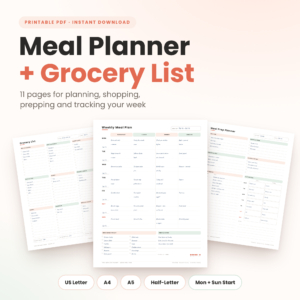
Fresh Week Meal Planner Printable Bundle
Price: $2.99 | Best for: pen and paper grocery budgeters
Eleven printable pages in US Letter, A4, A5 and Half-Letter PDFs, each in Monday and Sunday start. The Grocery List has nine labeled store sections with a checkbox on every line plus budget, estimate and actual total boxes, and you also get a weekly meal plan, a 72-item Master Shopping Checklist and a Pantry, Fridge and Freezer Inventory. Print the meal plan and grocery list as a pair each week.
A 10-minute weekly check-in
A monthly template only works if you look at it more than once a month. Pick one evening, say Sunday after dinner, and spend ten minutes on these four questions.
- Did any bill leave this week? Tick it off and check the amount matched what you planned.
- What did food cost this week? Add up receipts and any delivery orders. Compare with the weekly number.
- Is a big bill due next week? Make sure the money is sitting in the right account.
- Anything to move? If food ran $25 over, trim next week’s plan with a cheaper dinner or two.
That short habit catches problems while they are small. A $25 slip in week one is easy to fix. Four of them, found on the 30th, is a $100 hole and a lot more stress. Most people find the check-in gets quicker and calmer each week, and there is a quiet pride in seeing the lines stay on track.
When the big three are simply too big
Sometimes the template shows a hard truth: after rent, utilities and food, there is not enough left. That is useful information, even if it stings. Here are the levers, roughly from quickest to slowest.
- Food: plan meals, cut delivery, shop with a list and a number. Changes show up within weeks.
- Utilities: call providers about cheaper plans, drop unused services, ask about level billing.
- Shared costs: a housemate or lodger, if your lease allows it, can change the picture a lot.
- Rent: at renewal time, ask about the rate, compare nearby listings, or plan a move to a cheaper area.
None of these is fun. But knowing the numbers means you choose the change, rather than having a bounced payment choose it for you. If you prefer to set this up in Google Drive, see how to set up a Google Sheets budget template in one evening.
Common mistakes with a home budget
- Using one month’s utility bill. Use a 12-month average or you will be short in winter.
- Forgetting housing extras. Insurance, parking and building fees belong in the housing line.
- Leaving food as one lump. Split groceries from takeout or you will not see where it goes.
- No buffer. Leave a small amount unassigned each month for the bill you forgot.
- Setting it up once and never checking. Ten minutes a week keeps it true.
Frequently asked questions
What should a home budget include?
Income, housing costs, each utility, groceries, eating out, transport, debt payments, savings and everyday spending. Start with rent, utilities and food, since they are usually the largest.
How do I budget for utilities that change every month?
Average the last 12 months of bills and budget that amount monthly. Put the extra from cheap months into a buffer and use it in expensive ones, or ask your provider about a level-pay plan.
How much should I spend on groceries each month?
It depends on household size, location and diet. Start from your own last two months of spending, then aim a little lower with a weekly meal plan and a shopping list.
How do roommates split utilities fairly?
Most split utilities equally and rent by room size. Use a 12-month average so seasonal bills are shared fairly, and agree in writing what counts as a shared cost.
What is the easiest budget template for beginners?
One with a few clear sections: income, bills, food, savings and other spending, with planned and actual columns. A spreadsheet that totals for you is easiest to keep up; a printable suits people who prefer a pen.
Should I budget rent from one paycheck or split it?
If you are paid twice a month, many people set aside half the rent from each paycheck in a separate account. That way the full amount is ready on the 1st without draining one paycheck completely.
Your next step
Find your last 12 electric and gas bills and work out the monthly average. Then add your full housing cost and your real two-month food spend. Those three numbers are the core of your home budget. To track rent and utilities by due date, set up the PennyPetal Budget Planner Spreadsheet.