A macro meal planner turns three numbers into real meals. Protein, carbs and fat each get a daily target in grams, and the planner shows how close each breakfast, lunch and dinner brings you. Instead of guessing whether today had “enough protein”, you see it. Instead of wondering where the calories went, you can point to the line.
This guide is for anyone who has heard about counting macros and wants a calm, practical way to start: gym-goers, people losing weight who want more than a calorie count, and keto or high-protein eaters who need their split to line up. You will learn what each macro does on the plate, how to turn percentages into grams, how to build meals protein first, a sample day with the numbers worked out, and which spreadsheets do the adding for you.
Quick picks: macro meal planners and trackers
| Product | Best for | Price | Link |
|---|---|---|---|
| MacroBloom Macro Meal Planner Spreadsheet | Targets, a 4-week planner and recipes in one file | $27.95 | View |
| Platewell Calorie & Macro Tracker Spreadsheet | Households tracking macros for up to 4 people | $9.99 | View |
| SlimBloom Weight Loss & Fitness Planner | Macros alongside workouts and weigh-ins | Original price was: $2.99.$1.19Current price is: $1.19. | View |
| Sear & Sprig Keto Meal Planner | A low-carb split with menus already counted | $8.99 | View |
Protein, carbs and fat: what each one brings
Every calorie you eat comes from one of three macronutrients, plus alcohol if you drink. Each one carries a fixed amount of energy per gram, which is what lets a planner turn grams into calories.
| Macro | Calories per gram | Where you find it | What it does on the plate |
|---|---|---|---|
| Protein | 4 | Chicken, fish, eggs, Greek yogurt, cottage cheese, tofu, beans, lean beef | Makes meals filling and supports muscle |
| Carbohydrate | 4 | Rice, oats, bread, potatoes, fruit, beans, milk | Main fuel for activity, brings fiber when you choose whole foods |
| Fat | 9 | Oils, butter, nuts, seeds, avocado, cheese, fatty fish | Adds flavor and keeps meals satisfying |
That 9 is worth remembering. A gram of fat carries more than twice the energy of a gram of protein or carbs. So a tablespoon of olive oil, at about 14 grams of fat, adds roughly 120 calories. A planner that shows fat in grams makes that very visible, very fast.
Finding your daily macro targets
Most macro planners start the same way. You enter your age, height, weight, sex and activity level. The spreadsheet estimates how many calories you burn in a day, then sets a calorie target for your goal, whether that is losing, maintaining or gaining.
Next comes the split: how those calories divide between protein, carbs and fat. Here are some common patterns people choose. They are starting points, not rules.
| Style | Protein | Carbs | Fat | Often chosen by |
|---|---|---|---|---|
| Balanced | 30% | 40% | 30% | Most beginners |
| Higher protein | 35 to 40% | 30 to 35% | 25 to 30% | People lifting weights or cutting |
| Lower carb | 30% | 20 to 25% | 45 to 50% | People who feel better with fewer starches |
| Keto | 20 to 25% | 5 to 10% | 65 to 75% | Very low-carb eaters |
Fiber and water often sit alongside the three macros in a planner. They do not carry many calories, but they make a big difference to how full and comfortable you feel. Fiber comes mainly from vegetables, fruit, beans, oats and whole grains, so a day built on those foods tends to hit it without much thought.
Pick one, follow it for three or four weeks, and see how you feel and how your weekly trend moves. Adjusting later is normal. If you want a ready-made keto month where the split is already built into the menus, the Sear and Sprig Keto Meal Planner counts net carbs, protein and fat for every meal.
Turning percentages into grams: a worked example
Percentages are easy to choose but hard to eat. You cannot put “30% protein” on a fork. So the next step is converting to grams.
Say your calorie target is 1,900 and you pick the balanced split.
- Protein: 30% of 1,900 is 570 calories. Divide by 4. About 143 grams.
- Carbs: 40% of 1,900 is 760 calories. Divide by 4. About 190 grams.
- Fat: 30% of 1,900 is 570 calories. Divide by 9. About 63 grams.
Those three gram figures are what you plan against. Spread across three meals and a snack, that is roughly 35 to 45 grams of protein per meal, which gives you a very clear picture of what each plate needs. A good macro planner does this math the moment you enter your stats, and shows what is left for the day after every food you add.
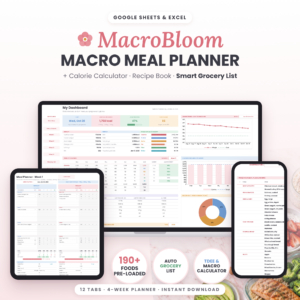
MacroBloom Macro Meal Planner Spreadsheet
Price: $27.95 | Best for: beginners setting macro targets
A spreadsheet for Google Sheets and Excel that calculates BMR and TDEE, then sets daily targets for calories, protein, carbs, fat, fiber and water across seven diet styles, from balanced and high protein to keto and low fat. It connects those targets to a four-week meal planner, a 40-card recipe book, a 190-food library and an aisle-sorted grocery list. Pick foods from a dropdown and the remaining macros update.
Plan meals protein first
Protein is usually the hardest macro to hit, and carbs and fat are the easiest to overshoot. So build every meal in that order.
- Choose the protein and size it to your per-meal target. Five ounces of cooked chicken breast gives roughly 40 to 45 grams.
- Add the carbs next, sized to what is left for the day. A cup of cooked rice is roughly 45 grams.
- Add vegetables freely. They bring fiber and volume with few calories.
- Finish with fat, measured. Oil, nuts, cheese and avocado add up quickly.
Working this way, the day almost balances itself. Most people who struggle with macros are building meals the other way round: a big pasta dish with a little chicken stirred in, then wondering why protein is short and carbs are over by dinner.
Eating out on macros
Restaurant meals do not have to wreck a macro day. Use the same order of thinking. Pick the dish with the clearest protein, such as grilled chicken, steak, fish or a burrito bowl. Ask for sauces and dressings on the side, since that is where most hidden fat lives. Then estimate the carbs by eye: a fist of rice or pasta, a bun, a tortilla. Log your best guess and move on. A rough entry is far more useful than skipping the meal in your log because you did not know the exact numbers.
A sample macro day, with the numbers
Here is one day planned against the 1,900-calorie balanced example. Figures are rough estimates, since brands and portions vary.
| Meal | Foods | Protein | Carbs | Fat |
|---|---|---|---|---|
| Breakfast | 1 cup nonfat Greek yogurt, 1/2 cup oats, 1 banana, 1 tbsp peanut butter | 33 g | 66 g | 11 g |
| Lunch | 5 oz grilled chicken, 1 cup brown rice, broccoli, half an avocado | 54 g | 60 g | 22 g |
| Snack | 1 oz almonds and an apple | 6 g | 31 g | 14 g |
| Dinner | 5 oz salmon, a medium sweet potato, green beans, 1 tsp olive oil | 36 g | 32 g | 20 g |
| Total | About 1,875 calories | 129 g | 189 g | 67 g |
Carbs are right on target. Fat is a few grams over. Protein is about 14 grams short. That is a typical first draft, and exactly why planning ahead helps. Swap the almonds for a string cheese and a hard-boiled egg, or add an extra ounce of chicken at lunch, and protein lands within range while fat drops back. A spreadsheet shows that gap before you shop, not at 9pm.
Hitting within about 5 to 10 grams of each target is a good day. Nobody hits all three exactly, and chasing perfection is the fastest way to give up.
Macro-friendly foods to keep on hand
Some foods make macros easy because they are mostly one thing. Keep a few from each column in the kitchen and building balanced meals gets much quicker.
| Mostly protein | Mostly carbs | Mostly fat |
|---|---|---|
| Chicken breast | Oats | Olive oil |
| White fish and shrimp | Rice and potatoes | Nuts and nut butter |
| Egg whites | Fruit | Avocado |
| Nonfat Greek yogurt | Whole-grain bread | Cheese |
| Low-fat cottage cheese | Beans and lentils (also some protein) | Seeds |
When a day runs short on one macro, reach for the matching column. Short on protein? Add cottage cheese or egg whites. Carbs low before a workout? A banana or a slice of toast. Fat is rarely short, but a spoon of nut butter fixes it.
Plan a macro week and the grocery list in one go
Daily logging is useful, but weekly planning is where macros get easy. Plan seven days at once and you can balance a high-carb Tuesday against a lighter Wednesday before you buy anything.
- Save five to eight go-to meals with their macros per serving.
- Drop them into the week, repeating freely. Most people eat the same breakfast four or five days a week.
- Check each day against your targets and nudge portions where needed.
- Let the planner build the grocery list from those meals, sorted by aisle.
- Batch cook proteins and grains on Sunday so weekday meals are assembly, not cooking.
Shared kitchens need a little more thought, because each person often has different targets. Our guide to the best weekly meal planner spreadsheet picks covers planners that write the grocery list for the whole household.
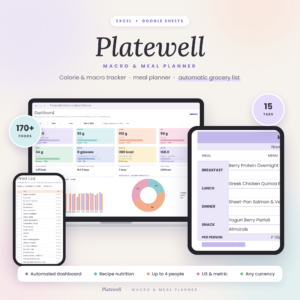
Platewell Calorie and Macro Tracker Spreadsheet
Price: $9.99 | Best for: couples and families counting macros
A calorie and macro tracker for Excel and Google Sheets that plans meals for up to four people, each with their own calorie, protein, carb, fat, fiber and water targets from a built-in goals calculator. More than 170 foods are preloaded, recipe nutrition is worked out from ingredients, and the shopping list is sorted by aisle minus pantry stock. A dashboard shows today, the last 14 days and weight change. Add each person’s stats first.
Macros, workouts and progress in one place
Many people counting macros also train. It helps to see food, workouts and weigh-ins side by side, because a heavy training week may call for more carbs, and a stalled scale may simply mean the weekly average crept up.
Weigh in once a week, same day, same time, and watch the four-week trend rather than any single number. If the trend is not moving the way you want after a month, adjust calories a little and keep the protein target steady. If you prefer to keep things very simple, our guide to a macro tracker spreadsheet without an app walks through a lighter setup.
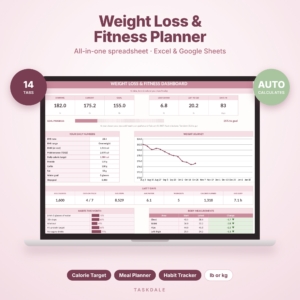
SlimBloom Weight Loss and Fitness Planner
Price: Original price was: $2.99.$1.19Current price is: $1.19. | Best for: people pairing macros with workouts
A 14-tab Excel planner where you enter your height, age, weight and goal, pick a pace and a macro style, and get a calorie target with protein, carb and fat grams. A daily log covers calories, macros, water, steps, sleep and mood for 366 days, with calories burned pulled in from the workout log. It also has a meal planner that builds a grocery list, 104 weekly weigh-ins and a dashboard with a projected goal date.
Common macro mistakes
- Chasing exact numbers. A range of 5 to 10 grams either side is a good day.
- Forgetting cooking oil. It is pure fat and easy to miss. Measure it.
- Using raw and cooked weights interchangeably. Pick one way to weigh meat and rice and stick with it.
- Back-loading protein. Trying to eat 80 grams at dinner is hard. Spread it across the day.
- Ignoring fiber. Two days with the same macros can feel very different if one is all refined carbs.
- Changing the split every week. Give one setup a month before judging it.
Frequently asked questions
How do I calculate my macros for weight loss?
Estimate your daily calorie needs, set a modest deficit, choose a split such as 30% protein, 40% carbs and 30% fat, and convert each share to grams. Protein and carbs have 4 calories per gram, fat has 9.
What is a good macro ratio for beginners?
Many beginners start with a balanced split of around 30% protein, 40% carbs and 30% fat, then adjust after a few weeks based on how they feel and how their weekly trend moves.
Do I need to hit my macros exactly?
No. Landing within about 5 to 10 grams of each target is a good day. Consistency over weeks matters far more than precision on any single day.
How much protein should I eat per meal?
Divide your daily protein target by the number of meals you eat. On a 140-gram target with three meals and a snack, that works out to roughly 35 to 45 grams per meal, with a smaller amount at the snack.
Can I plan macros in Google Sheets?
Yes. Macro meal planner spreadsheets for Google Sheets let you pick foods from a dropdown and see your remaining protein, carbs and fat update straight away.
What foods are high in protein but low in fat?
Chicken breast, white fish, shrimp, egg whites, nonfat Greek yogurt and low-fat cottage cheese are all good choices for adding protein without much fat.
Your next step
Work out your calorie target and pick a split, then convert it to grams using the method above. Plan tomorrow protein first, check the totals, and adjust one food to close the biggest gap. For a spreadsheet that sets your targets and builds a four-week plan and grocery list around them, start with MacroBloom.