If your bank balance hits single digits before payday, you need a budget. Not a strict one, not a perfect one. Just a plan that says where the next paycheck goes before it arrives. And if you are starting with no savings, no system and no real idea where last month’s money went, that is fine. Zero is a perfectly good place to begin.
This guide is for people starting from scratch: first job, fresh start after a breakup, a household that has always “just managed”, or anyone who opens their banking app with one eye closed. You will get a simple 30-day plan, a sample first budget for a $2,900 income, the small buffer that stops one surprise from undoing everything, and a few tools that make the adding up painless. (The phrase also happens to be the name of a well-known budgeting app. This article is about the idea, which works with any tool, including paper.)
Quick picks: tools for a first budget
| Product | Best for | Price | Link |
|---|---|---|---|
| Thriftwood Money Studio | A friendly app-style screen with no account | $12.99 | View |
| Seaglass Budget Planner | Excel users who like a guided start | Original price was: $19.99.$9.99Current price is: $9.99. | View |
| Cedarly Money Hub | Seeing debt, bills and paydays together | $19.00 | View |
| Ultimate Annual Budget Spreadsheet | Google Sheets on your phone | $6.00 | View |
Signs you need a budget right now
Most people do not decide to budget on a calm Sunday. Something nudges them. If two or more of these sound familiar, this is your nudge:
- You check your balance before buying groceries, and sometimes the card gets declined.
- A $90 car repair means borrowing or using a credit card.
- You are not sure what your rent, phone and insurance add up to each month.
- Payday feels great for three days, then tight for eleven.
- You have subscriptions you forgot about until the charge showed up.
- Money arguments at home keep circling back to “where did it all go?”
None of these mean you are bad with money. They mean the money has no plan, so it drifts. A budget is simply that plan, written down where you can see it.
What “starting from zero” really means
Zero can mean three different things, and it helps to know which one you are facing.
Zero savings
No cushion at all. Every unexpected cost becomes a crisis. This is the most common starting point, and the first goal is a small buffer, not a big emergency fund.
Zero system
You might have some savings, but no idea where spending goes. Money leaks through dozens of small purchases. Here the first goal is visibility: thirty days of honest tracking.
Zero knowledge
You have never made a budget and the words “sinking fund” mean nothing. That is fine too. You need about four ideas to get going, and you will pick them all up below.
Plenty of people are at zero on all three at once. Start anyway. The order of steps is the same.
Your first 30 days, week by week
Trying to do everything in one evening is how first budgets collapse. Spread it over a month instead. Each week has one job.
Week 1: Find your real numbers
Open your last two bank statements. Write down your take-home pay and every regular bill with its due date. Then add up roughly what went on food, fuel and eating out. Do not judge any of it yet. You are just counting.
Week 2: Write your first plan
Put next month’s income at the top. List bills, then food and transport, then everything else. Give each line an amount until income minus spending equals zero. If it does not balance, trim from the bottom of the list, not the top.
Week 3: Track every purchase
Log each purchase against its line, even the $3.50 coffee. Most people find one or two categories quietly eating far more than they guessed. That discovery alone is worth the effort.
Week 4: Review and adjust
Compare what you planned with what happened. Raise targets that were unrealistic, lower ones that had slack, and write next month’s plan with what you learned. Month two will be noticeably easier.
By day 30 you will not be perfect. You will, however, know your numbers. That is a huge step from zero.
A sample first budget on $2,900 a month
Here is how a first plan might look for a single person renting a room, with a car and a credit card balance. The numbers are an example, not a target.
| Line | Plan | Notes |
|---|---|---|
| Rent | $950 | Due on the 1st |
| Utilities share | $110 | Split with housemates |
| Phone | $55 | |
| Groceries | $380 | Weekly shop around $90 |
| Fuel and parking | $170 | |
| Car insurance | $125 | |
| Credit card minimum | $75 | Balance $1,900 |
| Starter buffer | $250 | Until it reaches $500 |
| Car repairs fund | $40 | Saved for the next tire or service |
| Toiletries and household | $60 | |
| Eating out and coffee | $140 | |
| Clothes | $50 | |
| Fun money | $120 | Spend it without guilt |
| Extra credit card payment | $375 | Every spare dollar for now |
| Total | $2,900 |
Notice two things. First, fun money is in there. A first budget with nothing for enjoyment is a diet that ends in a binge. Second, the extra card payment is large on purpose. Once the buffer hits $500 in two months, its $250 joins the card payment and the balance shrinks even faster.
The $500 starter buffer that changes everything
Before you attack debt seriously, before you save for a holiday, build a small cushion. Somewhere between $300 and $1,000, depending on your income. Many people pick $500 because it covers the usual small disasters: a car battery, a vet visit, a broken phone screen.
Why first? Because without it, the first surprise goes on a credit card, the budget falls apart, and you feel like you failed. With it, the surprise is just an annoying Tuesday. You pay it, rebuild the buffer over the next month, and carry on.
Keep the buffer in a separate savings account if you can, ideally one without a debit card. Out of sight is out of easy reach. The first time you pay a $180 repair bill from the buffer instead of a credit card, you will feel the difference in your shoulders. It is a quiet kind of pride.
Getting your first plan on screen
Paper works fine for a first budget. But if you know you will lose the paper, or the adding up puts you off, a tool that shows a live “left to assign” figure makes week two much easier. You type the numbers and watch the figure drop to zero.
For a complete beginner, look for three things: a clear place to put income, a list of categories you can rename, and one big number that tells you how much is still unplanned.
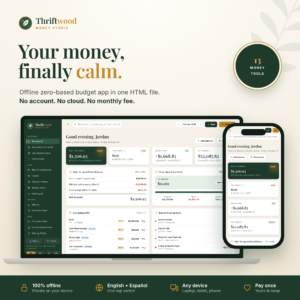
Thriftwood Money Studio
Price: $12.99 | Best for: beginners who want an app feel
Thriftwood is an offline budget app in a single HTML file that opens in your browser with no account and no bank login. It is built for zero-based budgeting, with a To assign counter that turns green at zero, a dashboard showing how much is safe to spend until payday, bills with due dates, savings goals and a debt payoff calculator. Add your accounts first, then build your first month category by category.
Whatever tool you choose, keep the first plan simple. Twelve to fifteen categories is plenty. You can split “household” into five lines next year if you really want to.
Tracking the first month without burning out
Week three is where most new budgeters drift. Logging every purchase feels tedious, and one missed day turns into a missed week. So make tracking as light as possible.
- Batch it. Log from your banking app twice a week instead of after every purchase. Monday and Thursday works well.
- Use the card more than cash. At least for the first month. Card spending leaves a trail; cash disappears.
- Keep categories broad. “Food” is fine. You do not need “snacks” and “lunches” as separate lines yet.
- Forgive missed days. Catch up from the statement. Nobody grades this.
A spreadsheet with a simple layout helps here, because you can see the whole month on one page and spot where the money is going without hunting.
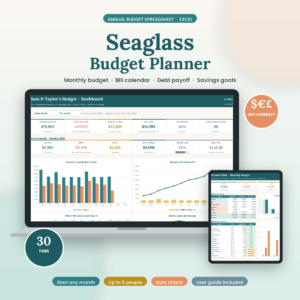
Seaglass Budget Planner
Price: Original price was: $19.99.$9.99Current price is: $9.99. | Best for: first-timers who like Excel
Seaglass is an annual budget spreadsheet for Excel with 30 tabs, a Start Here menu and about 15 minutes of setup. Each month shows budget versus actual for income, bills, subscriptions, expenses, debts and savings, and a dashboard highlights your top 10 spending categories and things that need attention. Fill in your categories and recurring bills first, then log spending a couple of times a week.
At the end of the month, look at the top three spending categories. That short list tells you more about your money than any article could.
When debt is part of your zero
Starting from zero often means starting below it. A credit card here, a car loan there, maybe a buy-now-pay-later plan for a sofa. Debt does not stop you budgeting. It just becomes one of the lines.
Keep it simple for the first few months. Pay every minimum on time, because late fees are pure waste. Then put any spare money on one debt at a time, usually the smallest balance for a quick win or the highest interest rate to save the most. If you want to see how the plan works month by month, the guide to the zero-based budget shows how debt fits into a plan where every dollar has a job.
Seeing all of it in one place helps more than people expect. When paydays, bills and balances sit side by side, the question stops being “can I afford this?” and becomes “which line does this come out of?”
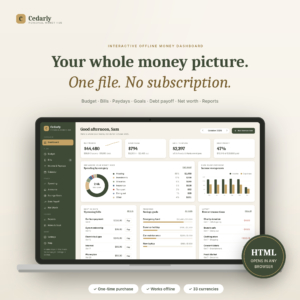
Cedarly Money Hub
Price: $19.00 | Best for: juggling debt, bills and paydays
Cedarly is an interactive budget dashboard in one HTML file that opens in your browser like an app, with nothing stored online. It links your bills, budget, paydays, debt payments and goals, so marking a bill paid updates the budget, the account balance and the reports at once. It suits beginners with several accounts or debts who want a real payoff date; start by entering accounts and paydays, then match bills to the payday that covers them.
Common first-budget mistakes
Everyone makes a few. Knowing them in advance saves a frustrating second month.
- Making it too strict. Cutting groceries to $200 when you have been spending $420 will not stick. Trim by $40 a month, not $220.
- Forgetting irregular costs. Birthdays, car registration, school supplies. If it happens every year, give it a small monthly line.
- Budgeting money you have not been paid. Overtime and bonuses get planned only once they land.
- Quitting after one bad week. Overspending is information, not failure. Move money from another line and keep going.
- Doing it alone when you share money. If you share bills with a partner, sit down together. Fifteen minutes on the 1st saves weeks of tension.
What month three looks like
It helps to know what you are working towards. By the end of the third month, most first-time budgeters notice a few changes. Bills stop being surprises because they are all on the list. The buffer has reached its target, or close to it. One debt balance is visibly smaller. And the panic before payday has eased, because there is a plan for exactly what that paycheck covers.
You will also find the routine shrinks. Week one took two hours. By month three, planning the month takes twenty minutes and tracking takes ten minutes twice a week. That is when budgeting stops being a project and becomes a habit. For more on the very first plan, our walk-through on how to make a budget when you have never made one covers the basics in a different way.
Frequently asked questions
How do I start a budget with no money saved?
List your take-home pay and bills, then plan next month’s spending line by line. Put a small amount, even $50 a paycheck, into a starter buffer until it reaches around $500.
Do I really need a budget if I earn enough?
A higher income hides leaks but does not stop them. A budget shows where money goes and makes sure savings and goals get funded before spending does.
What is the easiest budget for a complete beginner?
A simple zero-based plan with twelve to fifteen categories. Income at the top, every dollar given a job below, and a weekly check against your bank app.
How long does it take for a budget to start working?
Expect the first month to feel messy. By the second or third month, targets match real life and the plan starts to feel easy.
Should I pay off debt or save first?
Build a small buffer first so surprises do not land on a credit card. Then put spare money towards debt, while still paying every minimum on time.
Your next step
Tonight, open your last bank statement and write down your take-home pay and every bill with its due date. That is week one done in under an hour. When you are ready for week two, set up your first month in Thriftwood Money Studio and watch the To assign figure reach zero.