Being self employed means you are the boss, the sales team, the accounts department and the tax office’s favorite pen pal. Nobody withholds tax from your pay. Nobody sends a neat statement at year end. If you want your income and tax to stay in order, you have to build the system yourself.
Good news: it can be small. This guide sets out a simple system that works for freelancers, contractors, cleaners, tutors, makers and anyone else working for themselves. Three bank accounts, one weekly habit, a plan for quarterly tax and a short list of records to keep. The US examples use Schedule C and estimated tax dates, but the habits work anywhere.
Quick picks: spreadsheets for self employed income and tax
| Product | Best for | Price | Link |
|---|---|---|---|
| TallyBloom Tax-Ready Bookkeeping | Schedule C filers who want one complete file | Original price was: $19.00.$13.00Current price is: $13.00. | View |
| WriteOff Ready Tax Deduction Tracker | Catching every deductible expense | $17.99 | View |
| BalanceBloom Bookkeeping Spreadsheet | Sellers who collect sales tax | $24.99 | View |
| Petal & Profit Finance Planner | Freelancers who also send invoices | $9.99 | View |
Why going self employed feels messy with money
On a payroll, money arrives on the same day for the same amount, with tax already gone. Working for yourself flips all three. Payments land on random days, for random amounts, and every dollar still has tax inside it.
Picture a freelance photographer in her first year. September brings $7,800 from four weddings. She feels rich, replaces a lens and books a trip. January brings $900. Then April arrives with a tax bill for money she has already spent. Nothing went wrong with her work. Her system just did not exist yet.
The fix is not more effort. It is a little structure, set up once, that sorts money the day it arrives.
The three-account setup
Open three accounts, ideally at the same bank so moving money takes seconds. Many banks let you add extra savings pots inside one app at no cost.
1. Business income account
Every client payment, platform payout and cash deposit lands here. Business costs come out of here too: software, supplies, fuel, phone. Nothing personal touches it. This account becomes your clean record.
2. Tax account
A savings account you treat as already spent. The day a payment arrives, move a fixed share into it. Many self employed people start with 25% to 30% of each payment, then adjust after their first return. The right figure depends on your income, location and deductions, so check with an accountant or your tax agency if you are unsure.
3. Your pay account
Your normal personal account. Once a month, or every two weeks, pay yourself a set amount from the business account, like a salary. Bills, groceries and fun come from here.
The effect is quieter than it sounds. You stop guessing whether you can afford something, because the money in your pay account is genuinely yours. The tax account grows in the background. And the business account tells the plain truth about how the work is going.
One tip makes the tax transfer stick: give the account a blunt name in your banking app, like Not My Money or Tax Bill. It sounds silly. It works, because you stop seeing that balance as spare cash when a tempting purchase comes along.
Smoothing income that arrives in lumps
Irregular income is the hardest part of working for yourself. A steady personal paycheck solves most of it, but you need a cushion to make it work.
Here is how one freelance copywriter set hers up. Over the previous six months, after moving tax aside, her business earned an average of $4,600 a month. Some months were $7,000, one was $1,900. She set her own pay at $3,800 a month and left the difference in the business account. By month four she had a $3,200 buffer, enough to cover a slow month without touching savings.
Two rules keep this steady:
- Pay yourself less than your average. Around 80% is a comfortable starting point. The gap builds the buffer.
- Review every quarter. If the buffer passes two months of pay, give yourself a raise. If it shrinks for two quarters running, trim your pay or find more work before it runs out.
There is a real sense of calm the first time a quiet month arrives and your pay lands anyway. That is the system working.
What to record, and the 20-minute weekly habit
You do not need accounting software or a bookkeeper. You need a record of four things, kept every week.
- Income: date, client or platform, amount, and for US filers whether it will appear on a 1099.
- Expenses: date, supplier, category, amount, and whether you have the receipt.
- Business miles: date, from, to, purpose and distance, if you drive for work.
- Tax set aside: what you moved into the tax account and when.
Pick one slot each week, maybe Friday at 4pm, and spend 20 minutes on it. Open the business account, log every transaction since last week, snap photos of any paper receipts, and move tax money if you missed a transfer. That is it. Done weekly, it takes less time than a single coffee break. Left for a year, it eats a whole weekend in April.
Our guide to bookkeeping for freelancers breaks the weekly session down minute by minute if you want more detail.
A spreadsheet built for this does more than store the rows. It sorts expenses onto tax lines, adds up your miles and shows what to set aside before each due date.
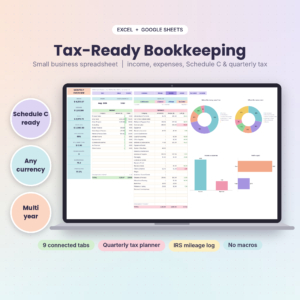
TallyBloom Tax-Ready Bookkeeping
Price: Original price was: $19.00.$13.00Current price is: $13.00. | Best for: US sole proprietors filing Schedule C
An Excel and Google Sheets workbook with 1,000 income rows and 1,000 expense rows, 26 expense categories already mapped to IRS Schedule C lines, a quarterly estimated tax planner and a mileage log that applies the right IRS rate by trip date. It tracks 1099 forms, business use percentages, missing receipts and up to 12 accounts. You get a blank workbook, a sample workbook with 10 months of example data and a 16-page guide. Explore the sample first, then enter your tax year and accounts in Setup.
Outside the US? TallyBloom’s income, expense, budget and account tabs work in any currency. Only the Tax Center and mileage rates are US-specific.
Quarterly tax without the panic
In the US, self employed people usually pay estimated tax four times a year rather than all at once. The usual due dates are April 15, June 15, September 15 and January 15 of the following year. Other countries have their own schedules, often twice a year, so check yours.
Because you set tax aside from every payment, each due date becomes a transfer, not a scramble. Here is a simple quarter for a self employed tutor:
| Item | Amount |
|---|---|
| Income, January to March | $11,400 |
| Business expenses | $1,650 |
| Profit for the quarter | $9,750 |
| Set aside at 28% of each payment | $3,192 |
| Estimated payment due April 15 | Worked out from profit with an accountant’s figure or the agency’s worksheet |
Notice the tutor set aside from income, not profit. That leaves a little extra in the tax account each quarter, which is a nice surprise at year end rather than a nasty one. It also covers the part many new freelancers forget: US self employed people pay self-employment tax for Social Security and Medicare on top of income tax.
For a deeper walk through amounts and dates, read quarterly estimated taxes: how much to set aside and when.
Deductions: the expenses that lower your bill
Business expenses reduce your profit, and profit is what you pay tax on. So every genuine business cost you record is money you keep. The trick is noticing them all.
Common ones for self employed people include:
- Software, apps and subscriptions used for work
- Equipment such as a laptop, camera or tools
- A share of your phone and internet, by business use
- Business miles or vehicle costs
- Home office costs, if you have a dedicated space
- Insurance, professional fees, training and licenses
- Advertising, website hosting and platform fees
- Business meals, which in the US usually count at 50%
Rules differ by country and change over time, so treat this as a starting list to check against your own tax agency’s guidance. The habit that matters is the same everywhere: record it the week it happens, and keep the receipt.
Small items are the ones that slip. A $14 parking fee here, a $9 app there. A dog groomer who forgets two of those a week misses well over $1,000 of expenses by December. Logging weekly catches them while the memory is fresh.
If you mainly want to catch every write-off and hand your accountant a clean report, a deduction tracker narrows the job to exactly that.
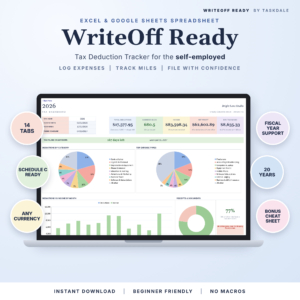
WriteOff Ready Tax Deduction Tracker
Price: $17.99 | Best for: freelancers who keep missing write-offs
A 14-tab Excel and Google Sheets workbook with 25 categories and 80 expense types. Pick one expense type, such as Client Meals, and the category, tax form and Schedule C line fill in on their own. It applies business use percentages and the 50% meals rule, and includes a mileage log, home office calculator, quarterly tax planner, missing receipts list and a printable report for your accountant. It comes with a 12-page guide and a deduction cheat sheet in US Letter and A4.
If you sell products and collect sales tax
Makers, market sellers and online shops have an extra layer. Sales tax you collect is not your income. It belongs to the state, and you hold it until you pay it over. Mix it into your revenue and your profit looks bigger than it is.
Track it in its own column from day one. A candle seller who takes $2,000 at a holiday market with 7% tax included has only about $1,869 of actual sales. The other $131 or so goes to the state. Keeping that split clear avoids an unpleasant surprise when the sales tax return is due.
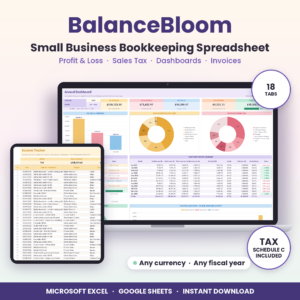
BalanceBloom Bookkeeping Spreadsheet
Price: $24.99 | Best for: makers and online sellers collecting sales tax
A bookkeeping workbook for Excel and Google Sheets with 2,000 rows each for income and expenses, 30 income and 30 expense categories, and 20 accounts you can rename. Sales tax can be included in the amount or added on top, with default rates per category and per-row overrides. Six dashboards, a printable profit and loss and a Tax Center update as you log. Set your tax rates and accounts first, then log one market or one week of orders.
Records to keep, and for how long
A tidy folder is half the battle if your return is ever questioned. Keep these together, digital or paper:
- Your income and expense log for each year
- Receipts and invoices, photographed or scanned
- Bank and card statements for the business account
- Your mileage log
- Copies of each tax return and every estimated payment confirmation
In the US, the IRS generally asks you to keep records for at least three years after filing, and longer in some cases. Many self employed people simply keep seven years to be safe. Name files by year and month, such as 2026-03-receipts, and finding anything takes seconds.
Who this system is not for
This setup suits sole traders and single-owner businesses with straightforward income. If you employ people, run payroll, hold lots of stock or have formed a company with a partner, you will likely need accounting software and a professional. The weekly habit still helps, but the tools will need to grow with you.
It also takes some honesty to run. The system only works if the tax transfer happens every single time, even in a tight week. Skip it twice and the pot falls behind. If that keeps happening, lower the percentage you set aside per payment but never skip it, then top it up when a big invoice clears.
For a side-by-side look at more options, see our comparison of the best bookkeeping templates for self-employed pros.
Frequently asked questions
How much should I save for taxes when self employed?
Many people start with 25% to 30% of each payment and adjust after their first return. Your real figure depends on your profit, deductions and where you live, so confirm it with an accountant or your tax agency’s guidance.
Do I need a separate bank account if I am self employed?
It is not always required for sole traders, but it makes record keeping far easier. One account for business money means your statements double as your books.
What records do self employed people need to keep?
Income records, expense receipts, bank statements, a mileage log if you drive for work, and copies of your returns and tax payments.
When are quarterly taxes due for self employed people in the US?
Usually April 15, June 15, September 15 and January 15. If a date falls on a weekend or holiday, it moves to the next business day.
Can I use a spreadsheet instead of accounting software?
Yes. For one-person businesses, a spreadsheet built around income, expenses, mileage and tax set-asides covers what you need, with no monthly fee.
Your next step
Open a second savings account today and name it Tax. Then move 25% of the last payment you received into it. That one transfer starts the whole system. When you are ready to log the rest, set up TallyBloom Tax-Ready Bookkeeping and enter this month’s income first.