A productivity planner printable is only as good as the pages you actually fill in. That sounds obvious, but most people pick planners the other way round: they buy the one with the most pages, print the lot, and abandon it by week three because there’s too much to keep up with.
So this roundup is about fit. Below are three printable planners from Taskdale, each built for a different kind of planner person. One goes from yearly goals down to the hour. One is eight pages and nothing more. One sits in the middle with focus sessions and a weekly scorecard.
First, a quick look at what to check before you print anything.
What a good productivity planner printable needs
- A link between big goals and today’s tasks. If your daily page has no idea what you’re aiming for this month, you’ll fill it with busywork.
- A weekly review page. This is the page that makes a planner productive rather than just tidy. Ten minutes on a Sunday, looking at what worked.
- Undated pages. You will skip weeks. Everyone does. Undated pages mean no guilt and no waste.
- Your paper size. Check that it comes in the size your printer and binder use, and that the margins leave room for punch holes.
- Typing option. Not essential, but it’s handy to type recurring commitments once and then print copies.
All three planners below tick those boxes. They differ in size, depth and style.
1. DayBright Printable Productivity Planner: best for goal-driven planners
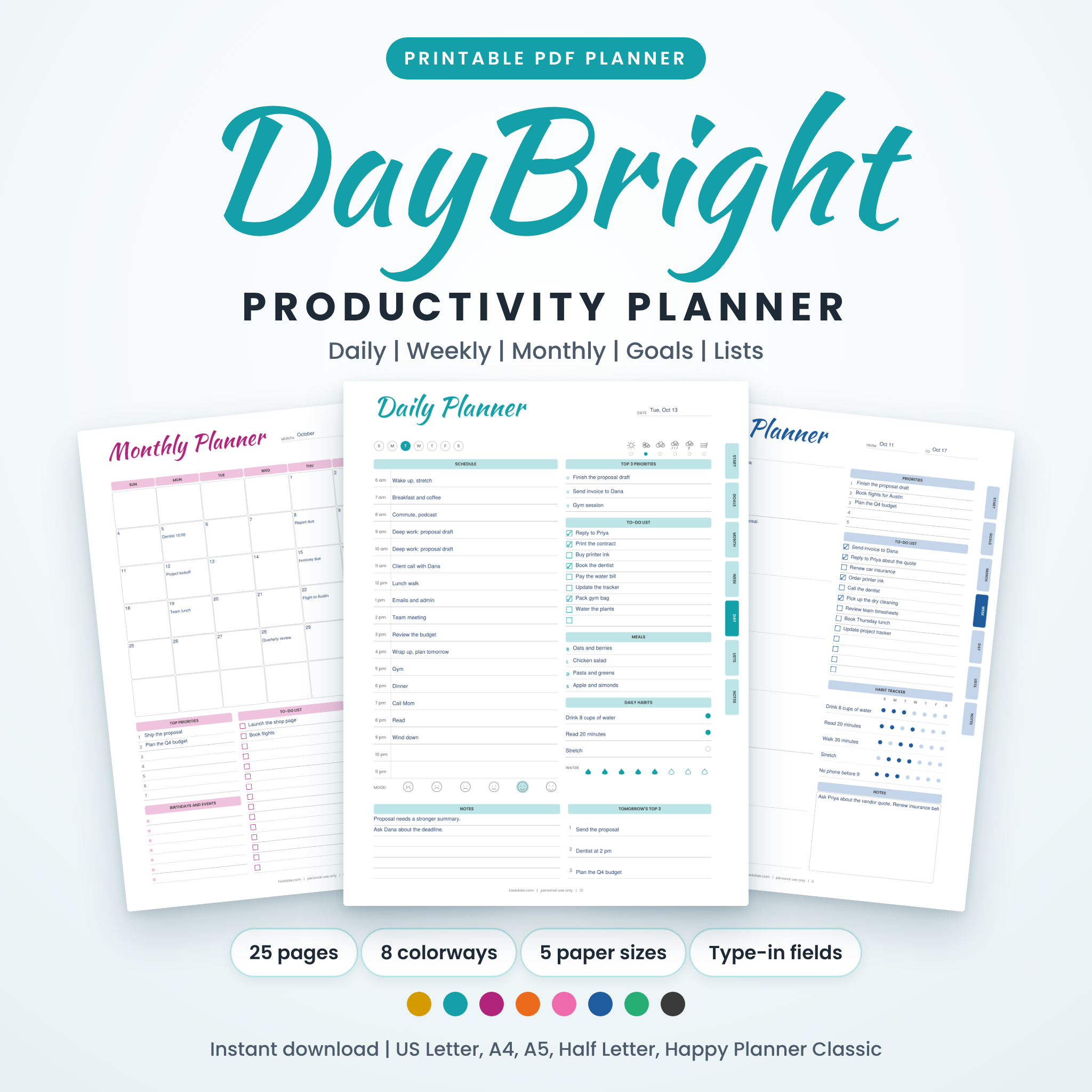
The DayBright Productivity Planner is the biggest of the three. It works from the top down: a year at a glance, then goals, months, weeks and single days. The idea is that what you do at 2 pm on a Tuesday traces back to what you want by December.
What’s inside:
- 25 page templates, including a Goal Planner where you break each goal into steps with due dates and a Goal Tracker with a progress bar
- Monthly planners (Sunday and Monday start), a Monthly Focus and Review page and a 14-habit monthly tracker
- Weekly planners plus a Weekly Review that rates energy, focus, productivity, mood and well-being from 1 to 5
- Daily pages with printed times (6 am to 11 pm) or blank times, a half-hour Time Block Planner with Plan and Actual columns, and a Daily Focus and Reflection page
- List pages: to-do, checklists, brain dump, priority matrix, project planner, meeting notes
- 8 colours (including a Graphite black and white option that saves ink) and 5 paper sizes, including Classic Happy Planner size
The Plan and Actual columns on the time block page are my favourite detail. Plan your day in half hours, then write what really happened next to it. After a week you’ll see exactly where the afternoon keeps going.
Who it suits: people with a clear goal (a business launch, a degree, a savings target) who want their daily pages tied to it. Also anyone who works odd hours, since the blank-time daily pages suit night shifts.
Who it doesn’t suit: someone who wants three pages and to get on with life. That’s the next one.
2. Everyday Focus Planner Set: best for minimalists
The Everyday Focus Planner Set is eight pages. That’s it. Daily Plan, Weekly Plan, Monthly Plan, Habit Tracker, Goal Planner, Weekly Review, Lined Notes and Dot Grid Notes. Every page has one job.
A few details that make it more useful than it sounds:
- The daily schedule runs 5 AM to 10 PM with a tall row for each hour and half-hour guides, so handwriting fits
- The monthly grid has six week rows, because some months spill into a sixth week
- The Goal Planner holds one goal per page with six milestones, weekly actions, obstacles and a 10-step progress bar
- The Weekly Review ends with a start, stop, keep section, which is a quick way to adjust without overthinking
- Comes in printable and fillable versions, Sunday or Monday start, in Letter, A4, A5 and Half Letter
Who it suits: first-time planners, people who’ve quit bigger planners before, and anyone who wants refill pages for an A5 binder they already own.
Who it doesn’t suit: anyone wanting lots of list pages or a project planner. It doesn’t try to be that.
3. Focus Planner Set: best for deep work and weekly scoring
The Focus Planner Set sits between the other two: 11 page types in three colours (Charcoal, Sage and Blush), each in printable and fillable form, across four paper sizes.
Its standout page is the Daily Focus. It’s built for days without a timetable. You write the one big thing, split tasks into morning, afternoon and evening, and track eight 25-minute focus sessions with circles. Then three wins and a short list for tomorrow. If you work in Pomodoro-style blocks, this page feels made for you.
The rest of the set:
- A Daily Plan with a half-hour schedule from 5:30 am to 10:00 pm, top 3 priorities and a 12-item to-do list
- Weekly Plan with a five-habit tracker, plus a Weekly Review where you rate the week from 1 to 10 and check each priority as done, partly or not yet
- Monthly Plan, a Monthly Goals and Review page, and a 14-habit tracker
Who it suits: freelancers, students in exam season and remote workers who need to protect blocks of focused time.
Who it doesn’t suit: tablet planners. It’s made for printing and typing in a PDF reader, not set up as a hyperlinked planner for note-taking apps.
Side by side
| DayBright | Everyday Focus | Focus Planner Set | |
|---|---|---|---|
| Page types | 25 | 8 | 11 |
| Colours | 8 | 1 design | 3 |
| Paper sizes | 5 | 4 | 4 |
| Goal tracking | Yearly, goal tracker | One goal per page | Monthly goals |
| Standout page | Time block with Plan vs Actual | Start, stop, keep review | Daily Focus with focus sessions |
Which one should you pick?
If you have a big goal this year and want every page pulling toward it, get DayBright. It’s the most complete, and the colour choice means you can colour-code sections (blue months, green weeks).
If you’ve started and quit planners before, get the Everyday Focus set. Fewer pages means fewer excuses. You can always add more later.
If your problem is distraction rather than organisation, get the Focus Planner Set. The Daily Focus page and its session circles do more for a scattered workday than any amount of scheduling.
Not sure? Start small. Most people overestimate how much planning they’ll do and underestimate how much a weekly review helps.
FAQ
What pages should a productivity planner have?
At minimum: a monthly calendar, a weekly plan, a daily page with priorities and a weekly review. Goal and habit pages are useful extras. Anything beyond that depends on your work.
Can I type into these printable planners?
Yes. All three have fillable fields you can type into using a PDF reader that supports forms, such as Adobe Acrobat Reader. You can then print the typed pages.
What size should I print my planner in?
Letter or A4 for a desk planner with lots of room. A5 or Half Letter for something portable that fits a smaller binder or disc planner.
Are these planners dated?
No. All three are undated, so you can start in any month and reprint pages as often as you need for personal use.