The first time I saw a junk journal, I thought it looked like a beautiful mess. Pockets stuffed with tags, old-looking paper, little cut-out roses, a ribbon hanging out the side. Then I learned the secret. Nobody makes one perfectly. That’s the whole point. If you want a junk journal for beginners, you don’t need a craft room, a stack of antique paper or a big budget. You need a printer, some glue and an afternoon.
This beginner junk journal guide walks you through the supplies, the folding, the page mix and the first mistakes everyone makes. And it shows four Taskdale kits that do the paper-hunting for you.
Quick picks: junk journal kits for beginners
| Product | Best for | Price | Link |
|---|---|---|---|
| Rosewater Keepsake Junk Journal Kit | A vintage rose look on a tiny budget | $0.79 | View |
| Strawberry Meadow Junk Journal Kit | A bright, sweet strawberry theme | $4.99 | View |
| Sage & Ember Autumn Junk Journal Kit | A no-sew autumn kit | $4.49 | View |
| Attic Letters Printable Junk Journal Pages | Vintage lined and blank pages | $2.89 | View |
What a junk journal actually is
A junk journal is a handmade book built from mixed papers, pockets, tags and bits of decoration. Some people fill it with writing. Some fill it with photos and keepsakes. Some just like making the book itself and never write a word. All of that is allowed.
The “junk” part comes from the old habit of reusing paper that would be thrown away: envelopes, book pages, ticket stubs, wrapping paper. Today many makers print their paper instead, which is cheaper, tidier and easier to repeat. A printable kit gives you the pages already designed, so you skip the hunting and get to the fun part.
Supplies for a junk journal for beginners
You really don’t need much. Here’s what I’d gather before you print a single page.
- A home printer and plain or lightly textured paper
- Scissors, plus a craft knife if you like clean edges
- A glue stick and some tape
- A needle and strong thread, or a stapler to start
- A cover: thin card, a cereal box front or an old book cover
That’s it. You can add a bone folder, washi tape, stamps and ribbon later. Resist the urge to buy a pile of tools first. Most beginners stop using half of what they buy by the second journal.
Which paper should you print on?
Standard printer paper works fine for a first try. It’s cheap, so a mistake costs you almost nothing. If your printer handles heavier stock, try it for pocket pages and covers. Thicker paper holds up to glue better. Thin paper is lovely for the inside pages, but it can ripple when wet.
Which size should you pick?
Kits like the ones below come in US Letter and A4, which suit most home printers. Print at actual size, not “fit to page,” or your pages will shrink and the layout will look off. Check that setting once and you’ll save yourself a pile of wasted sheets.
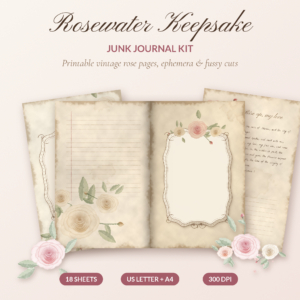
Rosewater Keepsake Junk Journal Kit
Price: $0.79 | Best for: a first junk journal with a vintage rose look
This printable kit lists vintage rose journal pages, ephemera, tags, bookmarks and fussy cuts. It comes as US Letter and A4 in PDF, JPG and PNG. At under a dollar, it’s the safest way to find out if you enjoy the craft before you spend more.
How to start your first junk journal, step by step
Don’t aim for a thick, bulging book. A small first journal of eight to ten folded sheets is plenty. It’s quick to finish, and finishing is what builds confidence.
- Print your pages and let the ink dry for a few minutes.
- Cut out the tags, bookmarks and loose pieces and keep them in an envelope.
- Fold your sheets in half. Nest a few together to make a bundle, called a signature.
- Poke holes along the fold and stitch the bundle together.
- Glue or stitch on a cover.
- Tuck in tags and pockets last.
Each step is small. You can do one at a time over a week. If a stitch looks crooked, leave it. Crooked stitches look handmade, and handmade is the goal.
Fussy cutting, ephemera and other words you’ll meet
Junk journal talk has its own vocabulary, and it can sound intimidating. It isn’t. Here’s the short version.
Ephemera means the small paper extras: labels, stamps, ticket-style pieces, scraps. Fussy cutting means cutting carefully around a picture, like a single rose, so you can stick it onto a page. Tags are the little paper labels you tuck into pockets. Pockets hold notes, photos or more tags. That’s about all you need to know.
The Rosewater kit lists fussy cuts, tags, bookmarks and ephemera in its title, so you get a taste of each. Cutting out a tiny rose with small scissors is oddly calming. Ten minutes in and you stop checking your phone.
A junk journal for beginners who like color
Some people want soft vintage. Others want something fresh and bright. If you’re in the second camp, a themed kit keeps your choices simple, because everything already matches.
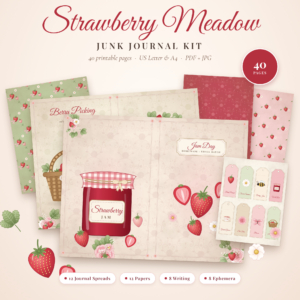
Strawberry Meadow Junk Journal Kit
Price: $4.99 | Best for: a cheerful, fruit-themed journal
The title describes printable strawberry journal pages, papers and ephemera. Because the pieces are designed as a set, you don’t have to worry about mismatched papers. It suits anyone who wants a bright, summery book without hunting for matching sheets.
Building a page mix that doesn’t feel boring
The trick to a good junk journal is variety. If every page looks the same, the book feels flat. Aim for a mix: a full pattern page, a plain page for writing, a pocket page, a page with a tag tucked in. Alternate busy with calm.
A simple rule helps. After a busy page, put a quieter one. Think of it like seasoning. A little goes a long way, and too much covers the taste. I like to place one pocket page every three or four pages, so there’s always somewhere to slide a note.
What to write in it
You don’t have to write at all. But if you want to, start small. Date a page. Write down what you ate on a good day. Copy a line from a song. Stick in a receipt from a trip. Junk journals are good at holding the little things that normal diaries skip.
Binding options when you have no tools
Stitching sounds scary until you try it. A pamphlet stitch uses a single thread and about three holes. You push a needle through the fold from the inside, come back through the middle hole, and tie off. Five minutes, tops. If sewing really isn’t your thing, a stapler on the fold does the job, and you can hide the staples under a strip of washi tape or a paper band.
Some beginners like loose pages in a clip or a small ring binder. It’s the lowest-pressure route, because you can swap pages whenever you like. A first junk journal for beginners doesn’t have to be a bound book at all. It can be a handful of pages in a folder, and you can bind them later when you feel braver.
Setting up a small workspace
You don’t need a desk. A kitchen table and a tray work well. Put down a sheet of scrap paper so glue doesn’t mark the surface. Keep a bowl for trimmings and a small envelope for the good scraps. Play something you like in the background. The best sessions I’ve had were short ones, about forty minutes, with a cup of tea going cold on the side.
Work in small batches. Cut on one day, glue on another, and stitch on a third. It keeps the craft from feeling like a chore, and it means you can stop at any point without leaving a mess. Set a timer if you tend to lose an hour without noticing. Or don’t. Losing an hour to paper and glue is not the worst way to spend an evening.
Ideas to fill your first pages
Staring at a blank page is the hardest part, so borrow a few starters. Glue a pocket and slip in a handwritten note to your future self. Add a page of three small wins from this week. Cut out a tag and write a quote you love. Tuck a bookmark in the spine and use it as a real bookmark. None of this needs fancy handwriting. Messy writing makes the page feel lived in, and that’s the look people love.
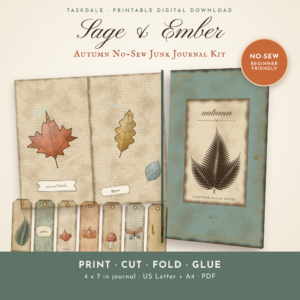
Sage & Ember Autumn Junk Journal Kit
Price: $4.49 | Best for: a no-sew fall junk journal
The title describes a printable no-sew fall junk journal with 16 journal spreads, 18 ephemera sheets, tags and pockets, as an instant download PDF. No sewing means you can glue and fold your way to a finished book, which suits a first project or a busy weekend.
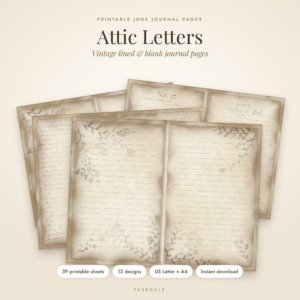
Attic Letters Printable Junk Journal Pages
Price: $2.89 | Best for: vintage letter-style pages for writing
The title lists 39 vintage lined and blank journal sheets with cards, tags and pockets, in US Letter and A4 as an instant download. The mix of lined and blank sheets gives you room to write letters and notes as well as to decorate.
Comparing the four kits
| Product | Format | Price | Best for | Link |
|---|---|---|---|---|
| Rosewater Keepsake Junk Journal Kit | Printable, US Letter and A4, PDF, JPG, PNG | $0.79 | Vintage rose pages, tags, bookmarks and fussy cuts | View |
| Strawberry Meadow Junk Journal Kit | Printable pages, papers and ephemera | $4.99 | A bright strawberry theme | View |
| Sage & Ember Autumn Junk Journal Kit | Printable no-sew kit, PDF | $4.49 | Autumn spreads, ephemera, tags and pockets | View |
| Attic Letters Printable Junk Journal Pages | 39 printable sheets, US Letter and A4 | $2.89 | Vintage letters, lined and blank pages | View |
Junk journal for beginners: mistakes almost everyone makes
Using too much glue is the big one. Wet paper wrinkles and warps, and a fat book won’t close. Use a thin layer and let it dry under a heavy book. Next is making the journal too thick. A bulky book has weak stitching and looks lumpy. Start thin.
Another mistake is waiting until you’re “good enough.” You won’t feel ready, and that’s normal. Make the first one for yourself, not for a photo. Then there’s the printer problem: forgetting to print at actual size, or using low-quality settings that make pretty designs look dull. Do a test page first.
Finally, don’t throw away your scraps. Bits of cut paper make great ephemera for the next book. A small envelope for leftovers is a good habit from day one.
Frequently asked questions
How much does a junk journal for beginners cost?
It can cost very little. A printable kit can be under a dollar, and you likely own scissors and glue already. The main costs are paper and ink. Start with one kit and a plain cover, then add tools only when you feel a real need for them.
Do I need special paper to print a junk journal for beginners?
No. Regular printer paper works for a first attempt. Heavier or lightly textured paper can make covers and pockets sturdier, so try it once you’re comfortable. Always print one test page first to check the size and colors before you run the full set.
How many pages should a first junk journal have?
Eight to ten folded sheets is a friendly start. That gives you plenty of space for pockets, tags and writing, but it’s thin enough to stitch neatly. You can always make a second book that’s thicker once you’ve learned how the folding and binding work.
What is fussy cutting?
Fussy cutting means trimming carefully around a single picture or shape, like one rose or one strawberry, so it can be stuck on a page. Go slowly with small scissors. Rounded corners and wobbly edges are fine, because they look natural on a handmade page.
Can I make a junk journal with kids?
Yes, with a bit of help. Children can choose colors, glue tags and decorate pockets. An adult should handle sharp tools and needles. A themed kit keeps the project simple, since the papers already go together and nobody has to plan a design from scratch.
Your next step
So, the short version for any junk journal for beginners: print one kit, make a thin book, and finish it. If you want the lowest-risk way in, grab the Rosewater Keepsake Junk Journal Kit and cut your first rose tonight. Want something brighter? Try the Strawberry Meadow Junk Journal Kit.