Teenagers can smell a boring Bible lesson from the parking lot. If you lead a youth group, or you are a parent trying to do something at home on Sunday nights, you know the glazed look. The answer is not louder music or more pizza. It is youth bible study lessons that tackle real questions teens already carry: friends, anxiety, doubt, social media, what comes after school. Below you will find 24 topics you can use straight away, tips for running them well, and three printable resources from Taskdale to save you hours of prep.
Quick picks
| Product | Best for | Price | Link |
|---|---|---|---|
| Firm Footing Teen Bible Study Journal | Teens and youth groups wanting ready-made lessons | $7.99 | View |
| Scripture Made Clear Bible Book Overviews | Leaders who want book overviews and an answer guide | $5.99 | View |
| Lamp & Path Bible Study Companion | A deep bank of study questions | $5.99 | View |
What Makes Youth Bible Study Lessons Work for Teens
Think back to being fifteen. You could sit through nearly anything if it felt honest. What you could not stand was being talked at, or being handed neat answers to messy problems.
The best youth bible study lessons share a few traits. They start with a question the teens actually have, not a verse. They keep the talking short, ten minutes at most before the group takes over. They leave room for doubt without panic. And they end with one small thing to try this week, not a lecture on everything.
A good lesson plan also gives the leader a rhythm so you are not inventing it on Saturday night. Open with a conversation starter, read a short passage, ask three open questions, pray, and send them off with a memory verse. That is the whole machine. Everything else is tuning.
24 Youth Bible Study Lessons by Theme
These topics are our own ideas for a group of mixed ages, grouped into six themes of four lessons each. Each can fill about forty minutes. Pick a theme per month and you have a half year ahead of you.
Identity and self-worth
Lesson one: Who am I really, and who says so? Lesson two: Comparison and the highlight reel. Lesson three: Made on purpose, not by accident. Lesson four: When you feel like you are not enough. Teens spend a lot of energy on how they look to others, so this theme usually starts the best talks.
Friends and relationships
Lesson five: What a real friend looks like. Lesson six: Peer pressure and holding your ground. Lesson seven: Forgiving someone who hurt you. Lesson eight: Dating and boundaries. These go better when you split into small groups for part of the time.
Faith and doubt
Lesson nine: Is it okay to have doubts? Lesson ten: Why does God feel quiet sometimes? Lesson eleven: Questions about suffering. Lesson twelve: What do I actually believe? Do not rush to fix doubt. Letting a teen say a hard question out loud, and not get scolded for it, is half the lesson.
Mind and heart
Lesson thirteen: Anxiety and the weight of everything. Lesson fourteen: Social media and what it does to us. Lesson fifteen: Anger and what to do with it. Lesson sixteen: Rest in a busy life. A quick note: these lessons are general discussion, not professional advice, and if a teen seems truly struggling, a trusted adult or counselor should be involved.
Character and choices
Lesson seventeen: Honesty when it costs you. Lesson eighteen: Using your words well. Lesson nineteen: Money and generosity. Lesson twenty: Standing up for someone else. Short Bible stories work here, such as Joseph, Daniel and the good Samaritan.
Purpose and the future
Lesson twenty one: Gifts and callings. Lesson twenty two: Serving others where you are. Lesson twenty three: How to read the Bible for yourself. Lesson twenty four: Praying when you do not know what to say. End the series here, since it gives teens tools that outlast the group.
How to Run a Youth Group Lesson in Forty Minutes
Here is a simple shape that has worked for many leaders.
- Five minutes: a light opener, such as “Would you rather” or a quick poll, to get voices warm.
- Ten minutes: read the passage and share a short thought. Keep it tight.
- Fifteen minutes: three or four open questions, in small groups or pairs.
- Five minutes: one practical challenge for the week.
- Five minutes: prayer and a memory verse.
Small groups are the secret. A shy fourteen year old will speak to two other people long before she speaks to twenty. And if you have a leader who loves to talk, give them the job of timekeeper.
Printed Resources That Cut Your Prep Time
Writing 24 lessons from scratch is a big job. Many leaders prefer to start with a ready-made set and adapt it. These three are available on Taskdale, and the descriptions come from the product listings.
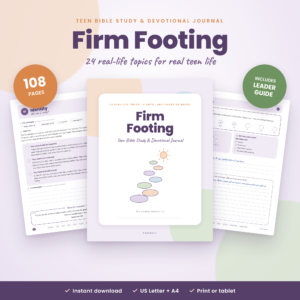
Firm Footing Teen Bible Study Journal
Price: $7.99 | Best for: Teens and youth groups who want a complete printable set
A 108-page printable teen devotional and youth group curriculum with a leader guide, 24 topics and memory verse cards. It comes as a US Letter and A4 PDF. If you need lessons that are ready on day one, this is the closest fit to what this article is about.
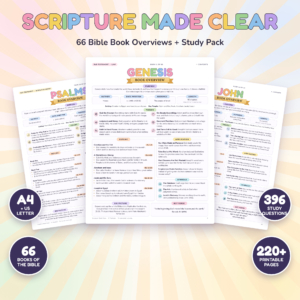
Scripture Made Clear Bible Book Overviews
Price: $5.99 | Best for: Leaders who want to explain how each book fits in
A printable overview of all 66 books with study questions, a leader answer guide, a reading plan and memory verse cards, as a US Letter and A4 PDF. It is handy when a teen asks, “Where does this book even come from?”
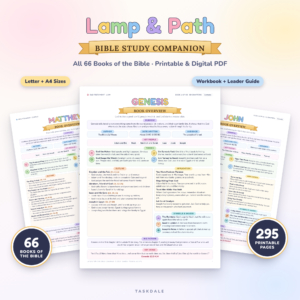
Lamp & Path Bible Study Companion
Price: $5.99 | Best for: Leaders who need a big bank of questions
A printable Bible study guide with summaries of all 66 books, a 396-question workbook, a leader guide and a one-year reading plan, as a US Letter and A4 PDF. Pull questions from it when your own run dry.
Comparing the Three Resources
| Product | Format | Price | Best for | Link |
|---|---|---|---|---|
| Firm Footing Teen Bible Study Journal | 108-page printable, US Letter and A4 PDF | $7.99 | 24 topics, leader guide, memory verse cards | View |
| Scripture Made Clear Bible Book Overviews | Printable, US Letter and A4 PDF | $5.99 | 66 book overviews and an answer guide | View |
| Lamp & Path Bible Study Companion | Printable, US Letter and A4 PDF | $5.99 | 396 questions and a one-year plan | View |
For a dedicated teen group, start with Firm Footing. Add the other two when you want to go wider.
Common Mistakes When Planning Youth Bible Study Lessons
The same slips keep coming up in youth groups, and they are easy to fix once you spot them.
The first is packing in too much. Three points and a game and a skit is a lot for forty minutes. Pick one idea and let it breathe. The second is answering every question yourself. If you reply first each time, teens learn to wait for you. Throw the question back: “What do you think?” The third is skipping prayer or rushing it. A short, honest prayer in which a teen names something real can be the part they remember.
The fourth mistake is ignoring the room. If the group is tired after exams, drop the planned lesson and talk about rest. Flexibility earns trust. And the fifth is forgetting follow up. A text on Wednesday saying “Thinking about what you said Sunday” does more than the whole lesson.
Choosing Youth Bible Study Lessons That Fit Your Group
Not every set of lessons suits every group. A big church youth night with forty teens needs more structure than six friends in a living room. Ask yourself three things. How long is your meeting? How confident is your leader? And how much do your teens already know?
If your group is new to the Bible, start with identity and friendship topics, which feel familiar. If they have grown up in church, try the faith and doubt theme, since they often have the most unspoken questions. Mixed groups do well with purpose and character lessons, which give everyone something to say.
Don’t overthink the first pick. Whatever you choose, run one lesson as a trial, then ask the group for honest feedback. Teens are surprisingly good at telling you what worked. Take notes and adjust the next one. A group that feels heard keeps coming back, and that matters more than any perfect plan.
Tips for Leading Teens Who Say Nothing
Even great youth bible study lessons hit the silent room. Every leader has faced it. You ask a question, and a clock ticks. Here is what helps.
Wait longer than feels comfortable. Count to ten in your head. Someone almost always fills the gap. Ask for a show of hands before words, since raising a hand feels safer than speaking. Let teens write answers on paper first, then share only if they want to. And share a small, honest story of your own first, one with a mistake in it. When the adult admits a flop, the room relaxes.
Also, pay attention to the one who looks bored. Often that is the person with the sharpest question, and they are waiting to see whether it is safe to ask.
Using Youth Bible Study Lessons at Home
You do not need a youth group to teach these. A parent and one teenager at the kitchen table can use the same shape in twenty minutes. Pick a topic from the list, read a short passage, ask two questions, and listen more than you talk. Teens often open up when they are not facing you, so try it in the car or while washing up.
Youth bible study lessons work just as well at home. A printed journal helps, too. A teen who has her own pages to fill in has something to hold and something that is hers. It becomes a private space to think, not a school assignment.
Planning a Season of Youth Bible Study Lessons
One good evening is easy. A whole term is harder. So plan in blocks of four to six weeks, with one theme per block. Identity might fill the first month, then friendship, then doubt. A short block gives everyone a finish line, and teens are far more willing to commit to six weeks than to “the rest of the year.”
Leave one week empty on purpose. Rain, exams, a cancelled bus, a hard conversation that ran long: something will wreck the schedule, and a spare week lets you catch up without guilt. Then ask the group what they want next. When teens help pick the topic, they show up differently.
Youth Bible Study Lessons FAQ
How long should a youth Bible study last?
Forty to sixty minutes suits most groups. Shorter still works at home. What matters more than length is shape: a short opener, a short talk, real discussion and a closing challenge. If attention drops, cut the talk, not the discussion.
What topics do teens want in Bible study?
Teens tend to care about identity, friendships, anxiety, social media, doubt and their future. Starting with those real concerns, then connecting them to Scripture, gets better engagement than starting with a verse and hunting for relevance.
How do I keep a teen group engaged?
Use small groups, open questions and a clear end time. Let teens lead part of it, such as reading the passage or choosing the next topic. Variety helps too: some weeks a discussion, some weeks a game, some weeks a quiet journaling time.
Do I need a trained leader to run these lessons?
No. A willing adult who listens well and prepares a little can run a good group. A leader guide, like the one in Firm Footing, gives you questions and structure so you are not guessing. Involve your pastor or a counselor for serious personal issues.
Can these lessons work for a mixed age group?
Yes, with small tweaks. Pair younger and older teens, and keep the questions open enough that each can answer at their level. Topics such as identity, friendship and prayer work across a wide age range.
Your Next Step
So, the short version: choose one theme, run the forty minute shape, and let the teens do most of the talking. If you want the lessons ready to print, the Firm Footing Teen Bible Study Journal gives you 24 topics, a leader guide and memory verse cards for $7.99. Print the first lesson tonight and try it on Sunday.