You said yes again. You did not want to, your evening was already full, and you knew you would resent it by nine o’clock. But the word was out before you could stop it. If that scene is familiar, you are not weak and you are not alone. Plenty of people learned young that being useful was the price of being loved. Codependency worksheets will not rewrite your history, but they can help you spot the pattern while it is happening and practice a different move.
This article explains what people-pleasing looks like day to day, offers exercises you can try on plain paper, and covers a printable workbook on Taskdale built for the job.
Note: this is general self-help information, not professional advice, and not a diagnosis. If a relationship feels unsafe, please contact a qualified professional or a local support service.
Quick picks
| Product | Best for | Price | Link |
|---|---|---|---|
| Rooted Together Codependency & Boundaries Workbook | People-pleasing, enmeshment and self-trust | $4.99 | View |
| Rooted in Me Self-Discovery Workbook | Identity, values and boundaries for adults | $4.99 | View |
| Worthy Within Self-Worth Workbook | Self-worth work with a 30-day journal | $4.49 | View |
What Codependency Looks Like in Everyday Life
The word gets thrown around a lot, so let me keep it practical. Codependency, in everyday language, describes a pattern where you put other people’s needs, moods and problems ahead of your own so often that you lose track of what you want.
It rarely looks dramatic. More often it looks like this. You check your partner’s face before you answer a question. You fix a coworker’s mistake and tell no one. You say “I’m fine” when you are not. You feel responsible for how everybody in the room feels, and tired from it.
A few common signs:
- Saying yes first and working out the cost later
- Feeling guilty when you set even a small limit
- Needing to be needed, and feeling lost when no one asks for help
- Struggling to say what you want or like
- Taking the blame for things that are not yours
None of that makes you a bad person. These habits usually start as clever ways to stay safe. A child who keeps a moody parent calm learns that peacekeeping works. The trouble is that the skill follows you into adult life, where it costs you more than it pays.
How Codependency Worksheets Help
You cannot think your way out of a habit that fires in half a second. By the time you notice, you have already agreed to host the party. Codependency worksheets slow things down. They let you look at a pattern after the fact, when your heart rate has dropped, and work out what you could do next time.
Most good exercises in this area do three things. They help you notice the pattern, they separate what is yours from what is not, and they give you a practice script. That last part matters more than people expect. Knowing you “should” set boundaries is useless if you freeze when the moment comes. A sentence you have written out and said aloud a few times is far easier to reach for.
Worksheets also let you go at your own pace. Some of this work touches old family stuff, and a private page gives you room to stop whenever it gets heavy.
Six Exercises You Can Try on Plain Paper
Here are six simple exercises. They are general ideas, not clinical treatment, and you can do them with a notebook.
The yes audit
For one week, jot down every time you said yes. Beside each, write down if you wanted to, and how you felt an hour later. Many people see the gap in black and white for the first time. Just three entries a day is plenty.
Whose problem is this?
Draw two circles. Label one “mine” and one “theirs.” Next time a friend vents about a conflict, write what falls in each. Your job might be to listen. The solution is often in the other circle.
The feelings check-in
Three times a day, ask, “What am I feeling right now, apart from what anyone else is feeling?” It sounds odd until you try it. If you spend all day reading others, your own signals go quiet.
Boundary scripts
Write three short sentences you could use this week. “I can’t take that on right now.” “Let me think and get back to you.” “That doesn’t work for me.” Say each one aloud. Notice that none includes a long apology or a made-up excuse.
The guilt log
Next time you feel guilty after saying no, note what you actually did wrong. Often the answer is nothing. You simply disappointed someone, and disappointing people is survivable.
What I want list
Write ten things you want, from tiny to huge. Dinner choices count. A person who has spent years accommodating others often finds this hard. That difficulty is information worth having.
A Typical Week, Before and After
It helps to picture how this plays out, so here is an invented example. Sam, who is thirty-four, takes on a coworker’s report on Monday because the coworker looked stressed. On Wednesday he lends his sister money he cannot spare. On Friday he agrees to host his friend’s birthday dinner, then lies awake counting the cost. Three yeses, three quiet resentments.
Now say Sam starts a yes audit and one worksheet a week. By week three he spots the Monday pattern as it happens. He still helps with the report, but he says, “I can look at it for twenty minutes.” By week six he says to his sister, “I can’t lend money right now, but I can help you work out a plan.” Nothing dramatic. The friendships survive. And he sleeps better on Fridays.
Notice that Sam did not become a different person. He did not turn cold or selfish. He just added a pause between the request and the answer. Those few seconds are where codependency worksheets do their work, because they train you to catch the moment before the automatic yes.
That pause is also why one page a week beats a burst of effort. Habits that took thirty years to build do not vanish in a weekend, but they do soften under steady, gentle practice.
Setting Boundaries Without Blowing Up Your Relationships
This is the part that scares people most. If I say no, will they leave? Will they be angry? Sometimes, yes. Some people will push back, especially those who benefited from your constant yes. That does not mean you did it wrong. It usually means the old arrangement is shifting.
Start small. Pick a low-stakes limit, such as not answering work messages after eight at night, and hold it for a week. Notice what actually happens. Usually, far less than you feared.
Keep your tone calm and short. Long explanations invite negotiation. “I won’t be able to come” is complete. You do not owe a speech.
Expect a wobble in your own head too. Guilt often rises right after you hold a boundary, like a muscle sore after the first workout. It does not mean the limit was wrong. Give it a day.
And be careful about one thing: boundaries are about what you will do, not about controlling what others do. “If you shout, I will leave the room” is a boundary. “You must stop shouting” is a demand. The first one you can enforce yourself.
If you live with someone who is controlling, frightening or violent, boundary scripts are not a safe first step. Reach out to a professional or a local helpline and put your safety first.
Codependency Worksheets and Workbooks From Taskdale
If you would rather have structured pages than a blank notebook, here are three printable options on Taskdale. All are PDFs you can print at home.
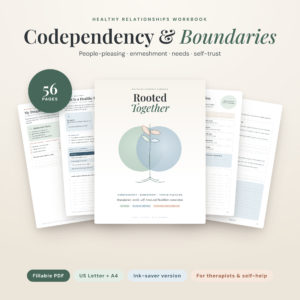
Rooted Together Codependency & Boundaries Workbook
Price: $4.99 | Best for: people-pleasing, enmeshment and rebuilding self-trust
A 56-page fillable set of healthy relationships worksheets focused on people-pleasing, enmeshment and self-trust. US Letter and A4 PDF. This is the closest match to what this article covers, and the one to pick if codependency is the main theme.
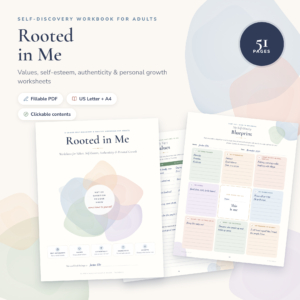
Rooted in Me Self-Discovery Workbook
Price: $4.99 | Best for: working out who you are apart from other people
A self-discovery workbook for adults with self-identity, values, self-esteem and boundaries worksheets, printable and fillable PDF in US Letter and A4. It pairs well with the codependency set if you have lost track of your own preferences.
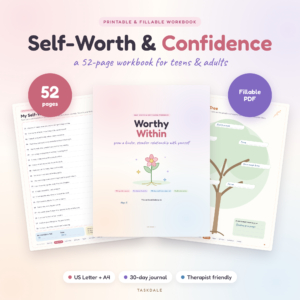
Worthy Within Self-Worth Workbook
Price: $4.49 | Best for: building self-worth through daily writing
A 52-page printable and fillable set of self-esteem and confidence worksheets, listed as therapy worksheets, with a 30-day journal. US Letter and A4 PDF. Good for the quiet work of believing you matter without earning it.
Which Workbook Fits Which Situation
| Product | Format | Price | Best for | Link |
|---|---|---|---|---|
| Rooted Together Codependency & Boundaries Workbook | 56-page fillable PDF, US Letter and A4 | $4.99 | Codependency and boundaries | View |
| Rooted in Me Self-Discovery Workbook | Fillable and printable PDF for adults | $4.99 | Identity and values | View |
| Worthy Within Self-Worth Workbook | 52-page PDF with 30-day journal | $4.49 | Self-worth and daily writing | View |
If you buy only one, make it the Rooted Together workbook. Add the others later if you find the identity side needs more room.
One last practical point on pacing. Do not do a worksheet right after a hard conversation, when your feelings are still hot. Wait an hour, or a day. Pages written in a calmer state tend to be more honest and less harsh on you, and that is the voice you want in your notebook.
Mistakes People Make With Codependency Worksheets
Using them to analyze someone else. It is tempting to fill pages about your difficult mother or partner. Turn the pen back to yourself. The only behavior you can change is your own.
Expecting to feel better right away. Early on, many people feel worse. You are noticing what you used to numb. That tends to ease with time and support.
Swinging to the other extreme. Some people start by saying no to everything. Balance is the target, not a wall. You can still help, just by choice.
Going without support. A trusted friend, a support group or a therapist makes a big difference. Worksheets are strongest as one piece of a wider plan, not the only piece.
Quitting after one slip. You will say yes when you meant no again. Everyone does. Write it down, learn from it, and carry on.
Frequently Asked Questions
What are codependency worksheets?
They are printable exercises that help you notice people-pleasing and over-responsibility patterns, separate your needs from other people’s, and practice boundaries. You complete them privately, usually over weeks. They are self-help tools, not a diagnosis or treatment.
Can codependency worksheets replace therapy?
No. They can support your own reflection, and some people use them alongside therapy. If your patterns are tied to trauma, addiction in the family or an unsafe relationship, a qualified professional can offer support a worksheet cannot.
How do I know if I am people-pleasing?
Common clues are saying yes automatically, feeling guilty about small limits, hiding your real opinion, and feeling drained after helping. If several fit you, try the yes audit above for a week and see what it shows.
How long does it take to set healthier boundaries?
It varies. Small limits can feel easier within weeks, while deep habits take months of practice. Progress usually comes in uneven steps. Aim for slightly better, not perfect.
Are these worksheets only for romantic relationships?
No. The same patterns show up with parents, friends, coworkers and adult children. Exercises like the yes audit and boundary scripts work in any of these settings.
Where to Start
Try the yes audit this week. Just count and note, no judging. Then, if you want guided pages, the Rooted Together Codependency & Boundaries Workbook gives you 56 fillable pages for $4.99. Codependency worksheets will not fix everything, but one honest page can change how you answer the next request.