It’s 4 pm and you can’t say where the day went. You answered emails, made tea, answered more emails, and the report you meant to finish is still open on the screen. An hourly planner printable fixes that quietly. You give each stretch of the day a job before the day starts, and the drift mostly stops.
This guide shows how to plan a day in 30-minute blocks, what to put in each block, and which Taskdale planners make it easy. No fancy system. A page, a pen and ten minutes the night before.
Quick picks
| Product | Best for | Price | Link |
|---|---|---|---|
| Calm Day Daily Planner | Hourly and half-hour schedule with mood, meal and water trackers | $1.17 | View product |
| FlowBlock Weekly Hourly Planner | Time block schedule with daily pages and a habit tracker | $1.39 | View product |
| Hearth Hours Work From Home Daily Planner | Undated hourly planner and to-do list for home workers | $1.29 | View product |
| Clear Day Daily Planner | Daily schedule, to-do list and time block pages | $2.49 | View product |
Why an hourly planner printable beats a to-do list
A to-do list tells you what. It says nothing about when. So you write “finish report”, “call the bank”, “reply to Sam”, and then spend the day choosing between them. Every choice costs a little energy, and by noon you’re tired of choosing.
An hourly planner printable answers the when. It puts each task into a slot you can see. The report gets 9:00 to 10:30. The bank call gets 11:00. Sam’s reply waits for the 2:00 admin block. Now the decisions are made, and your brain can just do the work.
There is also a reality check built in. Try to fit eleven tasks into a page with sixteen half-hour slots and you see immediately that it can’t work. Better to find that out at breakfast than at 6 pm.
Picture a Tuesday with a 10 am meeting, a school run at 3 and a deadline on Friday. Without a plan, that deadline gets whatever energy is left over, which is usually none. With a plan, it gets a protected 90-minute block on Tuesday morning, and you know it before the day begins.
And paper helps. Writing a day by hand takes a few minutes and makes you think. Typing into a calendar app often feels like dragging boxes around. Both are fine, but many people find the pen version sticks better.
How to plan a day in 30-minute blocks
Thirty minutes is a handy unit for any hourly planner printable. It is long enough to get something done and short enough that a slot never feels huge. Here’s a simple method.
Step 1: Start with what is fixed
Fill in the things that can’t move: meetings, school pick-up, appointments, lunch. These are your rocks. Everything else flows around them.
Step 2: Pick your top three
Choose the three things that would make the day a success. Not ten. Three. Write them at the top of the page, so they stay in sight.
Step 3: Give the big task your best hour
Most of us have a time of day when we think clearly. For some it’s 8 am, for others 3 pm. Put your hardest task there and guard it. Phone away, door shut, tea made beforehand.
Step 4: Add buffer
Tasks take longer than you think. Leave a 30-minute gap or two for overruns, a slow email, or just standing up and stretching. A day with no gaps breaks at the first surprise.
Step 5: Batch the small stuff
Emails, quick calls and errands go into one or two blocks. Checking email every ten minutes chops up your focus. Two planned email slots, say 11:30 and 4:00, do the job.
Step 6: Review at night
Spend five minutes each evening. What got done? What didn’t? Move leftovers to tomorrow’s page. This small habit makes the next morning much calmer.
A sample day, block by block
Here’s what a plain working day might look like. Adjust it to fit your life.
- 7:00 to 7:30: Wake, coffee, look at today’s page
- 8:00 to 9:30: Deep work on the main task
- 9:30 to 10:00: Break and a short walk
- 10:00 to 11:00: Second task or calls
- 11:00 to 11:30: Email batch
- 12:30 to 1:30: Lunch, away from the desk
- 1:30 to 3:00: Project work or meetings
- 3:00 to 3:30: Admin and loose ends
- 3:30 to 4:00: Buffer
- 4:00 to 4:30: Plan tomorrow, close the laptop
Looks tidy, doesn’t it? Real days rarely go exactly to plan, and that’s all right. The page is a guide, not a contract. When something blows up at 10:15, you cross out a block and slide the rest down. The plan bends, and you still know where you are.
If you’d like to see the same idea across a whole week, our guide to a time blocking planner covers it in more depth.
Calm Day: hourly and half-hour planning
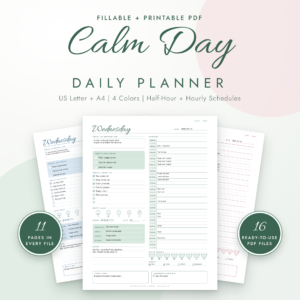
Calm Day Daily Planner
Price: $1.17 | Best for: a day plan with hourly and half-hour slots plus self-care trackers
Calm Day is a printable and fillable PDF with an hourly and half-hour schedule, plus a mood tracker, a meal tracker and a water tracker. It comes in US Letter and A4. If you want your day plan and your daily wellbeing checks on one page, this fits.
The half-hour schedule is the standout for this topic. It matches the 30-minute method above exactly, so you can fill in blocks without redrawing the page. The mood, meal and water trackers are small extras, but small extras often get used because they take five seconds.
FlowBlock: a weekly view with time blocks
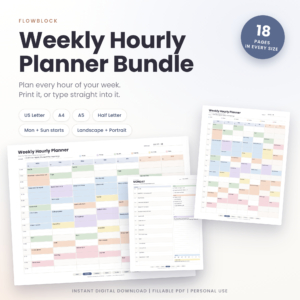
FlowBlock Weekly Hourly Planner
Price: $1.39 | Best for: planning the week in time blocks, with daily pages to match
FlowBlock is a printable and fillable PDF time block schedule with weekly hourly planning, daily pages and a habit tracker. The sizes listed are Letter, A4, A5 and Half Letter. It suits people who like to see the whole week before zooming in on a day.
A weekly spread is great for spotting trouble early. If Wednesday is jammed with meetings, you can move your deep work to Tuesday while you still have the chance. Then the daily pages let you plan the details the night before.
Hearth Hours: for people who work from home
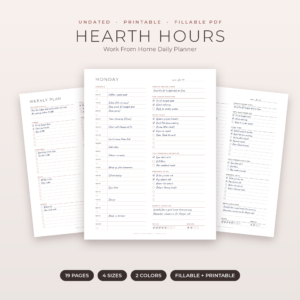
Hearth Hours Work From Home Daily Planner
Price: $1.29 | Best for: home workers who need an hourly planner and a to-do list in one
Hearth Hours is a printable and fillable undated hourly planner with a to-do list, designed as a work from home daily planner. It comes as a PDF in Letter, A4, A5 and Half Letter. Because it is undated, you can start any day you like and never waste a page.
Working from home blurs the edges of the day. The washing machine beeps, the dog wants out, and suddenly it’s lunchtime. Writing hours down gives the day edges again. For more on that, see our piece on the work from home planner.
Clear Day: a simple daily schedule
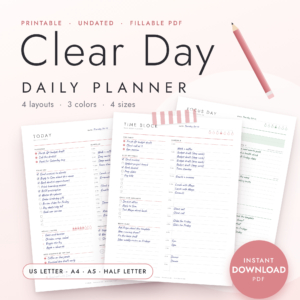
Clear Day Daily Planner
Price: $2.49 | Best for: a clean daily schedule with a to-do list and time block pages
Clear Day is a printable daily planner with a fillable daily schedule, a to-do list and time block pages. It comes in US Letter, A4, A5 and Half Letter. It is the priciest of the four, but it is still under three dollars.
If you’ve been put off by cluttered planners, a plain layout like this can be a relief. Schedule on one side, to-do list on the other, and not a lot else asking for your attention.
Using your hourly planner printable with a family or a team
Planning gets trickier when other people share your day. Kids need lifts, a partner needs the car, a colleague wants a “quick chat” that lasts forty minutes. A printed page can help here, because it is easy to show.
Try pinning the day’s page where others can see it, or mention your protected blocks out loud. “I’m in focus mode until 10:30” works better than a closed door nobody understands. People respect a plan they can see.
You can also plan the household together on Sunday evening. Ten minutes with a pen, a printed week and a cup of tea. Who is cooking Tuesday? Who has the dentist? Put the fixed pieces in first, then each person adds their own blocks around them. It sounds fussy. It prevents about three arguments a week.
And be kind about the interruptions. They will come. Leave a flexible block each afternoon with “catch-up” written in it, so surprises have somewhere to land.
Mistakes that wreck an hourly planner printable
Most people who quit blocking their day make one of the same few errors.
The first is overpacking. A page where every slot is filled looks impressive and collapses by 11 am. Leave air in it.
The second is planning without time estimates. If you have never timed how long a report takes, guess high. Next week, note the real number and adjust.
The third is ignoring energy. Scheduling a hard task at 2 pm when you hit a slump is asking for a battle. Put easy admin there instead.
The fourth is treating a missed block as failure. It isn’t. Cross it out, move it, carry on. A planner is a map, and maps get redrawn.
The fifth is skipping the night-before review. Five minutes then saves thirty minutes of fog in the morning.
Which hourly planner printable should you choose?
| Product | Format | Price | Best for | Link |
|---|---|---|---|---|
| Calm Day Daily Planner | Printable and fillable PDF, US Letter and A4 | $1.17 | Half-hour slots with mood, meal and water trackers | View product |
| FlowBlock Weekly Hourly Planner | Printable and fillable PDF, Letter, A4, A5, Half Letter | $1.39 | Weekly time blocking with daily pages | View product |
| Hearth Hours Work From Home Daily Planner | Undated printable and fillable PDF, Letter, A4, A5, Half Letter | $1.29 | Home workers who want an hourly plan and a to-do list | View product |
| Clear Day Daily Planner | Printable and fillable, US Letter, A4, A5, Half Letter | $2.49 | A plain daily schedule with time block pages | View product |
My honest pick for the 30-minute method: Calm Day, because the half-hour schedule is right there in the title. For a week-first approach, go with FlowBlock. Working from home? Hearth Hours. Want it plain? Clear Day.
Frequently asked questions
What is an hourly planner printable?
It is a printable page that divides the day into hours or half-hours so you can assign tasks to specific times. You print it, fill it in by hand or on screen, and use it as a daily guide. Many versions add a to-do list.
Is 30-minute blocking better than hourly?
Neither is better for everyone. Hourly blocks suit long tasks and meetings. Half-hour blocks suit busy days with lots of small jobs. Many people use half-hours for flexibility and simply join two slots when a task needs more time.
How far ahead should I plan my day?
The night before works best for most people. You wake up knowing what to do, and the plan comes from a calm head. Some people add a two-minute check in the morning to adjust for anything that changed overnight.
What do I do when my plan falls apart?
Cross out what no longer fits, and re-slot the important tasks into the time left. Keep your top three and drop the rest if needed. A plan that bends is still doing its job. Tomorrow gets a fresh page.
Can I use a printable planner on a tablet?
Fillable PDFs can be typed into on a computer, then printed. Whether a particular file works with a note-taking app depends on the product, so check the listing. Printing it and writing by hand is the simplest route.
Your next step
So, here’s the thing to do tonight. Print one page, write your top three, and fill in the fixed parts of tomorrow. Ten minutes, tops. If you want a page that already has the half-hour slots, grab Calm Day for $1.17 and see how it feels by lunchtime.