You reread the email four times before sending it. You redo the slide because the font felt slightly off. You skip the pottery class because you might be bad at it. And somewhere in the back of your mind a voice keeps saying that anything less than perfect is failure. Perfectionism worksheets will not turn that voice off overnight. What they can do is help you hear it clearly, question it, and slowly replace it with something fairer.
This article covers what perfectionism does to you, a handful of CBT-style exercises to try on paper, and a printable workbook on Taskdale built around good-enough thinking.
Note: this is general self-help information, not professional advice and not a replacement for therapy. If perfectionism is tied to anxiety, an eating problem or low mood that will not lift, please speak to a qualified professional.
Quick picks
| Product | Best for | Price | Link |
|---|---|---|---|
| The Good Enough Workbook | Perfectionism, with 57 pages of CBT worksheets | $4.99 | View |
| Rooted Worth Self-Worth Workbook | CBT self-esteem and confidence worksheets | $11.50 | View |
| Bloom Inward Self-Esteem Workbook | Thought and mood trackers on a small budget | $2.99 | View |
What Perfectionism Really Costs You
People often wear perfectionism like a badge. “I just have high standards.” But high standards and perfectionism are not the same thing. High standards say, “I want to do this well.” Perfectionism says, “If I do this badly, I am worthless.”
Spot the difference? One is about the work. The other is about you.
The costs add up quietly. There is procrastination, because starting means risking a flawed result. There is overwork, since nothing ever feels finished. There is a thin joy in success, because the goalposts move the moment you reach them. And there is the strain on other people, who feel judged by your standards as well as their own.
Many perfectionists also avoid things they might not master. They stick with what they already do well and give up new hobbies, new jobs, new friendships. A life shrinks that way, one cautious choice at a time.
The good news is that this is a thinking habit, and thinking habits respond to practice. That is where perfectionism worksheets come in.
Why CBT-Style Perfectionism Worksheets Work
Cognitive behavioral therapy, often shortened to CBT, rests on a simple idea. The way you interpret a situation shapes how you feel and what you do. Change the interpretation, even a little, and the feeling often changes with it.
Take a missed typo in a report. A perfectionist thought might be, “Everyone will think I’m sloppy and incompetent.” That thought triggers dread, then over-checking, then exhaustion. A CBT-style worksheet asks you to slow down and test the thought. How likely is it that everyone noticed? What would you say to a colleague who made the same slip? What is a fairer way to put it?
The fairer version might be, “A typo is annoying but small, and I can fix it.” Not cheerful. Just accurate. And accuracy is far easier to live with than the catastrophe version.
Worksheets help because they make the process visible. You see the thought, the feeling, the behavior and the alternative side by side on a page, instead of tangled in your head.
Five Perfectionism Worksheets to Try on Plain Paper
These are general exercises in the CBT spirit. Copy them into a notebook and try one a week.
The all-or-nothing catcher
Perfectionists often think in extremes: perfect or useless, success or disaster. For a week, note every time you use words like “always,” “never,” “completely,” or “totally.” Beside each, write a more accurate middle-ground version. “The presentation was a total disaster” becomes “Two slides went badly and the rest was fine.”
The cost-benefit sheet
Pick one perfectionist habit, such as rewriting every message. Draw two columns: what it gives me, and what it costs me. Be fair. It may give you a sense of safety. It may also cost you an hour a day. Seeing both columns helps you decide if the trade still makes sense.
The 80 percent experiment
Choose a low-stakes task and deliberately do it to about 80 percent. Send the email after one read-through. Hand in the draft. Then write down what actually happened. Most people find that nobody noticed, or that the result was fine. That is data your anxious brain needs.
The double standard check
Write the standard you hold yourself to. Then write the standard you hold a friend to in the same situation. They are rarely the same. Ask which one is fairer, and why you apply the harsher one to yourself.
The good-enough timer
Before starting a task, decide how long it deserves. Ten minutes for a routine email, an hour for a report. Set a timer. When it rings, stop and write how you feel. Uncomfortable, usually, and then a little relieved.
A Small Story About Good Enough
Here is a made-up example to show how it plays out. Lena is a designer who rewrites her client emails three times each. Each email takes twenty minutes. She has maybe fifteen a week, which is five hours of rewriting.
She tries the 80 percent experiment on emails to one friendly client. She sends the first draft after one read. The client replies, “Thanks, perfect.” Nothing broke. She tries it again the next day, then the next. Within a month she has cut her email time by half and felt only a little twitchy.
It is not a miracle. It is a slow collection of small proofs. And that is how this kind of change tends to happen: not through a sudden insight, but through lots of tiny experiments where the feared disaster fails to show up.
The Good Enough Workbook and Other CBT-Style Tools on Taskdale
If you want structured pages, here are three printable options. Each is a digital PDF, so you print what you need at home.
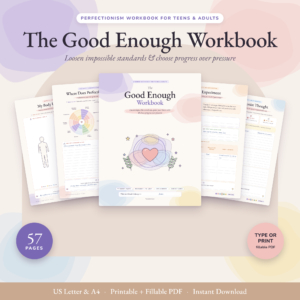
The Good Enough Workbook
Price: $4.99 | Best for: teens and adults who want to loosen perfectionism
A perfectionism workbook for teens and adults with 57 pages of printable and fillable CBT worksheets in PDF form. It is built for exactly the topic of this article, so it is the one to start with if perfectionism is your main struggle.
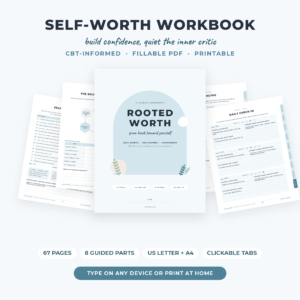
Rooted Worth Self-Worth Workbook
Price: $11.50 | Best for: when self-criticism runs deeper than the work itself
A 67-page set of CBT self-esteem and confidence worksheets, fillable and printable PDF in US Letter and A4. Perfectionism often sits on top of shaky self-worth, and this workbook works on that base.
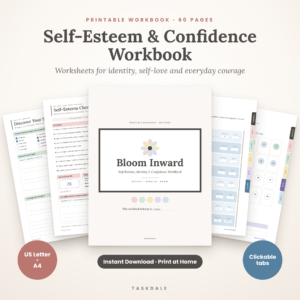
Bloom Inward Self-Esteem Workbook
Price: $2.99 | Best for: tracking thoughts and moods cheaply
Sixty printable confidence and self-love worksheets, listed as therapy worksheets, with a thought tracker, a mood tracker and affirmation cards. US Letter and A4 PDF. The thought tracker suits the all-or-nothing catcher exercise above.
How the Three Compare
| Product | Format | Price | Best for | Link |
|---|---|---|---|---|
| The Good Enough Workbook | 57-page printable and fillable CBT worksheets, PDF | $4.99 | Perfectionism | View |
| Rooted Worth Self-Worth Workbook | 67-page CBT worksheets, fillable PDF, US Letter and A4 | $11.50 | Self-worth underneath | View |
| Bloom Inward Self-Esteem Workbook | 60 worksheets with trackers and cards, PDF | $2.99 | Budget tracking | View |
My suggestion for perfectionism worksheets: begin with The Good Enough Workbook. It is the only one aimed squarely at perfectionism, and it costs less than a lunch.
Where Perfectionism Comes From
Nobody wakes up one day with a perfectionist streak. It grows from somewhere, and knowing where can take some of the shame out of it.
For some people it starts with praise that was tied to results. Good grades earned a smile, a bad one earned a silence. The child learns that love depends on performance, and carries the rule into adulthood. For others it comes from a harsh home, a competitive school, or a sport where mistakes were punished. Sometimes it is simply temperament: a sensitive, careful person in a world that rewards polish.
Whatever the root, the habit once did a job. It kept you safe, or it earned approval, or it gave you a sense of control. That is worth respecting. You are not trying to destroy a flaw. You are retiring a strategy that has outlived its use.
A short worksheet-style prompt can help here. Write the sentence “When I make a mistake, I expect…” and finish it three different ways without stopping. Then look at where those expectations might have come from. Many people spot a specific teacher, parent or coach in the answer. Seeing the source does not erase the habit, but it makes the rule feel less like a law of nature.
Using Perfectionism Worksheets at Work and School
Perfectionism shows up differently depending on where you spend your days, so tailor the exercises.
At work
Watch for over-checking, avoiding delegation, and missing deadlines because the thing is not yet “ready.” Try the good-enough timer on routine tasks. Agree with yourself in advance on what finished looks like for each piece of work, and write it at the top of the page. A clear finish line is the best cure for endless polishing.
At school
Students often hold off on starting essays or studying because they fear a weak result. A worksheet can help split the task into small, imperfect steps: a rough outline, a bad first paragraph, a messy set of notes. Shipping something ugly on Monday beats a perfect plan that never leaves the head. Parents and teachers can help by praising effort and learning, not just marks.
At home
Spotless-house standards wear everyone out. Pick one room to keep “good enough” for a month and see what changes. Often the family relaxes before you do.
Common Traps When Working on Perfectionism
Trying to be a perfect recoverer. This one is almost funny. People turn the worksheets into one more thing to get exactly right. If you skip a day, that is fine. Good enough applies here too.
Confusing good enough with lazy. It does not mean careless. It means choosing where effort pays off and where it does not. Your tax return deserves care. A grocery list does not.
Dropping standards everywhere at once. Pick one area first. Loosen your grip on email before you tackle your career.
Hiding the practice. Perfectionists often feel ashamed of being perfectionists. Telling one trusted person can take a lot of pressure off.
Ignoring the body. Perfectionism lives in tight shoulders and short breaths. A walk or a few slow breaths belongs in the plan as much as any page.
Frequently Asked Questions
What are perfectionism worksheets?
They are printable exercises, often based on CBT ideas, that help you notice all-or-nothing thinking, test harsh standards, and practice good-enough behavior. You work through them on your own, usually over several weeks.
Can perfectionism worksheets cure perfectionism?
Perfectionism is a habit rather than an illness, so there is nothing to cure, but habits can soften. Worksheets can help you notice and loosen the pattern. If it causes heavy distress, see a qualified professional.
How long until I notice a difference?
Many people notice small shifts in a few weeks of steady practice, though it varies a lot. Expect uneven progress, with old habits returning when you are stressed or tired.
Are these worksheets suitable for teens?
The Good Enough Workbook is listed for teens and adults. Teens facing exam pressure often relate to the all-or-nothing thinking exercises. A parent or counselor can help if the topic gets heavy.
Do I need a therapist to use them?
No, they are designed for self-help. But a therapist can tailor the work to you, especially if perfectionism links to anxiety or depression. Worksheets are a fine supplement either way.
Try One Good-Enough Experiment This Week
Pick one small task. Do it to 80 percent. Write down what happens. That single page is a decent start, and if you want a full set of CBT-style pages, The Good Enough Workbook has 57 of them for $4.99. Perfectionism worksheets work the same way as any gym: it is the repeats that count, not the perfect session.