When your pay changes every month, a normal budget breaks on contact. It assumes $3,000 lands on the 1st. You got $1,900 on the 6th, $1,400 on the 22nd, and a client who still has not paid from August. The standard advice does not fit, and that can feel lonely.
Managing money when income is irregular comes down to one shift: stop budgeting the money you hope to earn and start budgeting the money already in hand. Freelancers, gig drivers, commission sales staff, seasonal workers, tradespeople and creatives all use versions of the same system. This guide lays it out step by step, with a six-month worked example, a spending order for the day money lands, and a plain look at the stress that comes with it.
Quick picks: tools for uneven income
| Product | Best for | Price | Link |
|---|---|---|---|
| Soft Ledger Budget Planner | Freelancers who want a printable plus an Excel file | Original price was: $12.99.$8.99Current price is: $8.99. | View |
| The Calm Money Method | Budgeting plus the habits behind it | $11.99 | View |
| Financial Anxiety Workbook | Dread, avoidance and money worry | $17.99 | View |
| Money Mindset Workbook | Spotting your money patterns | $6.49 | View |
Why uneven pay feels harder than it is
Irregular income has a rhythm, and it is usually feast then famine. A big month arrives. You breathe out, pay off a few things, maybe buy the new laptop. Then a slow month comes and you are scrambling, sometimes onto a credit card. The swings feel huge even when the yearly total is perfectly decent.
Look at the year instead of the month and the picture often changes. A freelance designer earning anywhere from $1,600 to $5,300 a month may still bring in $40,000 across twelve months. That is a liveable income. The problem is timing, not size. And timing is something a system can fix.
The fix has three parts: know your bare minimum, keep a pool of money between you and your income, and pay yourself a steady amount out of that pool. Everything else is detail.
Step 1: find your bare-bones number
Your bare-bones number is what it costs to keep the lights on for one month with nothing extra. Rent or mortgage, utilities, phone, insurance, minimum debt payments, basic groceries, fuel or transit. No eating out, no new clothes, no streaming.
Write each item down and add it up. For most single adults it lands somewhere between $1,800 and $3,000, depending on where they live. Write your number somewhere you will see it. On a sticky note inside your wallet is not a silly idea.
This number does two jobs. It tells you the minimum you must cover in a slow month. And it gives your safety buffer a target: one month of bare bones first, then two, then three.
Step 2: look back to find your low and your average
Pull your deposits for the last 6 to 12 months. Write down what came in each month after any tax you set aside. Then find two numbers.
- Your lowest month. This is your realistic floor.
- Your average month. Total for the period divided by the number of months.
If your lowest month is above your bare-bones number, good news: you can cover essentials even in a slow month. If it is below, the buffer in the next step matters even more, and the first goal is to build it.
If you are new to freelancing and have no history yet, use a cautious estimate and budget on the bare-bones number until you have three months of real data.
Step 3: use a holding account and pay yourself a salary
This is the heart of the system. Every payment you earn goes into one separate account. Call it the holding account. Then, once or twice a month, you move a fixed amount from the holding account into your everyday account. That fixed amount is your “salary,” and your normal monthly budget runs on it.
Pick a salary below your average month and at or above your bare-bones number. Good months refill the holding account. Slow months draw it down. Your everyday life stays steady either way.
A worked example over six months
Leila is a freelance illustrator. Her bare-bones number is $2,300 and her six-month average after tax set-aside is about $3,330. She starts with $3,000 already in her holding account and pays herself $2,800 on the 1st of each month.
| Month | Earned (after tax set-aside) | Salary paid out | Holding account at month end |
|---|---|---|---|
| Start | $3,000 | ||
| January | $2,100 | $2,800 | $2,300 |
| February | $4,800 | $2,800 | $4,300 |
| March | $3,200 | $2,800 | $4,700 |
| April | $1,600 | $2,800 | $3,500 |
| May | $5,300 | $2,800 | $6,000 |
| June | $3,000 | $2,800 | $6,200 |
April was rough. A big client went quiet and only $1,600 came in. In the old days, Leila says, that would have meant a week of panic and a card she could not clear. This time her rent went out on schedule and nothing changed at home. That calm is the whole point.
By June the holding account sits at $6,200, more than two months of bare bones. Once it passes three months, she plans to sweep anything above that into long-term savings and give herself a small raise.
Starting without a buffer
Most people do not have $3,000 sitting ready. That is fine. Start by paying yourself your bare-bones number only, and let every dollar above it build the holding account. It can take four to six months. Each month it grows, the slow months get a little less frightening.
Step 4: a spending order for the day money lands
Some people prefer not to use a fixed salary, or they are still building the buffer. In that case, decide in advance where each payment goes, in order. When money arrives, you work down the list until it runs out.
- Tax set-aside, if you are self-employed. Move it out first.
- Housing and utilities. Keep a roof and the power on.
- Food and transport to work.
- Minimum debt payments and insurance.
- Phone and internet, since for most freelancers these are work tools.
- Holding account or emergency savings.
- Extra debt payments.
- Flexible spending and fun.
Write this list once and keep it with your budget. When a $900 payment lands on a Thursday afternoon, you are not deciding anything in the moment. You are following a list you wrote on a calm day. That is a quiet kind of freedom.
This style of “every dollar gets a job” planning is close to a zero-based budget, which our guide to the zero-based budget explains in full.
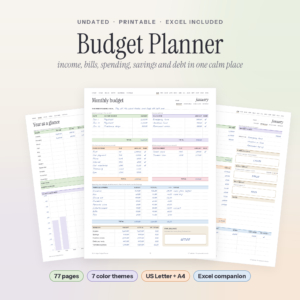
Soft Ledger Budget Planner
Price: Original price was: $12.99.$8.99Current price is: $8.99. | Best for: freelancers and gig workers
Soft Ledger is a 77-page undated budget planner you can print or use in a PDF app, and it comes with an Excel budget spreadsheet that does the maths. Each month has four linked pages: a Budget page, an Overview page that turns what is left into a weekly and daily spending number, a Daily log and a Review page. Totals go onto a Year at a glance sheet. Start by filling the Budget page with your salary amount, not your hoped-for income.
Taxes and money that is not really yours
If you are self-employed, a slice of every payment belongs to the tax office. Treat it as theirs from the moment it lands. The simplest habit is a separate tax account and a fixed percentage moved there with every deposit.
The right percentage depends on where you live, how much you earn and what you can claim, so ask an accountant or check your tax authority’s guidance for self-employed people. What matters most is that the move happens every single time. Missing it for three months is how people end up with a frightening bill in spring.
Keeping clean records helps too. Business income and costs in one file, personal spending in another. Our guide to a self-employed bookkeeping spreadsheet shows a simple way to track income and expenses through the year.
The feelings side of uneven income
Numbers are only half of it. Irregular income tends to bring a particular mix of feelings, and they drive a lot of money decisions.
Dread and avoidance
When a month looks thin, it is tempting to stop opening the banking app. Invoices go unchased. Bills sit in the inbox. The worry grows in the dark. Most people know this pattern well.
Feast-month spending
Then a big payment lands and relief turns into spending. A nice dinner, an upgrade, a weekend away. Each feels earned. Together they drain the money that should have carried you through April.
Scarcity thinking
Even in good months, some people never feel safe. They turn down rest, take every low-paid job and feel guilty buying a coffee. That is exhausting, and it often leads to burnout, which hurts income more than anything.
Working through these patterns on paper can help. Not as a replacement for a budget, but as the part that makes a budget possible to keep.
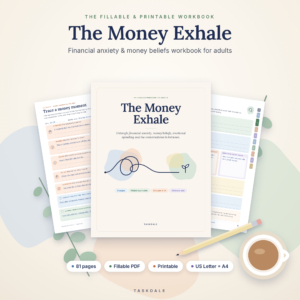
Financial Anxiety Workbook
Price: $17.99 | Best for: anyone who avoids money tasks
The Money Exhale is an 81-page fillable and printable PDF workbook in US Letter and A4. Gentle prompts and worked examples help you separate facts from fears, slow down emotional spending, open the mail you have been avoiding and prepare for money conversations. It openly acknowledges real limits such as uneven income, with a section on circumstances and support. Start with the pages on avoidance if unopened bills are your sticking point.
For a lighter starting point, our article on money mindset workbook exercises includes a few prompts you can try on a single sheet of paper.
Rules for good months and slow months
Having two short sets of rules, decided in advance, takes the drama out of both.
In a good month
- Pay your normal salary. No more.
- Let the rest refill the holding account.
- Once the buffer is full, split any surplus: half to savings or debt, a smaller slice to a treat you planned ahead.
- Chase every outstanding invoice anyway. Good months are when people get sloppy about this.
In a slow month
- Still pay your salary from the holding account. That is what it is for.
- Pause extra debt payments and savings transfers if the buffer is low.
- Trim flexible spending for a few weeks: eating out, shopping, subscriptions you can pause.
- Use quiet time to pitch, follow up and plan. A slow month often sets up a busy one.
Review both sets each quarter. If you dip into the holding account more often than you refill it, your salary is too high. Drop it by $100 or $200 and check again in three months.
If you want your rules, budget and habits in one workbook, a combined mindset and planning book keeps them together.
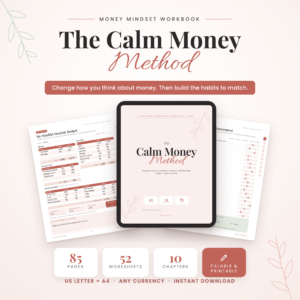
The Calm Money Method
Price: $11.99 | Best for: mindset work plus a working budget
The Calm Money Method combines a money mindset workbook with a financial planner across 85 fillable, printable pages in US Letter and A4. The first chapters look at where your habits came from and what triggers spending. Later chapters cover goals, a monthly budget, savings, debt trackers and weekly money dates, and the last section includes a 30-day challenge. Begin with the spending triggers chapter, then set up the monthly budget around your salary figure.
Mistakes that keep the feast-and-famine cycle going
Counting invoices as income
An invoice is a promise, not money. Clients pay late, pay part, or forget. Only count a payment once it clears. If you sent $4,000 of invoices in March and $2,500 has arrived, your March income is $2,500.
Raising your lifestyle after one great month
A $6,000 month feels like a new normal. It usually is not. Wait until your average has risen for at least three to six months before moving to a bigger apartment or signing a new car lease.
Using the holding account as a second checking account
The holding account only does its job if you leave it alone. Pay yourself on set days, then close the app. Dipping in for a $70 dinner here and a $120 jacket there is how the buffer quietly disappears.
Skipping the review
Uneven income needs a short check every month. Ten minutes: what came in, what is in the holding account, what invoices are still out, what bills are due before the next salary. Skip it for two months and the picture gets blurry fast.
Going it alone when it gets hard
If a long dry spell means you cannot cover essentials, talk to your lender or utility company early. Many have hardship options that are easier to arrange before a missed payment than after.
Frequently asked questions
How do you budget with an irregular income?
Find your bare-bones monthly cost, put all income into a holding account, and pay yourself a fixed monthly amount below your average earnings. Your regular budget then runs on that fixed amount.
How much buffer should a freelancer keep?
Aim for one month of bare-bones costs first, then build toward three months. A bigger buffer suits work with long gaps between payments, such as seasonal or project-based jobs.
What should I pay first when money comes in?
Tax set-aside first if you are self-employed, then housing, food and transport, minimum debts and insurance, then savings, then extra debt and fun.
Should I budget on my lowest month or my average?
Your everyday budget should be at or above your bare-bones number and below your average. That way good months refill the buffer and slow months draw on it without changing life at home.
Can I use a normal budget planner if my income varies?
Yes. Fill in the income line with your fixed salary from the holding account, not what you earned. The rest of the planner works exactly as it would for a steady paycheck.
Your next step
This week, open a separate savings account to act as your holding account, and work out your bare-bones number on one sheet of paper. Next month, route every payment into the holding account and pay yourself once on the 1st. If you want the monthly pages and a spreadsheet that does the maths, set it up in the Soft Ledger Budget Planner.