You write down a big goal on January first. By February it’s a sticky note on the fridge, curling at the corners. Sound familiar? The goal wasn’t the problem. The person who was supposed to chase it was still the old you, with the old habits and the old story about what you’re “like.” That’s where future self journaling comes in. Instead of forcing yourself to act like someone else, you spend a few minutes a day getting to know the person you’re becoming, then you borrow one small behavior from them. This guide shows how it works day to day, and which pages are worth printing.
Quick picks for future self journaling
| Product | Best for | Price | Link |
|---|---|---|---|
| Future Self Blueprint Workbook | A guided identity shift with a habit tracker | $5.99 | View product |
| Becoming Me Self-Identity Workbook | Core values, strengths and confidence work | $3.99 | View product |
| Steady Streak Monthly Habit Tracker | Tracking the one habit your future self already has | $1.99 | View product |
What future self journaling actually is
Future self journaling is writing from the point of view of the person you want to be, or writing about that person as if you’ve sat down for coffee with them. It sounds a bit soft. It isn’t. You’re building a clear picture, and a clear picture is something your brain can act on at 6:40 on a Tuesday morning when the alarm goes off.
Most goal advice skips this step. It jumps straight to targets and deadlines. But a target like “lose 20 pounds” or “get promoted” says nothing about the daily choices of the person who gets there. Does she pack lunch the night before? Does he answer emails at 9 or at 2? Future self journaling fills in those blanks, one page at a time.
Think of it as a rehearsal. A musician doesn’t walk on stage and hope. They play the piece slowly, many times, until the hands know it. Your journal is where the hands learn the piece.
Why an identity shift beats a pile of resolutions
Here’s a small example. Two people are offered a cigarette-free week. One says, “I’m trying not to smoke.” The other says, “I don’t smoke.” Same week, same cravings, but the second person has already decided who they are. That’s an identity shift, and it makes each choice lighter because you’re not renegotiating with yourself every hour.
The idea is common in habit writing: small actions are votes for the kind of person you want to be. Make a run, cast a vote for “I’m a runner.” Skip a run, no tragedy, one lost vote. The vote count is what builds the identity over weeks.
Journaling helps because it makes the votes visible. When you write “Today I did what a calm person does: I paused before replying,” you’ve named the vote. Do that 30 times and the sentence stops feeling like pretend.
A day-by-day future self journaling routine
You don’t need an hour. Ten minutes will do, and five is fine on rough days. Here’s a rhythm that works for most people.
Morning: meet the person you’re becoming
Write two or three sentences in the present tense. “I’m someone who starts the day with water and a short walk. I answer the hard email first.” Keep it plain. Fancy language makes it feel fake, and fake is easy to ignore.
Then pick one action that person would take today. Only one. If you pick five, you’ll do none and feel bad about it by lunch.
Midday: a ten-second check
Glance at your page. Did you do the action yet? If not, what’s the smallest version you can do in the next hour? A five-minute walk counts. A single paragraph of the report counts. Small is the point.
Evening: collect the evidence
Write what you actually did, not what you meant to do. One line is enough: “Walked 10 minutes after lunch. Felt better than I expected.” This is where the identity gets built, because you’re recording proof.
And when you missed the action? Write that too, without the lecture. “Skipped it. Meeting ran late. Tomorrow I’ll walk before lunch instead.” A plain note beats a guilt spiral every time.
Future self journaling prompts to try this week
Blank pages scare people. So here are prompts you can lift straight into a notebook. Pick one a day and don’t overthink it.
- Describe an ordinary Wednesday one year from now. What time do you wake up, and what’s on the table at breakfast?
- What does your future self stop doing that you still do?
- Write a short note from you in five years to you today. What would they say about the worry you’re carrying?
- What’s one thing your future self is proud of that nobody else would notice?
- Which belief about yourself is the old story? What’s the new line you’d like to try?
- If your future self had your calendar for a day, what would they cancel?
The Wednesday prompt is the best starting point. It forces specifics. “Successful” tells you nothing, but “I close the laptop at 5:30 and cook dinner without checking my phone” is a picture you can copy this week.
How to make the habit stick
Journals fail for boring reasons. The notebook is in a drawer. The prompt takes too long to think up. You skipped two days and decided the whole thing was ruined. None of this is a character flaw. It’s design.
Put the journal where you’ll trip over it, next to the coffee maker or on your pillow. Decide the time before you decide anything else. Attach it to something you already do: after brushing teeth, before opening your phone. And when you miss a day, start again at the next entry, not at page one.
A habit tracker helps here, because it turns “I think I’ve been consistent” into a row of checkmarks you can see. Seeing a streak of eight days feels oddly good, and not breaking it becomes its own small motivation.
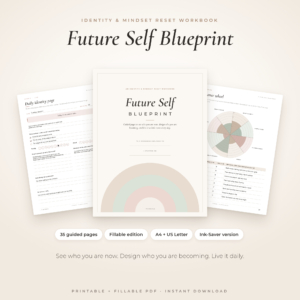
Future Self Blueprint Workbook
Price: $5.99 | Best for: People who want a guided path instead of a blank page
This is a printable and fillable identity shift journal, built as a mindset reset and self improvement workbook with a habit tracker included. It comes as a US Letter and A4 PDF, so you can fill it on screen or print it. If you like structure and want future self journaling set up for you, this is the one to start with.
Common mistakes with future self journaling
Let’s be honest about where people go wrong. The first mistake is writing a fantasy. A mansion, a perfect body, no problems. That’s wishing, and it doesn’t tell you what to do on Thursday. Aim for a version of you that is one or two steps ahead, not a movie character.
The second is skipping the present. If your journal only describes the future, you lose track of where you’re starting from. Spend a few lines on today: what’s working, what’s heavy. A map needs a “you are here” dot.
The third is going big on actions. “I’ll wake at 5, run, meditate, journal and cold plunge.” Nobody becomes that person in a week. Choose the smallest action that still feels like a vote for the new identity. Two minutes of stretching is a vote.
Another one: waiting to feel ready. You won’t. The first entry will be clumsy, maybe three awkward lines about a person you can barely picture. Keep it anyway. By the tenth entry the voice gets steadier, and the picture gets sharper without any extra effort.
Last, don’t treat the journal as a judge. It’s a notebook. If you write something messy or doubtful, good. That’s honest, and honest pages are the useful ones.
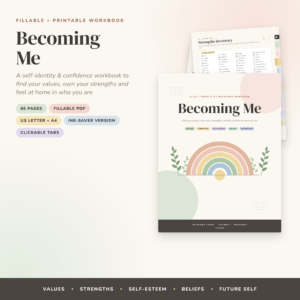
Becoming Me Self-Identity Workbook
Price: $3.99 | Best for: Getting clear on values and strengths before you picture your future self
A 66-page fillable and printable self-discovery workbook covering self-esteem, core values, strengths and confidence. It’s set up as therapy-style worksheets and comes as a US Letter and A4 PDF. Pair it with future self journaling when you’re not sure what your future self should even care about. It’s a self-help tool, not a replacement for a therapist.
One more tip from watching how people use these pages. Read last week’s entries every Sunday. Five minutes, no editing. You’ll spot the days you felt most like your future self and what was true about those days: slept well, planned the morning, said no to one thing. Those details become next week’s prompts.
Pairing your journal with a simple tracker
Writing builds the picture. Tracking builds the proof. If you only do one, the picture fades and the proof has no meaning. Together they work well, and it takes about thirty seconds extra.
Say your future self drinks water first thing and walks after lunch. Put those two habits on a monthly tracker and tick them off each night while you write your evening line. After two weeks, flip back. You’ll see a pattern: the days with ticks are the days you wrote your morning lines. That link is hard to argue with.
Keep the tracker short. Three habits at most. Anything more and the page turns into homework.
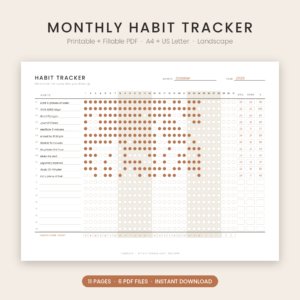
Steady Streak Monthly Habit Tracker
Price: $1.99 | Best for: A simple monthly view of the habits you’re building
A printable and fillable PDF monthly habit tracker. It’s a light, low-cost way to check that your future self’s daily actions are happening. Print a fresh page each month and keep it beside your journal.
Comparing your options
| Product | Format | Price | Best for | Link |
|---|---|---|---|---|
| Future Self Blueprint Workbook | Printable and fillable PDF, US Letter and A4 | $5.99 | Identity shift journaling with a habit tracker | View product |
| Becoming Me Self-Identity Workbook | 66-page fillable and printable PDF, US Letter and A4 | $3.99 | Values, strengths and confidence | View product |
| Steady Streak Monthly Habit Tracker | Printable and fillable PDF | $1.99 | Tracking daily habits | View product |
If you want just one purchase, pick the Future Self Blueprint Workbook, since it already includes a habit tracker. The other two are good add-ons when you need a deeper look at values or a monthly view.
A quick note: journaling is general self-help and general information. It isn’t professional advice, and it doesn’t replace talking to a therapist if you’re struggling.
Frequently asked questions
How long should future self journaling take each day?
Five to ten minutes is plenty. A short morning entry, a quick midday glance and a one-line evening note covers it. On busy days, just write the single action your future self would take. Consistency matters far more than length, so keep it small enough that you’ll really do it.
Is future self journaling just positive thinking?
No. Positive thinking tells you to feel good about the outcome. This asks you to pick a specific action today and record if it got done. You also write down doubts and missed days. That honest record is what builds a real change, not a mood.
Should I write by hand or on a screen?
Whichever you’ll use. Many people like handwriting because it slows the mind down, and a printed workbook is easy to leave in view. Fillable PDFs suit people who type faster than they write. Pick the format that removes the most friction for you.
What if I don’t know who my future self is?
That’s common. Start with values: what matters to you, and what do you want more of? A values worksheet can help you find words for it. Then picture one ordinary day a year from now. You don’t need the full picture, only the next step.
How long until I notice a change?
It varies, and no one can promise a timeline. Many people notice small shifts in how they talk to themselves within a few weeks of daily entries. Track your actions, not your feelings, and look back after 30 days at what you actually did.
Your next step
So, the short version: describe one ordinary day for your future self, pick one action from it, and write it down tonight. That’s it. If you’d like the pages laid out for you, the Future Self Blueprint Workbook gives you the identity shift journal and the habit tracker in one printable PDF. Print it, grab a pen, and cast your first vote today.