Open a Bible cold and it is easy to feel lost. Sixty six books, written over many centuries, in poetry, law, letters, history and visions. Nobody tells you which ones to read first or what each one is even about. This books of the bible summary gives you the short version of every book, grouped the way the Bible is arranged, in plain language. No theology degree needed. Keep it open while you read, and if you want the printed version with study questions, we point out three Taskdale options below.
Quick picks
| Product | Best for | Price | Link |
|---|---|---|---|
| Scripture Made Clear Bible Book Overviews | Group study with questions and an answer guide | $5.99 | View |
| Scripture Snapshots Illustrated Bible Study Guide | Visual learners going book by book | $7.49 | View |
| Lamp & Path Bible Study Companion | Summaries plus a big question workbook | $5.99 | View |
How the Bible Is Organized Before You Start a Books of the Bible Summary
The Bible is a library, not a single book. That one idea clears up a lot of confusion. The first 39 books tell the story of God and his people up to the time before Jesus. The last 27 cover the life of Jesus, the early church, and letters written to new believers.
The books are arranged by type, not by date. So Job, one of the oldest, sits in the middle. And the letters in the back are ordered by length, roughly, not by when they were written. Once you know the types, you know what to expect from each book. Law and history tell stories. Wisdom books are poems and sayings. Prophets deliver messages. Gospels tell about Jesus. Letters answer real questions from real churches.
Why a Books of the Bible Summary Helps (and Where It Falls Short)
A good books of the bible summary does one job well: it tells you what you are walking into. Imagine opening Habakkuk with no idea who is talking or why. Ten minutes later you would give up. With a two line summary first, the same pages make sense, because you know a prophet is arguing with God about injustice.
But a summary is a map, not the trip. It cannot replace reading the text, and it cannot tell you what a passage means for your own week. Use it to get oriented, then spend your real time in the book itself. Most people who stay with the Bible for years do exactly that.
Let’s go group by group.
Books of the Bible Summary: The Law (Genesis to Deuteronomy)
These five books are called the Law, or the Pentateuch. They open the whole Bible.
Genesis covers beginnings: creation, the first family, the flood, and the stories of Abraham, Isaac, Jacob and Joseph. Exodus follows the people out of slavery in Egypt, through the Red Sea, and to Mount Sinai where they receive the Ten Commandments. Leviticus is a rulebook for worship and holy living. It is the book where many a reading plan dies, so read it in small bites. Numbers tracks forty years of wandering in the desert. Deuteronomy is Moses giving his last speeches before the people enter the promised land.
The History Books in This Books of the Bible Summary (Joshua to Esther)
Twelve books carry the story forward.
Joshua is the conquest of the promised land. Judges is a rough cycle of failure and rescue. Ruth is a short, warm story of loyalty between two widows. 1 and 2 Samuel follow Samuel, Saul and David as Israel gets its first kings. 1 and 2 Kings trace the kingdom as it splits and slides toward exile. 1 and 2 Chronicles retell much of that history with a focus on the temple and worship. Ezra and Nehemiah cover the return from exile and the rebuilding of the temple and the city walls. Esther tells how a young queen risked everything to save her people.
The Wisdom and Poetry Books (Job to Song of Solomon)
These five books are the Bible’s heart on the page.
Job wrestles with why good people suffer. Psalms is 150 songs and prayers, from joy to rage to grief. If you only read one book for comfort, it is often this one. Proverbs is short, practical sayings about work, money, words and friends. Ecclesiastes asks what life is for, and answers with an honest, slightly tired voice. Song of Solomon is a love poem.
The Prophets: Major and Minor
The prophets spoke to people who had drifted from God, warning them and also promising hope. The “major” and “minor” labels refer to length, not importance.
The five major prophets
Isaiah mixes judgment with some of the Bible’s most hopeful promises. Jeremiah is the weeping prophet, writing as Jerusalem falls. Lamentations is a set of grief poems for that fall. Ezekiel is full of visions, written from exile. Daniel has the lions’ den and strange dreams about future kingdoms.
The twelve minor prophets
Hosea uses a painful marriage as a picture of God’s faithfulness. Joel speaks about a locust plague and a coming day of the Lord. Amos calls out injustice. Obadiah is the shortest book of the first 39, a warning to Edom. Jonah is a reluctant prophet and a big fish. Micah pairs warnings with a promise of a ruler from Bethlehem. Nahum speaks against Nineveh. Habakkuk argues with God and ends in trust. Zephaniah warns of judgment and promises restoration. Haggai pushes people to rebuild the temple. Zechariah has visions to encourage the rebuilders. Malachi closes this section with a call to return to God.
The Gospels and Acts
Here the story turns to Jesus.
Matthew shows Jesus as the promised king, and includes the Sermon on the Mount. Mark is short and fast, the best place for a new reader to start. Luke is detailed and warm, with many stories about people on the edges of society. John is more reflective, and shares seven signs and long talks with Jesus. Acts is the sequel to Luke. It follows the first Christians as the church spreads from Jerusalem across the Roman world.
The Letters of Paul
Thirteen letters carry Paul’s name, written to churches and to individuals.
Romans lays out the gospel in careful order. 1 and 2 Corinthians deal with a messy, divided church. Galatians defends the idea that we are made right by faith, not rule keeping. Ephesians describes the church as one body. Philippians is a joyful letter written from prison. Colossians puts Christ at the centre of everything. 1 and 2 Thessalonians encourage new believers who are worried about the future. 1 and 2 Timothy and Titus advise young church leaders. Philemon is a short, personal plea about a runaway slave.
The General Letters and Revelation
Hebrews shows how Jesus fulfils the old system of worship. James is practical: faith should show up in how you live. 1 and 2 Peter help people facing hard times. 1, 2 and 3 John focus on love and truth. Jude warns against false teachers. And Revelation closes the Bible with visions of the end of evil and a new creation. It uses a lot of symbols, so go slowly and expect some questions.
Printable Study Guides That Cover All 66 Books
A quick summary gets you oriented, and a longer books of the bible summary in printed form gives you room to write notes. If you want to go further, a printed guide helps you stay with it. These three are on Taskdale, and everything below comes from the product listings.
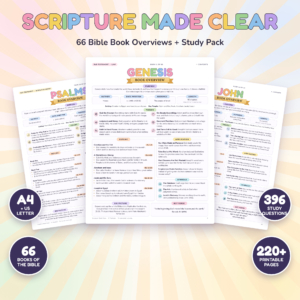
Scripture Made Clear Bible Book Overviews
Price: $5.99 | Best for: Groups and leaders who want questions and answers ready
A printable overview of all 66 books with study questions, a leader answer guide, a reading plan and memory verse cards. It comes as a US Letter and A4 PDF. A study group leader will like having the answer guide on hand.
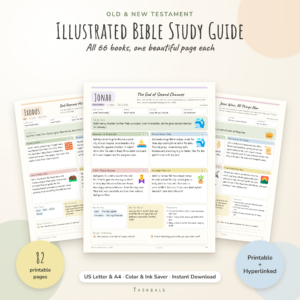
Scripture Snapshots: Illustrated Bible Study Guide for All 66 Books
Price: $7.49 | Best for: Visual learners who like pictures with their summaries
An illustrated Bible study guide that covers all 66 books. If you remember things better when you can see them, this one is built for you. It is the pick for working through the Bible one book at a time.
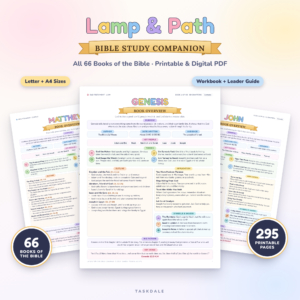
Lamp & Path Bible Study Companion
Price: $5.99 | Best for: Readers who want depth and lots of questions
A printable Bible study guide with summaries of all 66 books, a 396-question workbook, a leader guide and a one-year reading plan, as a US Letter and A4 PDF. With that many questions, you can keep going for months.
Comparing the Three Guides
| Product | Format | Price | Best for | Link |
|---|---|---|---|---|
| Scripture Made Clear Bible Book Overviews | US Letter and A4 PDF | $5.99 | Questions, leader answer guide, memory verse cards | View |
| Scripture Snapshots Illustrated Bible Study Guide | Illustrated study guide | $7.49 | Visual learners | View |
| Lamp & Path Bible Study Companion | US Letter and A4 PDF | $5.99 | 396-question workbook and one-year plan | View |
How to Use a Books of the Bible Summary Without Getting Overwhelmed
Every books of the bible summary, including this one, works best in small doses. Do not try to learn all 66 at once. Pick one book, read the summary, then read the book itself. The summary acts like a map, so you know where you are while you walk.
A few habits help. Read the summary first, then the text, then the summary again to see what stuck. Write one sentence per book in your own words. That sentence is yours, and it will stay in your head far longer than anything copied. And if you are new, start with Mark, then Acts, then Genesis. That order gives you the center of the story before the long background.
If you study with others, try a simple rhythm: one book a week for the short ones, and two or three weeks for the long ones. Each person shares one thing that surprised them. It takes about twenty minutes, it costs nothing, and it gets even quiet members talking. Memory verse cards, like the ones in Scripture Made Clear, make a nice closing activity.
Books of the Bible Summary FAQ
How many books are in the Bible?
There are 66 books in the Protestant Bible: 39 in the first section and 27 in the second. Some Christian traditions include extra books, so the count can differ depending on which Bible you hold. Most study guides use the 66 book list.
Which book of the Bible should a beginner read first?
Mark is the usual suggestion. It is short, quick and tells the story of Jesus plainly. After that, many people read Acts, then Genesis, then Psalms alongside them for variety. John is also a popular first pick for its personal feel.
What is the shortest book of the Bible?
By word count, 2 John and 3 John are usually named as the shortest, each only one chapter of a few verses. Obadiah is the shortest book in the first 39. Reading one takes only a few minutes.
Are the books in the order they were written?
No. They are grouped by type, such as law, history, poetry, prophets, Gospels and letters. That is why some of the oldest writings, like Job, appear in the middle. A guide that explains each book helps you place them in time.
Is there a printable summary of all 66 books?
Yes. Taskdale carries several, including Scripture Made Clear, Scripture Snapshots and Lamp & Path. They differ in style, so check which mix of questions, pictures and reading plan suits you best.
Your Next Step
So, the short version: use the summaries above to pick your starting book, then add a guide so you actually stay with it. For most beginners the Lamp & Path Bible Study Companion is the best value at $5.99, with summaries, a workbook and a one-year plan in one file. Group leaders may prefer Scripture Made Clear for its leader answer guide. Print it, pick Mark, and start tonight.