A short CV is a kindness to the person reading it. They have a pile of applications, a meeting in ten minutes and a role to fill. A page that tells them who you are, what you have done and why it matters, in under a minute, gets read properly. A three-page wall of text gets skimmed and set aside.
Short does not mean thin, though. The skill is choosing. Every line on a short CV has to earn its place, and that means cutting things you are proud of.
Below you will find a complete one-page CV example, notes on why each part made the cut, a priority list for what to remove first, a simple formula for writing short bullets, and ways to keep even a 20-year career on a single page.
Quick picks: one-page CV layouts
| Product | Best for | Price | Link |
|---|---|---|---|
| Alder Resume Template with Photo | A tidy 1-page two-column layout | $4.79 | View |
| Sloane Resume Template | A slim sidebar that saves space | $4.49 | View |
| Marlowe Resume Template | Calm one-pagers with a 2-page version in reserve | $4.79 | View |
| Hollis Resume Template | 1-page ATS and design versions side by side | $8.99 | View |
What counts as a short CV
For most people, short means one page. In words, that is usually somewhere between 350 and 550, including headings. Any more and the font has to shrink or the margins vanish, and the page stops being easy to read.
Think about how it gets read. A hiring manager glances at your name and current title, jumps to your most recent job, reads the first bullet or two, checks dates for gaps, then glances at education and skills. If something catches their eye, they go back and read properly. If not, the next CV.
A short CV is built for that glance. The most important facts sit where the eye lands first. Everything else is either gone or tucked into one line.
If you are torn between one and two pages for your situation, our guide on how long a resume should be compares 1, 2 and 3 page versions with examples of who each suits.
The full short CV example
Here is a complete one-page CV for Sam Okafor, a project coordinator with six years of experience, applying for a project manager role at a construction firm. It runs to about 420 words.
Sam Okafor
Project Coordinator | Phone | Email | Leeds | LinkedIn
Profile
Project coordinator with six years in commercial fit-out and construction. Keeps budgets, suppliers and site teams moving on jobs from 2 to 14 weeks long. Ready to step up to project manager on mid-size commercial work.
Experience
Project Coordinator, regional fit-out contractor, 2022 to present
- Coordinate 6 to 8 office and retail fit-outs at a time, each with budgets up to 400,000.
- Built a shared delivery schedule that cut site waiting time for materials on most jobs.
- Run weekly progress meetings with clients, site leads and subcontractors.
- Stepped in as acting project manager on two jobs during staff leave; both finished on time.
Assistant Project Coordinator, building services firm, 2020 to 2022
- Tracked orders, deliveries and invoices for a team of four project managers.
- Set up a simple snag list template now used on every job.
Earlier roles: Office administrator and site receptionist, 2018 to 2020.
Education and training
BSc Construction Management, 2018
Site safety and first aid certificates, current
Skills
Scheduling software, Excel (budgets and trackers), supplier negotiation, client reporting, reading drawings
That is the whole thing. One page, nothing missing that a construction hiring manager would need on first read.
Why each line made the cut
The title under the name
“Project Coordinator” tells the reader who Sam is before they read a word of the profile. It costs one line and saves them working it out.
A three-sentence profile
Sentence one: field and length of time. Sentence two: the core strength, with scale (“2 to 14 weeks”). Sentence three: the next step. No adjectives about personality. The bullets will prove those.
Four bullets on the current job, two on the last
The current role gets the most space because it is the most relevant. The acting project manager bullet is there for one reason: it answers the hiring manager’s biggest question, “Can this person do the bigger job?”
Earlier roles in one line
Sam’s receptionist and admin jobs matter less now. Listing them in full would steal half a page. One line shows there is no gap and moves on.
No hobbies, no references, no full address
None of these help a reader decide in the first minute. References can go on a separate page if asked for. A city is enough location.
A layout with a narrow sidebar is handy for a page like this, because skills and education sit to the side and leave the main column for experience.
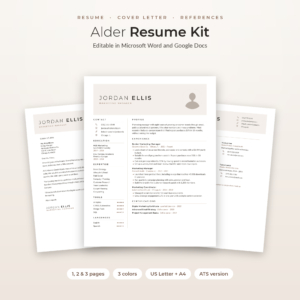
Alder Resume Template with Photo
Price: $4.79 | Best for: people fitting a career onto one page
Alder’s 1-page resume uses two columns with a shaded header, so education, skills and languages sit in a narrow column while experience gets the wide one. There is also a centered 1-page version without a photo and a single-column ATS resume. Everything comes in Mocha, Sage and Slate, in US Letter and A4, with 2 and 3 page versions in reserve, matching letters, and an Excel Job Application Tracker.
What to cut first
When your draft runs to a page and a half, cut in this order. Stop as soon as it fits.
- The objective statement. If you have one, it is probably saying what the profile already says.
- “References available on request”. Everyone knows.
- Hobbies, unless they connect clearly to the job.
- Duties anyone in that job would do. A receptionist answering phones is not news.
- Jobs more than 10 to 15 years old. Fold them into an “Earlier roles” line.
- School grades once you have a degree or a few years of work.
- Repeated bullets. If two jobs say the same thing, keep the stronger one.
- Soft-skill lists. “Communication, teamwork, problem-solving” tells the reader nothing new.
It hurts a little. That course you took in 2014, the award from your first job. Let them go. The page gets stronger with each cut, and there is real satisfaction when it finally clicks onto one sheet without any squeezing.
How to write short bullets that still prove something
Short bullets follow a simple pattern: verb + what you did + the result or scale. Aim for 12 to 20 words. Here are some before-and-after rewrites.
| Before | After |
|---|---|
| I was responsible for managing the day-to-day running of the store’s stockroom and making sure deliveries were checked in properly. | Ran the stockroom and checked in 3 to 4 deliveries a day. |
| Worked closely with the finance team to help improve the process for monthly expense claims across the business. | Simplified monthly expense claims, cutting approval time from two weeks to five days. |
| Helped to train and support new members of staff when they joined the team. | Trained 11 new starters on the booking system in their first week. |
Notice what went. “I was responsible for”, “worked closely with”, “helped to”, “day-to-day”. Those phrases fill space and add nothing. The numbers stayed, because numbers do the convincing.
Three short bullets per job is a good target on a one-page CV. Four for your current role. Two for anything older.
Keeping a long career on one page
Can someone with 20 years of experience really fit on one page? Often, yes, and it can look confident rather than cramped.
- Give detail to the last 10 years only. Older roles become one line each, or one combined line.
- Group similar roles. Three jobs as a sales rep at different firms can sit under one heading with combined dates.
- Pick your top achievements. A senior applicant might have 30 good bullets. Choose the eight that match this job.
- Drop dates on education if they make the page longer or say more about your age than your skills.
That said, some senior roles expect two pages, and squeezing too hard looks odd. If you lead a large team or a big budget, a tight two-pager may serve you better.
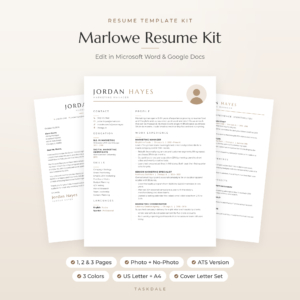
Marlowe Resume Template
Price: $4.79 | Best for: experienced people choosing 1 or 2 pages
Marlowe gives you the same calm design in 1, 2 and 3 page versions, each with and without a photo, so you can build the one-pager and still have a matching two-pager if a job calls for it. The set includes an ATS resume, cover letter, references page and thank-you letter in Sand, Sage and Slate, US Letter and A4. The bonus Resume Playbook has before-and-after bullet examples that help with the cutting.
Layout choices that make a short CV read faster
Words do most of the work, but layout decides how fast the eye finds them.
- Bold job titles, normal weight employer names. The reader cares what you did first, where second.
- Dates aligned on the right. A clean column of dates is easy to scan for gaps.
- Consistent spacing. The same gap after every section makes the page feel ordered.
- A sidebar for small items. Skills, languages and certificates take less space in a narrow column.
- No tiny text. Keep body text at 10 pt or more. If it does not fit at 10, cut words.
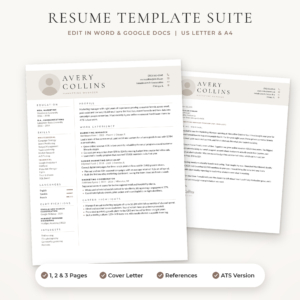
Sloane Resume Template
Price: $4.49 | Best for: job seekers who want a compact page
Sloane puts education, skills and languages in a slim left column and gives work experience the wide right column, which keeps a one-page CV compact without feeling crowded. You get 1-page versions with and without a photo, a 2-page resume, a 3-page CV, an ATS version, a cover letter and a references page, in Stone, Sage and Navy, US Letter and A4. Columns flow onto a new page if you add content, so you can see straight away when you have gone over.
Applying online? Use a single-column version for upload, since some screening software reads sidebars out of order. Our guide to ATS-friendly resumes covers the details.
The 60-second test
Once your page is done, find out whether it really works at a glance. You need one other person and a timer.
- Hand your CV to a friend, partner or neighbor who does not know your work history well.
- Give them exactly 60 seconds to read it, then take it back.
- Ask three questions: What job do I do now? What is the most impressive thing I have done? What job am I applying for?
If they get all three, your page is doing its job. If they hesitate on the second question, your best bullet is buried. Move it to the top of your current role. If they cannot name the job you are applying for, your profile needs a sharper last sentence.
This takes five minutes and is the closest you can get to sitting behind the hiring manager’s desk. Sam tried it with his sister over Sunday lunch. She answered the first question straight away, struggled with the second, and pointed at the acting project manager line only after a pause. He moved that bullet up to first place the same evening.
When short is the wrong choice
A one-page CV suits most jobs. A few situations call for more.
- Academic and research roles often expect a full CV listing publications, grants and teaching. These can run many pages.
- Some government and public sector applications ask for detailed work histories with every role and date.
- Senior leadership roles sometimes need two pages to show scale and range.
- Technical contract roles where agencies search for many specific tools may need room for a long skills list.
Read the advert. If it asks for a full employment history or a specific length, follow that over any general rule.
Still choosing a design? Our comparison of the best resume templates for Word and Google Docs shows which layouts handle one page well.
Frequently asked questions
Is a one-page CV enough?
For most people with under ten years of experience, yes. It is often better than two pages, because the reader sees everything at once. Longer careers can still fit if older roles are summarized.
How many words should a short CV have?
Roughly 350 to 550 words on one page, depending on the layout and font size. Beyond that the page usually gets crowded.
What should I leave off a short CV?
Objective statements, references, full addresses, school grades once you have a degree, hobbies with no link to the job, and duties that anyone in your role would have.
How many bullet points per job on a one-page CV?
Three or four for your current or most relevant job, two or three for the one before, and a single line for older roles.
Does a short CV look less experienced?
No. A tight page with strong results often reads as more confident than a long one. Experience shows through the numbers and job titles, not the page count.
Should my cover letter be short too?
Yes. Three or four paragraphs on one page is plenty. It should add one story or reason the CV cannot, not repeat the bullets.
Your next step
Print your current CV, take a pen, and work through the cut list above from the top until it fits on one page. Then rewrite your three weakest bullets with the verb, task and result pattern. Drop the finished text into a compact layout such as the Alder Resume Template, and you will have a CV someone can read properly in the minute they have.