It is 9:40 on a Tuesday. Breakfast dishes are still on the table, the toddler is wearing one sock, and your nine year old wants to know if math counts if she does it upside down. Every homeschool parent has lived this morning. A workable homeschool schedule does not fix it, but it gives the day a spine. Below you will find real schedule examples from kindergarten to high school, the thinking behind them, and the planners that help you keep the plan on paper instead of in your head.
Quick picks
| Product | Best for | Price | Link |
|---|---|---|---|
| Rainbow Days Homeschool Weekly Planner | A weekly planner and command center for a busy family | $6.99 | View |
| Little Oak Homeschool Planner Spreadsheet | Excel fans who want the whole week in one workbook | $8.99 | View |
| Brightpath Homeschool Planner Spreadsheet | A spreadsheet plus printable pages at a friendly price | $6.99 | View |
What a good homeschool schedule really does
Let us clear up a myth. A schedule is not a cage. It is a default. On a good day it tells you what comes next so you do not have to decide fifty times. On a bad day it gives you somewhere to restart.
The best homeschool schedule has three parts: an anchor, a flow and some slack. The anchor is the one or two things that happen at roughly the same time every day, like a morning read-aloud at nine. The flow is the order of subjects around it. The slack is the empty ten minutes between things, because kids spill milk and printers jam.
One more thing. Schedules and routines are different. A schedule says “math at 10:00”. A routine says “after snack, we do math”. Younger kids usually thrive on routines, and older ones on clock times. Many families end up with a mix.
Homeschool schedule examples for kindergarten and first grade
Little kids learn in short bursts, so a full homeschool day for a five or six year old can be shockingly brief. Think one to two hours of focused time, with play and outdoor time doing a lot of the learning.
Here is a sample. At 9:00, a calendar and read-aloud on the couch. At 9:20, phonics with a hands-on game. At 9:45, a movement break, even if it is just ten jumps and a dance. At 10:00, math with blocks or counters. At 10:25, snack. At 10:45, art, science play or a nature walk. Done by 11:30, and the rest of the day is for reading, building and being a kid.
Do not stretch it. If your daughter is tired after twenty minutes of writing, stop at twenty. Short and consistent beats long and cranky, every single time.
Homeschool schedule examples for elementary (grades 2 to 5)
Now the day gets longer, usually three to four hours. A good pattern is to put the heavy subjects first while minds are fresh and leave the lighter ones for after lunch.
A typical morning: 8:30 morning basket with a poem, a bit of history or a short story. 9:00 math. 9:50 break. 10:10 language arts, covering reading, spelling and writing. 11:00 outside time. 11:30 science or history, alternating by day. Lunch at noon. After lunch, 1:00 for art, music, a project, library time or a co-op class. Finish by 2:00.
Many families use a loop schedule for the extras. Instead of assigning art to Tuesday and music to Thursday, you keep a list of subjects and do the next one each day. If you miss a day, nothing falls behind. You just pick up where the list left off.
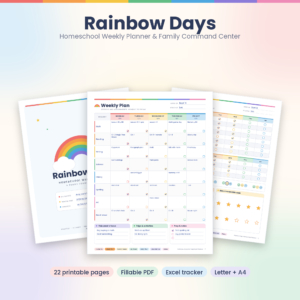
Rainbow Days Homeschool Weekly Planner
Price: $6.99 | Best for: busy families who want one weekly planner for the whole home school
Rainbow Days is built around the week, so it suits parents who think in weeks more than days and want one home base for the family routine.
Homeschool schedule examples for middle school
Middle schoolers need more independence and more sleep than anyone admits. Aim for four to five hours, and start a little later if you can. A thirteen year old who is up at 6:30 and dragged to the table at 7:30 will not learn much.
Try this. At 9:00, a short family start with a check-in on the plan for the day. 9:15 to 10:30, math and one other core subject done independently, with you available for questions. 10:30 break and snack. 10:50 to 12:00, writing or a project that you review together. Lunch. 1:00 to 2:30, science, history or a co-op block. Finish with 20 minutes of reading on the couch.
The key at this age is a weekly checklist. Give your child a list of what must be done by Friday and let them decide the order. They will grumble, then grow. It is the first taste of managing their own time.
Homeschool schedule examples for high school
High school is about credits, so it helps to schedule in blocks. Many teens do best with two or three long blocks instead of eight short ones. A sample day: 8:30 to 10:30, math and science. Break. 10:45 to 12:30, English and history. Lunch. 1:15 to 3:00, an elective, a language, a dual enrollment class or a job.
Teens also need real flexibility. Sports, jobs, volunteering and driving lessons cut into the day. Plan weekly, not daily, and let them tell you where each class fits. You are moving from teacher to coach.
If your teen works better at night, believe them and plan around it, as long as the work gets done and sleep is protected. A schedule only matters if it matches the person living it.
Block, loop and four-day homeschool schedule examples
Not every family wants a clock-based day. Here are three other shapes that work.
A block schedule groups subjects by day. Monday and Wednesday are math and science heavy, Tuesday and Thursday cover writing and history. It means fewer transitions and deeper focus. A loop schedule, as mentioned, is a rotating list for the extras. And a four-day week keeps Friday free for field trips, co-op or catch-up. Plenty of parents find that a flexible fifth day saves the entire week.
Pick one shape for a month and see how it feels. If you are drowning by Thursday, shorten the day. If your kids finish by 11:00 and drift, add a project block. Tweaking is normal.
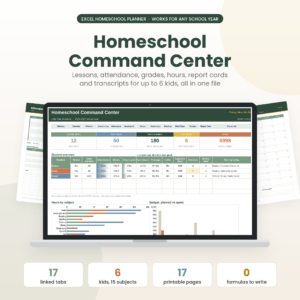
Little Oak Homeschool Planner Spreadsheet
Price: $8.99 | Best for: families who want one Excel workbook that holds the plan
Little Oak is a homeschool planner spreadsheet for Excel, set up as a command center. It suits parents who like to build and adjust a schedule on screen, then keep lessons and records in the same file as the school year rolls along.
Mistakes that break a homeschool schedule
I see three again and again. First, overplanning. A day packed from 8:00 to 4:00 collapses at 8:20. Second, copying someone else’s perfect routine without asking if it fits your kids. A family with a newborn and a family with four teens need different days. Third, forgetting breaks, meals and the buffer time that makes everything else possible.
The fix is to start small. Plan the first hour well. Add one thing at a time. When it works for two weeks, add another. This is how routines stick without any drama.
And please, build in room for a rough day. If the plan says seven things and you do three, you did school. Mark it and move on.
How to write your own homeschool schedule in an evening
Grab a cup of tea and a blank page, or open your planner. Start by writing the fixed items: meals, naps, co-op, music lessons, work hours. Then place your anchor, the one thing that must happen daily. Next, drop in your core subjects in their best slots. Last, add the extras where they fit.
Try it for a week, then ask each child what worked. Kids are good at this. A ten year old will tell you flat out that she hates math right after lunch, and she will be right. Move it.
Keep the plan visible. Print the week and stick it on the fridge, or keep it open on a shared screen. A plan nobody sees is just a wish.
Finally, review it every term. Kids grow, interests shift and what worked in September may feel tight by January. Ten minutes at the start of each term, with a pencil and fresh eyes, keeps the schedule honest. Ask what you want to keep, what you want to drop and what keeps getting skipped. Whatever keeps getting skipped probably does not belong in that slot.
That small review is where most families find their groove. Be patient with it, and with yourself.
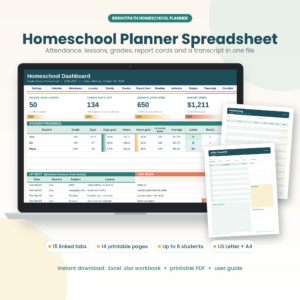
Brightpath Homeschool Planner Spreadsheet
Price: $6.99 | Best for: families who want a spreadsheet and printable pages at a low price
Brightpath is a homeschool planner spreadsheet that comes with printable pages. At $6.99 it is an easy way to get your schedule out of your head and into a weekly view you can print, tweak and stick where everyone can see it.
Which homeschool schedule planner fits your family?
If you want one weekly command center for the whole house, start with Rainbow Days. If you like a spreadsheet that can hold the schedule and the year, Little Oak does the job. And if you want a low cost mix of spreadsheet and printable pages, Brightpath is a friendly start. All three are digital downloads, so you can try a schedule today and adjust it tomorrow.
One last thought on the homeschool schedule you choose. Write it in pencil, or in a file you can edit in seconds. The first version is never the final one. By the third week you will know that your son needs a movement break before math, that your daughter wakes up sharper after a walk, and that Wednesdays are always chaos because of the co-op drive. Fold those facts in and the day starts to run itself.
Think of the planner as a notebook where you keep the experiments. Which ones worked, which ones flopped and what you want to try next term. That record is worth more than any template, because it is about your kids.
| Product | Format | Price | Best for | Link |
|---|---|---|---|---|
| Rainbow Days Homeschool Weekly Planner | Weekly planner and command center | $6.99 | A busy family week in one place | View |
| Little Oak Homeschool Planner Spreadsheet | Excel spreadsheet | $8.99 | Building and adjusting a schedule on screen | View |
| Brightpath Homeschool Planner Spreadsheet | Spreadsheet + printable pages | $6.99 | A budget friendly weekly view | View |
Frequently asked questions
How many hours a day should homeschool take?
It varies by age. Kindergarten and first grade often need only one to two hours of focused work. Elementary usually takes three to four, middle school four to five, and high school depends on credits and electives. Check any local requirements, then adjust to your child.
What time should a homeschool day start?
Whenever it suits your family. Many start between 8:30 and 9:30 after breakfast and chores. Teens often do better a little later. Pick a time you can keep most days, and use an anchor activity like a read-aloud to begin.
Should I follow a strict homeschool schedule?
Most families do better with a flexible one. A loose routine gives structure without stress, and it handles sick days and surprises. Keep one or two anchors fixed, let the rest flow, and leave a few empty minutes between subjects.
How do I schedule homeschool with several kids?
Group children for shared subjects like history, science and read-alouds, then give each a separate block for math and language arts. Stagger independent work so you can help one while another works alone. A weekly view makes the overlaps easy to spot.
How long does it take to find a homeschool schedule that works?
Expect a few weeks. Try one version for two weeks, note what fell apart, and change one thing at a time. Most families settle into a rhythm within a month, then adjust again each term as the kids grow.
Your next step
So, the short version: pick the example closest to your kids, copy it onto a weekly page, and run it for two weeks without judging yourself. If you want a ready place to keep it, Rainbow Days Homeschool Weekly Planner is the best fit for a busy family week. Adjust as you go, and give the plan a fair try before you decide it does not work.