You’ve been eating well and moving more for three weeks. The scale hasn’t budged. Maybe it even went up a pound. That moment is where lots of people throw in the towel, and it’s a shame, because the scale is only one number and it’s a pretty moody one. A body measurement tracker gives you a second set of numbers, and often a more honest picture of what’s changing. Here’s how to set one up, what to measure, and how to read the results when the scale stalls.
Quick picks for a body measurement tracker
| Product | Best for | Price | Link |
|---|---|---|---|
| Steady Reps Workout Planner | Measurements next to your lifting log | $3.79 | View |
| The Complete Health & Fitness Planner | Measurement trackers with workouts and meals | $4.25 | View |
| Scale Story 52-Week Weight Loss Tracker | Long-term weight log and progress graph | $1.67 | View |
| Well Within Fitness & Life Planner | Low-cost planner for workouts, meals and habits | $1.19 | View |
Why the scale stalls (and why it’s not always bad news)
Your weight at any moment is more than fat. It includes water, food still moving through your gut, salt from last night’s takeout, and for many women, shifts that happen across the month. It’s normal for the number to wander by a few pounds from one day to the next without any real change in body fat.
Then there’s muscle. If you’ve started strength training, your body can build some muscle while losing fat. Muscle takes up less room than fat does, so your clothes can fit better while the scale stays put. That’s the classic “my jeans are loose but I weigh the same” story, and it’s real.
So a stalled scale doesn’t always mean a stalled body. It means you need more than one way to look. That’s where measurements come in.
Fair warning, though: measurements aren’t magic either. They have their own wobble. The aim isn’t to find one perfect number. It’s to collect a few honest ones and watch the direction over weeks.
What to measure with a body measurement tracker
Keep the list short and consistent. Here are the usual spots.
- Chest, around the fullest part
- Waist, at the narrowest point or at the belly button, your choice, but stick with it
- Hips, around the widest part
- Upper arm, midway between shoulder and elbow
- Thigh, about halfway between hip and knee
Some people add neck and calf. That’s fine. Just don’t add so many spots that measuring day becomes a chore. Five or six places is plenty.
Get a soft tape and use it the same way every time
A flexible tape measure from a sewing kit works well. Keep the tape snug but not squeezing. Stand relaxed, don’t suck in, and measure on bare skin or thin clothing. Write down exactly where you measured, like “waist, 1 inch above belly button,” so you can repeat it next time. A tiny difference in where you place the tape can change the number by more than your real progress would.
Pick one day and one time
Measure every two weeks, or once a month if you prefer. Same time of day, ideally in the morning before eating. Weekly measuring tends to be too frequent, because changes are small and tape error can look bigger than the progress.
How to read your body measurement tracker results
After a few entries, you’ll have a little table of numbers. Here’s how to make sense of it.
Look at the trend, not the single reading. If your waist was 34 inches, then 34.5, then 33.75, then 33.5, the story is “slowly going down,” even though one reading went up. That’s normal noise.
Compare more than one place. If your waist and hips are shrinking while your arms and thighs stay level or grow slightly, you may be losing fat while building some muscle. If everything stays flat for six weeks, it’s time to look at your habits, not to panic.
And remember that bodies lose in different orders. Some people drop an inch from their face and chest first, others from their waist. You don’t get to pick. Patience here is hard but it pays.
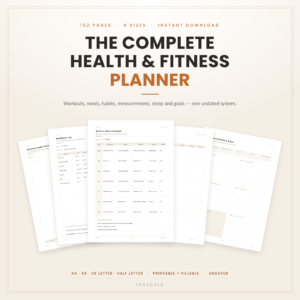
The Complete Health & Fitness Planner
Price: $4.25 | Best for: measurements tracked next to workouts and meals
A 102-page undated printable fitness planner with a workout log, meal planner, habit tracker and measurement trackers. It comes in A4, US Letter, A5 and Half Letter, plus a fillable PDF. Keeping measurements in the same book as your training and food makes it easier to spot what moved the numbers.
Other ways to see progress when the scale stalls
Measurements are one tool. A few more can round out the picture, and none of them cost much.
Progress photos
Take one front photo, one side and one back, in the same spot with the same lighting and the same kind of clothing. Do this every month. You’ll rarely notice changes in the mirror because you see yourself daily, but photos side by side can surprise you. If photos feel stressful, skip them. They’re optional.
How your clothes fit
Pick one pair of trousers or a belt notch and check it monthly. It’s low-tech and oddly motivating when the waistband finally gives.
Strength and stamina
Can you carry the shopping up the stairs with less huffing? Do your reps with a slightly heavier weight? Those wins show a stronger body even when the scale is quiet. Write them down in a notes box so you can see them later.
Energy, sleep and mood
Not every sign of progress is visible. If you sleep better and feel less drained at 3 pm, something is working. A short daily note, even a one-word rating, builds a record you’ll be glad to have.
Keeping the weight log without letting it run your day
Weighing yourself doesn’t have to be a daily verdict. Some people weigh daily and use the average of the week, which smooths out the water swings. Others weigh once a week. Both are fine, as long as you treat the number as data and not as a grade.
If you do weigh often, plot the points on a simple chart. The line shows the direction clearly, even when single points zigzag. A graph makes it much easier to notice a real trend and ignore the noise.
A paper weight log with a progress graph handles this neatly. You see the dots, you see the line, and you stop obsessing over today’s dot.
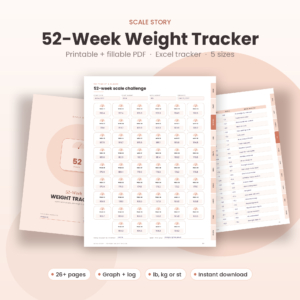
Scale Story 52-Week Weight Loss Tracker Printable
Price: $1.67 | Best for: a year-long weight log with a progress graph
A printable tracker with a fillable PDF weight log, a progress graph and an Excel tracker. It comes in Letter, A4, A5, Half Letter and Classic sizes. Pair it with a measurement log and you have two views of the same story.
Putting measurements and lifting numbers in one file
If you lift weights, there is a good argument for keeping your tape measure numbers beside your training log. When your arm measurement creeps up a quarter inch in the same month your overhead press improved, you can see the link. A spreadsheet planner with a body measurements section makes that easy, and it can chart the trend for you so you do not have to squint at a column of numbers.
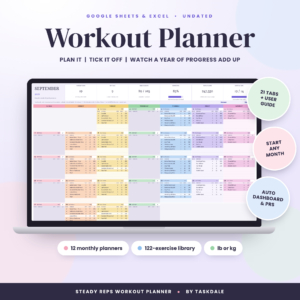
Steady Reps Workout Planner
Price: $3.79 | Best for: measurements next to your lifting log
An undated monthly gym planner spreadsheet for Google Sheets and Excel with a workout log, fitness dashboard, PR tracker, 1RM calculator and body measurements. Good if you want your tape measure numbers and your training numbers sitting in the same file.
Body measurement tracker templates compared
| Product | Format | Price | Best for | Link |
|---|---|---|---|---|
| Steady Reps Workout Planner | Google Sheets & Excel spreadsheet | $3.79 | Measurements next to your lifting log | View |
| The Complete Health & Fitness Planner | 102-page printable, fillable PDF, A4/Letter/A5/Half Letter | $4.25 | Measurements, workouts and meals together | View |
| Scale Story 52-Week Weight Loss Tracker | Fillable PDF weight log, progress graph and Excel tracker | $1.67 | Charting weight over a year | View |
| Well Within Fitness & Life Planner | Printable & fillable PDF | $1.19 | Low-cost all-round fitness planning | View |
A two month example of body measurement tracker numbers
Numbers on a page can feel abstract, so here’s an invented but realistic example. Say someone starts with a 36 inch waist, 42 inch hips and a 12 inch upper arm. After two weeks the waist reads 35.75. After four weeks, 35.5. After six, 35.5 again. After eight, 34.75.
Look at that middle stretch. Weeks four to six show no change, and that’s the moment people give up. Yet two weeks later the waist drops by three quarters of an inch. Progress rarely moves in a straight line. It moves in steps, with flat spots in between.
Now picture the same person on the scale over the same eight weeks. Maybe 168, 169, 167, 168, 167, 168, 166, 167. That’s a mess of ups and downs, and the trend is barely visible. The tape tells a clearer story. This is exactly why having two kinds of numbers is so helpful.
Making measuring day a routine you’ll keep
The best tracker is the one you’ll still use in month four. Treat measuring day like a small appointment. Put it in your phone calendar, pick a spot in the house, and keep the tape and your planner in the same drawer.
Keep it quick. Five measurements should take about three minutes. Write them in, glance at the last entry, and close the book. No analysis spirals. If you want to look closer, do it once a month, not every time.
Some people like to pair it with a small reward that has nothing to do with food, like a new playlist or a long bath. It sounds silly. It works.
Common mistakes with a body measurement tracker
A few things trip people up again and again.
Measuring too often is the first. If you measure every other day, tape slips will look like progress or setbacks. Stick to every two to four weeks and let the changes build up.
The second is changing the method. A different tape, a different spot or a different time of day will change your numbers. Write down your method on the first page and copy it each time.
The third is comparing yourself with someone else’s numbers. Bodies are shaped differently. Your hips and your friend’s hips don’t need to match, and a number that’s right for one person is meaningless for another. Compare only with your own past entries.
The fourth is using the tape as a weapon. If measuring makes you feel awful, step back. A tracker is meant to help you notice progress, not to make you feel worse about your body. For anyone who has struggled with disordered eating or body image, tracking numbers may not be a good idea at all, so speak with a doctor or therapist first.
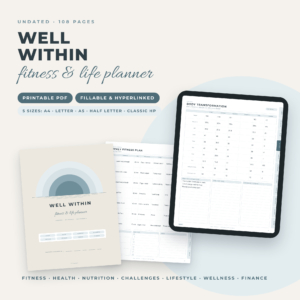
Well Within Fitness & Life Planner
Price: $1.19 | Best for: an affordable planner covering workouts, meals and habits
A printable and fillable PDF fitness planner with workout, meal, weight loss and habit trackers. It comes in A4, Letter, A5, Half Letter and Classic HP sizes. A low-cost starting point if you’re not ready to buy a bigger planner.
A note before you start: this article is general information, not medical advice. If you have a health condition or you’re unsure how to approach weight changes safely, check with a doctor.
Frequently asked questions
How often should I use a body measurement tracker?
Every two to four weeks works for most people. Changes in inches are small, and measuring too often makes normal tape error look like progress or failure. Choose a set day, measure at the same time and record exactly where you placed the tape.
Why am I losing inches but not pounds?
Your weight includes water, muscle and food as well as fat. If you’re exercising, you may be adding some muscle while losing fat, so the scale stays level while your waist shrinks. Looking at both numbers together gives a fuller picture.
Where should I measure my waist?
Choose one spot and keep to it, such as the narrowest part of your torso or level with your belly button. The exact spot matters less than repeating it each time. Note it in your tracker so you can find it again.
Are progress photos necessary?
No. They’re a helpful extra for many people, because changes are easier to see side by side than in the mirror. If photos make you uncomfortable, skip them and rely on measurements, clothes fit and how you feel.
What if my measurements go up?
One higher reading is usually noise from time of day, water or tape placement. Look at the trend over several entries. If numbers rise across a couple of months and you’re not aiming for that, review your habits or talk to a health professional.
Your next step
So, grab a soft tape, write down your five spots and take your first set of numbers today. If you’d like one place to log them alongside workouts and meals, The Complete Health & Fitness Planner is $4.25 and includes measurement trackers, or Steady Reps Workout Planner at $3.79 if you prefer a spreadsheet with body measurements and a PR tracker. Then book your next check-in for two weeks from now, and let the scale be just one voice in the room.