It is August, the curriculum boxes have arrived, and you are staring at a blank calendar wondering how to fit four kids, three subjects and a dentist appointment into one week. A good planner will not teach your children, but it will stop you from losing a Tuesday. This guide compares six picks for the best homeschool planner 2026-2027, from Excel command centers to fillable PDFs and a digital planner. We use only what each listing says, so you can match the format to the way you really work, not the way a Pinterest board says you should.
Quick picks
| Product | Best for | Price | Link |
|---|---|---|---|
| Brightwood Homeschool Planner 2026-2027 | Fillable PDF plus Excel in one bundle | $9.99 | View |
| Hearthside Homeschool Command Center | Records, gradebook and transcript in Excel | $8.99 | View |
| Little Oak Command Center | Excel spreadsheet fans | $8.99 | View |
| Brightpath Homeschool Planner | Spreadsheet plus printable pages on a budget | $6.99 | View |
| Rainbow Days Weekly Planner | Weekly planning with a command center | $6.99 | View |
| Lesson Lane Digital Planner | Tablet-based planning | $9.99 | View |
What the Best Homeschool Planner 2026-2027 Needs to Do
Before you compare anything, decide what job the planner has. Most families want three things, and a few want a fourth.
First, a place to plan lessons week by week. Second, a way to record attendance and grades without hunting for scraps of paper. Third, one spot to keep it all so you are not running a dozen tabs and sticky notes. Fourth, for families with older kids, records that can turn into a transcript later.
If you only need the first, a simple weekly planner is plenty. If you need the rest, a command center style planner that bundles lessons, attendance and grades saves a lot of stress when your state, co-op or umbrella school asks for records.
Ask yourself, too, how you plan. Do you like to sit at the table with a pen and a printed page? Or do you prefer to type once and let a spreadsheet do the math? There is no right answer, only the one that suits your Sunday night.
Excel, Fillable PDF or Digital: Which Format Is Best?
Excel and spreadsheets
A spreadsheet planner does the adding for you. Enter grades, and averages and totals fall into place. It also copies and pastes easily when a plan repeats week after week. The catch is that you need a computer, or at least the Excel app, and you have to be okay with a screen.
Fillable PDF and printables
You can type into a fillable PDF or print it and use a pen. Many families like printed pages in a binder because you can tuck them next to the stack of workbooks. Printing costs ink, so check how many pages you will really use.
Digital planners
A digital planner lives on a tablet and lets you tap between sections. It travels well and never runs out of paper. It suits people who already use a tablet for school work, but it can be fiddly if you prefer handwriting on real paper.
Six Picks for the Best Homeschool Planner 2026-2027
Here is how the six Taskdale planners stack up. Descriptions use what is in each product listing, nothing more.
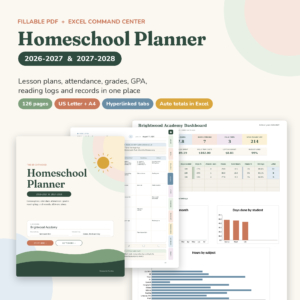
Brightwood Homeschool Planner 2026-2027
Price: $9.99 | Best for: Families who want printable and spreadsheet tools together
A fillable PDF lesson planner with attendance and a grade and GPA tracker, plus an Excel command center. It comes in US Letter and A4. If you like to plan by hand but want a spreadsheet to track the numbers, this bundle covers both.
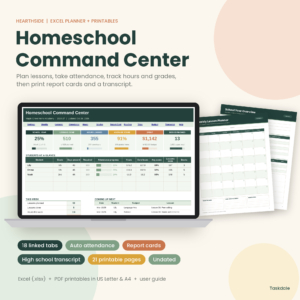
Hearthside Homeschool Command Center
Price: $8.99 | Best for: Families who need records, report cards and a transcript
An Excel homeschool planner with a lesson planner, attendance, gradebook, report cards and transcript, plus 21 printable pages. It comes in US Letter and A4. The transcript is a strong point if you have a high schooler.
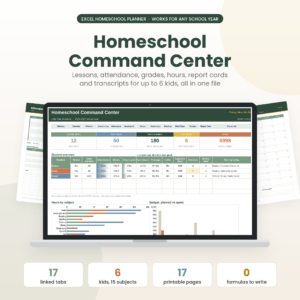
Little Oak Homeschool Planner Spreadsheet
Price: $8.99 | Best for: Excel users who want a command center
A homeschool planner spreadsheet for Excel, set up as a command center. It suits families who like to keep everything in one workbook.
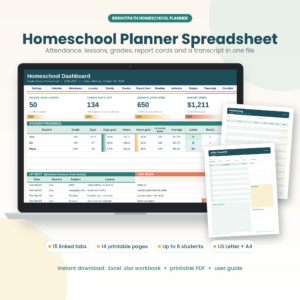
Brightpath Homeschool Planner Spreadsheet
Price: $6.99 | Best for: A lower cost mix of spreadsheet and printable pages
A homeschool planner spreadsheet with printable pages. It is the budget friendly option for families who want some of each format without paying for a larger bundle.
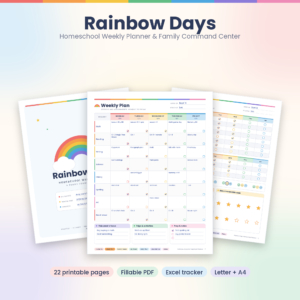
Rainbow Days Homeschool Weekly Planner
Price: $6.99 | Best for: Families who plan by the week
A homeschool weekly planner with a command center. A weekly layout is helpful if you think in weeks rather than daily time slots.
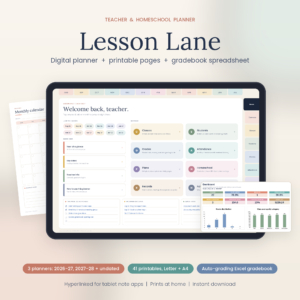
Lesson Lane Digital Planner
Price: $9.99 | Best for: Families who plan on a tablet
A digital teacher planner for 2026-2027 that doubles as a homeschool planner. It is the only digital pick here, so choose it if your planning happens on a screen.
Best Homeschool Planner 2026-2027 Compared Side by Side
| Product | Format | Price | Best for | Link |
|---|---|---|---|---|
| Brightwood Homeschool Planner 2026-2027 | Fillable PDF plus Excel, US Letter and A4 | $9.99 | Lesson planning, attendance, grade and GPA tracking | View |
| Hearthside Homeschool Command Center | Excel plus 21 printable pages, US Letter and A4 | $8.99 | Gradebook, report cards, transcript | View |
| Little Oak Command Center | Excel spreadsheet | $8.99 | All-in-one Excel workbook | View |
| Brightpath Homeschool Planner | Spreadsheet and printable pages | $6.99 | Budget mix of formats | View |
| Rainbow Days Weekly Planner | Weekly planner and command center | $6.99 | Week by week planning | View |
| Lesson Lane Digital Planner | Digital planner | $9.99 | Tablet users | View |
How to Choose Your Best Homeschool Planner 2026-2027
With six options, it helps to narrow by situation. Here is a quick way to decide.
If you have a high schooler, look first at Hearthside, since its listing includes a gradebook, report cards and a transcript. Brightwood is also a good fit because it tracks grades and GPA. If you want one Excel file for everything, Little Oak is the plain choice. On a tight budget, Brightpath and Rainbow Days are the two lowest priced at $6.99 each. And if a tablet is your teaching home, Lesson Lane is the one built for it.
Think about the number of kids, too. A family with five children and a co-op schedule needs more space and more tracking than a family with one child in third grade. Check the listing for what is included before you buy.
And be honest about your habits. A planner you love but never open is worse than a plain one you use every day. If you have started and abandoned three planners already, choose the format that matches your real routine, not your best intentions.
Setting Up Your Planner Before the School Year Starts
Buying is the easy part. A little setup in August makes the whole year smoother.
Start by listing the subjects each child will study and the days you plan to teach. Put in your fixed events first: co-op days, music lessons, field trips. Then slot in lessons around them. Many families plan the first four weeks in detail and the rest in broad strokes, since real life changes the plan anyway.
Next, decide where records live. Attendance and grades go in the same place every week, on Friday afternoon, say. A five minute weekly habit beats a panicked evening in June trying to rebuild the year from memory.
Finally, keep a spare printed page of the schedule on the fridge. Kids like to know what is coming, and you will stop answering “what are we doing today?” forty times.
A Sample Week With Your Planner
Seeing a real week helps. Say you teach Monday to Thursday and keep Friday for catch-up and field trips. On Sunday evening, you open the planner for ten minutes and write in the four lessons per child. Monday morning, you tick off math and reading as you go. By Wednesday, a sick day has wiped out science, so you slide it to Friday. Nothing falls apart, because the plan has a gap built in.
On Friday afternoon, you enter attendance and any grades, then look ahead to next week. That is the whole routine. It takes about fifteen minutes, and it means the dreaded end-of-year paperwork is already done. This rhythm works with any of the planners above. The best homeschool planner 2026-2027 is the one that makes this rhythm feel easy.
Planning for Different Ages and Grade Levels
A first grader and a tenth grader need very different things from a planner. Younger children thrive on short, visual routines: reading, math, a read-aloud, then outside time. For them, the planner is mostly for you, a place to note what you covered.
Older students can start taking charge. A teenager can own a weekly checklist, enter their own assignments and see their grades climb. That ownership is part of the education. If you have a high schooler, records matter more, because grades, credits and a transcript may be needed for college or work later. That is why a gradebook and transcript, like the one listed in Hearthside, carries real weight for some families.
For mixed ages, plan the shared parts first, like read-alouds and science, then fit individual work around them. It saves your voice and your sanity.
Mistakes to Avoid With a Homeschool Planner
The biggest one is over-planning. Writing a perfect schedule for all 180 days feels productive, until week three turns into a cold, a visit and a late library book. Leave gaps.
Another is planning only the lessons and forgetting the records. Many states want attendance or portfolio evidence, and the details differ, so check your local requirements. A planner can store the information, but it cannot tell you what your area asks for.
A third is choosing on looks alone. A pretty layout is nice, but check the features first. And the last is forgetting to back up. If you use a spreadsheet or digital planner, save a copy somewhere else once a month.
Best Homeschool Planner 2026-2027 FAQ
What is the best homeschool planner for 2026-2027?
It depends on how you plan. Brightwood suits families who like a fillable PDF and Excel together, Hearthside suits those who need a gradebook and transcript, and Lesson Lane suits tablet users. Match the format to your routine, then check the listing details.
Is an Excel homeschool planner better than a printed one?
Neither is better in general. Excel handles grade math and copying across weeks well. Printed pages feel easy to carry and write on. Some bundles, such as Brightwood and Hearthside, include both, which helps if you are not sure.
Do I need a homeschool planner for attendance records?
Many families keep attendance in their planner, and several of these options include an attendance tracker. Requirements vary by state or country, so check what your area asks for and keep records that match.
Can I use a planner for more than one child?
Yes, many families do. Check how each product handles multiple students before you buy. A spreadsheet can often hold several students in one file, while printables may need one set per child.
When should I start planning the school year?
Many families begin four to six weeks before the first day. That leaves time to gather curriculum, set the calendar and fill in the first month. Even two weeks of setup is far better than none.
Your Next Step
So, the short version: pick the format you will really use, then buy one planner and set it up this week. For most families, the best homeschool planner 2026-2027 is the Brightwood Homeschool Planner 2026-2027 at $9.99 is the all-round choice, with a fillable PDF lesson planner and an Excel command center. Families who need report cards and a transcript should look at Hearthside. Fill in the first four weeks tonight, then set a Friday reminder to update attendance. The rest of the year gets easier once the habit is in place.