A customer pulls in with a crumpled fender and a long story. You walk around the car, squint at the paint, and scribble a number on the back of a business card. Three days later you pull the bumper off and find a bent support nobody saw. Now you are on the phone explaining why the price changed, with nothing in writing to back you up. A solid auto body estimate template stops that call before it starts. It gives you a standard page to fill in every time, so the customer, the insurer and your own crew all read from the same sheet.
Quick picks
| Product | Best for | Price | Link |
|---|---|---|---|
| CollisionDesk Auto Body Repair Estimate Template | Shops that want a vehicle check-in form with the estimate | $2.99 | View |
| Bodyline Auto Repair Estimate Template | Shops that want a damage diagram on the page | $2.99 | View |
Why Every Body Shop Needs an Auto Body Estimate Template
Body work is hard to price on sight. Damage hides. A dented door might hide a cracked frame piece, and a scraped bumper might hide a broken sensor. That is exactly why the written estimate matters so much. It is your record of what you saw, what you planned to fix, and what you said it would cost on the day.
A plain sheet of paper can do that job, but it rarely does. Details get skipped. Totals get added up wrong. Two techs write the same job two different ways. A good auto body estimate template fixes all of that by giving every job the same bones: customer details, vehicle details, a damage list, parts, labor, paint, tax and a total.
There is a people side too. Customers judge a shop by its paperwork before they judge the repair. A clean, itemized page says “we know what we are doing.” A scribble on a card says the opposite, even if the work is excellent. A well-made auto body estimate template makes that first impression for you.
What an Auto Body Estimate Template Should Include
Let’s go through the sections one by one. If your current form is missing any of these, that is where trouble hides.
Customer and vehicle details
Start with the basics: name, phone number, email, and the vehicle’s make, model, year and plate. Add the VIN and the mileage when the car comes in. These lines look boring until you need them, and then they save you a lot of digging.
A damage description
This is the heart of the page. List each damaged panel and what you plan to do. Repair, replace, refinish, or blend. The more specific you are, the fewer arguments later. “Rear bumper cover: replace and paint” is far better than “fix back end.”
Parts, labor and paint, shown separately
Split the costs into parts, labor hours, paint and materials, and any sublet work such as glass or alignment. Customers and insurers both want to see where the money goes. When everything is lumped together, people assume the worst.
Totals and tax
Subtotal, tax, and the final figure. If your sheet adds these up for you, you avoid the classic mistake of a total that does not match the lines above it.
Terms and approval
Include how long the estimate is good for, what happens if hidden damage turns up, and a spot for the customer to sign. That one signature line turns a rough price into a record both sides agreed to.
Handling Hidden Damage and Supplements
Here is where a body shop earns or loses its reputation. You write the estimate from what you can see. Then the car gets taken apart and new damage shows up. This happens all the time, so plan for it.
When insurance is paying, the extra work usually goes through a supplement. That is a follow-up request for added repairs or costs found after teardown. The insurer reviews it, and the shop waits for approval before going further. Rules differ by insurer and by region, so check how yours handles them.
A good estimate form leaves room for this. You do not want to start a new document from scratch every time something extra turns up. You want a line or section built for it, so the original estimate and the added items sit together and the paper trail stays clean.
Even when no insurer is involved, tell the customer right away. A quick call, a photo of the new damage, and a written note on the form go a long way. People accept a higher bill when they understand it. They do not accept surprises at pickup.
Photos and Damage Diagrams: Small Details That Help
Photos are your best friend. Take them at check-in, from every side, with the date visible if your phone allows it. They protect you if a customer claims a scratch was your fault, and they help the insurer see what you saw.
A damage diagram does a similar job on paper. It is a simple outline of a car where you mark dents, scratches and broken parts. Pointing to a spot on a drawing beats describing it in words, especially at a busy front counter. It also lets the customer confirm, with their own eyes, what you are about to fix.
The same goes for a vehicle check-in form. Before the keys change hands, you note things like existing damage, fuel level, valuables left in the car and warning lights. It takes two minutes. It can save you hours of arguing.
Choosing Your Auto Body Estimate Template
Most shops run on Word, Excel or a mix. A few people like fillable PDFs because they look neat when emailed. The best choice is the file type your front-desk person will use without grumbling. If a template is annoying to fill in, it will not get filled in.
Look for these points before you buy any auto body estimate template:
- File types you already use, such as Word, Excel, Google Docs or fillable PDF
- Totals that add up on their own, so nobody does sums by hand
- A section for insurance supplements
- A way to record the car’s condition on arrival
- Page sizes that match your printer, US Letter or A4
Both Taskdale kits below tick the main boxes. Each is cheap enough to test on a few real jobs. I’m describing only what the listings say, so read the full product page for the details.
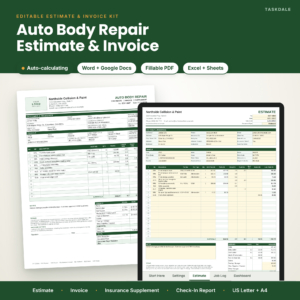
CollisionDesk Auto Body Repair Estimate Template
Price: $2.99 | Best for: shops that want an estimate, an invoice and a check-in form together
CollisionDesk is a body shop estimate and invoice kit for Word, Google Docs, fillable PDF and Excel. The listing mentions auto totals, an insurance supplement and a vehicle check-in form, in US Letter and A4. It suits a shop that wants to start every job with a proper walk-around record.
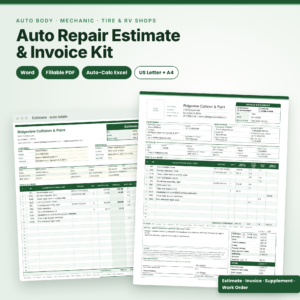
Bodyline Auto Repair Estimate Template
Price: $2.99 | Best for: shops that like to mark damage on a diagram
Bodyline is a body shop estimate and invoice for Word, fillable PDF and Excel. The listing mentions auto totals, an insurance supplement and a damage diagram, in US Letter and A4. If you think better with a picture than with a paragraph, this one fits.
CollisionDesk vs Bodyline Side by Side
| Product | Format | Price | Best for | Link |
|---|---|---|---|---|
| CollisionDesk Auto Body Repair Estimate Template | Word, Google Docs, fillable PDF, Excel; US Letter and A4 | $2.99 | Estimate and invoice with a vehicle check-in form | View |
| Bodyline Auto Repair Estimate Template | Word, fillable PDF, Excel; US Letter and A4 | $2.99 | Estimate and invoice with a damage diagram | View |
The honest difference comes down to two extras. CollisionDesk lists a vehicle check-in form and Google Docs support. Bodyline lists a damage diagram. Both list auto totals and an insurance supplement. If you work in Google Docs or care most about a check-in record, lean toward CollisionDesk. If you want to mark dents on a drawing, lean toward Bodyline.
How to Roll Out a New Estimate Template in Your Shop
A new auto body estimate template only helps if people use it, so here is a simple way to make it stick.
First, fill in your shop details once and save a clean master copy. Lock it away. Every estimate starts from a copy, never from the master, so nobody overwrites your logo or tax rate by accident.
Second, run it alongside your old process for a week. Pick three or four jobs and write them up both ways. You will spot gaps fast. Maybe your shop charges a hazardous waste fee that the form has no line for. Add it now, once, and it is there for good.
Third, number your estimates. A simple running number makes it easy to find a job when a customer calls about EST-0142 and you need the paper in thirty seconds.
Fourth, train the counter staff on one rule: nothing gets quoted by phone as a final price. Phone numbers are ballparks. The written sheet is the price. That single habit prevents more disputes than any template can.
Last, keep every signed copy. A folder on your computer works fine. Name files with the date and the plate number, and you can find any job in seconds.
Common Estimate Mistakes in Body Shops
Some errors show up in shop after shop. Watch for these.
Rounding labor too tidily. If every job shows exactly 4.0 hours, customers and insurers get suspicious. Write the time you actually expect.
Forgetting the blend. When you paint one panel, the next panel often needs blending so colors match. Leave it off and you either eat the cost or fight about it later.
Skipping small materials. Tape, sandpaper, fillers and clips add up. Put them in a clear line so they are not a surprise.
No expiry date. Parts prices change. An estimate with no end date can come back months later at an old price.
Keeping prices in one person’s head. If only the owner knows how to price a hood, the shop stalls whenever they are away. A shared form lets anyone at the counter write up a job the same way, with the same lines in the same order.
Vague hidden-damage wording. Say plainly that more damage may be found after teardown and that you will tell the customer before doing extra work.
Frequently Asked Questions
What is an auto body estimate template?
An auto body estimate template is a ready-made form for pricing collision repair. It has spaces for customer and vehicle details, damage notes, parts, labor, paint, tax and a total. Using the same layout on every job keeps your quotes consistent and makes your shop look organized and trustworthy.
Should an estimate include parts and labor separately?
Yes. Splitting parts, labor, paint and materials makes the price easier to understand and easier for insurers to review. Customers also feel more comfortable when they can see how the total is built. A single lump sum tends to invite questions and pushback.
What is an insurance supplement?
A supplement is a request for extra repairs or costs found after the car is taken apart. The insurer reviews it before the added work goes ahead. Processes vary by insurer and region, so check your own rules. Keeping the supplement with the original estimate helps.
Can I use Excel for body shop estimates?
Yes. Excel is handy because totals can calculate on their own, which cuts addition errors. Many shops pair it with a fillable PDF or Word version for printing and emailing. Pick whichever your team actually enjoys using day to day.
Do I need a customer signature on the estimate?
It is wise. A signature shows the customer saw and approved the scope and price. It is a good habit rather than a promise of legal protection, and rules differ by place, so check local requirements for your shop.
Your Next Step
So, the short version: stop pricing from memory and put every job on the same page. Pick the kit that matches how your shop works, run it on three real jobs, and adjust. If you want a check-in form up front, start with CollisionDesk for $2.99. If a damage diagram sounds more useful, try Bodyline for the same price.