Your first year of homeschooling starts with a strange feeling: total freedom and total panic at the same time. Nobody hands you a timetable. Nobody tells you how many days to teach or what to do on a rainy Wednesday. If you are wondering how to plan a homeschool year without losing your mind, this guide is for you. We go step by step, from choosing your goals to filling in the calendar, tracking attendance and handling the weeks that go sideways. Along the way we point to three Taskdale planners that can hold it all together.
Quick picks
| Product | Best for | Price | Link |
|---|---|---|---|
| Brightwood Homeschool Planner 2026-2027 | Fillable PDF lesson planning with an Excel command center | $9.99 | View |
| Hearthside Homeschool Command Center | Attendance, gradebook, report cards and transcript | $8.99 | View |
| Brightpath Homeschool Planner | A lower cost spreadsheet with printable pages | $6.99 | View |
Start With Your Rules Before You Plan Anything
The first step in how to plan a homeschool year has nothing to do with calendars. It is finding out what your area requires. Rules differ a lot from one state or country to the next. Some places ask you to notify the school district. Some want a set number of days or hours. Others want records, test results or a portfolio.
Check your local rules first, from an official source, and write down the key points. That one page of notes will shape everything else. This article is general information, not legal advice, so confirm the details for your own area.
Once you know the rules, you know your boundaries. After that, the rest of the plan is up to you, and that is the fun part.
Decide Why You Are Doing This
It sounds soft, but it matters. On a hard Thursday in November, your reasons will keep you going. Write three sentences about what you want for your children this year. Maybe it is stronger reading. Maybe it is a love of learning, or more time together, or a calmer home.
Keep those sentences on the first page of your planner. When you hesitate over adding another activity, you can ask whether it serves one of the three. If not, leave it out. Most first-year families overbook themselves, and the cure is a short, honest list of goals.
How to Plan a Homeschool Year in Seven Steps
Here is the whole process, start to finish. Take your time with each step.
- Set your calendar frame: start date, end date and breaks.
- List the subjects for each child.
- Gather your curriculum and count the lessons.
- Divide the lessons across the weeks you have.
- Add fixed events, such as co-op, lessons and appointments.
- Set up records: attendance, grades and work samples.
- Build in slack, then plan the first four weeks in detail.
Let’s walk through the ones that trip people up.
Build Your Calendar Frame for the Year
When you plan a homeschool year, start with the big blocks. Pick a first day and a last day. Mark holidays, family trips and the weeks you want off. Then count the teaching weeks that remain. Many families aim for around 36 weeks, but your local rules and your own rhythm decide that.
Here is a trick that saves headaches: plan four days a week, even if you intend to teach five. The extra day becomes your catch-up day. When a sick child or a surprise visitor wipes out a Tuesday, you have somewhere to put the lost work. A calendar with no slack breaks by October.
Also think about your own energy. If your family is slow in the morning, start later and run longer into the afternoon. If you have a toddler who naps at one, plan quiet reading then. The best schedule is the one that works with the people living in it.
Count Your Lessons and Divide Them Up
This is the part that feels like math, and it is. Take each curriculum book and count its lessons or chapters. Divide that number by your teaching weeks. If a math book has 150 lessons and you have 30 weeks, that is five lessons a week. Simple.
If the number does not fit, you have two choices: do more per week or drop something. Most families find that they cannot do everything the curriculum suggests, and that is fine. Pick the essentials, which are usually reading, writing and math, and treat the rest as bonus.
A spreadsheet is useful here because it can do the dividing for you and redo it when the plan changes. That is one reason families like Excel based planners. Change a date, and the schedule updates.
Three Taskdale Planners to Help You Plan a Homeschool Year
You can plan a homeschool year on plain paper. But a planner built for homeschooling saves you from inventing the layout. The details below come from the product listings.
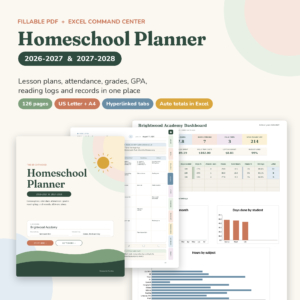
Brightwood Homeschool Planner 2026-2027
Price: $9.99 | Best for: A first-year family who wants one bundle
A fillable PDF lesson planner with attendance and a grade and GPA tracker, plus an Excel command center, in US Letter and A4. It gives you hand-plannable pages and a spreadsheet side for numbers, which is a sensible mix for a new homeschooler.
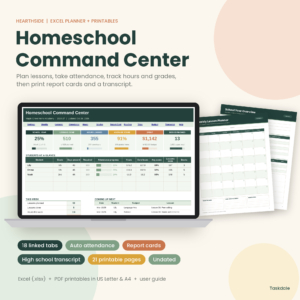
Hearthside Homeschool Command Center
Price: $8.99 | Best for: Families who want strong record keeping
An Excel homeschool planner with a lesson planner, attendance, gradebook, report cards and transcript, plus 21 printable pages, in US Letter and A4. If your area asks for records, or you have an older child heading toward high school, this has the pieces.
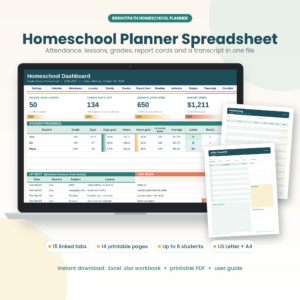
Brightpath Homeschool Planner Spreadsheet
Price: $6.99 | Best for: Families who want spreadsheet power at a lower price
A homeschool planner spreadsheet with printable pages. It is the lowest priced of the three, so it works as a trial run if you are not sure how much planner you need.
Comparing the Three Planners
| Product | Format | Price | Best for | Link |
|---|---|---|---|---|
| Brightwood Homeschool Planner 2026-2027 | Fillable PDF plus Excel, US Letter and A4 | $9.99 | Lesson planning, attendance, grade and GPA tracker | View |
| Hearthside Homeschool Command Center | Excel plus 21 printable pages, US Letter and A4 | $8.99 | Gradebook, report cards, transcript | View |
| Brightpath Homeschool Planner | Spreadsheet and printable pages | $6.99 | Budget friendly start | View |
Set Up Records From Day One
Records are part of how to plan a homeschool year, even though they feel boring when you begin and precious when you need them. Set up the habit now. Decide where attendance goes, where grades go, and where you keep work samples such as a drawing, a writing piece or a photo of a science project.
A simple weekly routine works well. On Friday, tick off the days you taught, enter any grades, and drop one or two samples into a folder. It takes ten minutes. By June, you have a year of evidence without a single panicked evening.
If you have an older student, think ahead. High school records can turn into a transcript later, so tracking courses and grades from the first year makes that job easy. Hearthside lists a transcript in its description for exactly that reason.
Plan the First Four Weeks in Detail
Do not try to plan all 36 weeks in fine detail. You will rewrite most of it. Instead, plan the first four weeks closely and the rest in broad strokes. After week four, you will know how long a lesson really takes, which subjects get skipped, and when your children are at their best.
Start gently. Many families ease in over two weeks, adding one subject at a time. A short, calm first week builds habits better than an ambitious one that ends in tears. Think of it as a trial run with real children.
Here is a sample first day: read aloud for twenty minutes, do math, take a snack break, write a short paragraph, then spend the afternoon on a nature walk. That is a real school day, and it takes about three hours.
What to Do When the Plan Falls Apart
It will. Every homeschooling family has a week where nothing works. A cold sweeps through the house, the printer dies, or the baby decides sleep is optional.
First, breathe. One bad week is not a bad year. Use your catch-up day, drop the lowest priority subject for a bit, and return to the basics. Second, change the plan, not your children. If a curriculum is making everyone miserable, you are allowed to swap it. Third, review every six weeks. Sit down with your planner and ask what is working and what is not.
The plan is a tool. It serves you, and you are allowed to change it.
Common First-Year Mistakes When You Plan a Homeschool Year
Almost every new homeschooler makes at least two of these. Knowing them early saves a lot of stress.
The first is copying a school timetable. A classroom of thirty needs bells and transitions. A kitchen table with two kids does not. You can finish a good morning of work in three or four hours, and that is normal. The second is buying too much curriculum. A stack of boxes looks impressive, but you will use perhaps half. Start with the core subjects and add as you find gaps.
The third is comparing your first year to someone else’s tenth. Veteran families make it look easy because they have had years to adjust. Give yourself a year to find your feet. The fourth is skipping rest. Plan breaks into the calendar before you plan lessons, since a tired parent teaches badly. And the fifth is never reviewing. Set a date every six weeks to look at the plan and adjust it.
A Simple Weekly Rhythm to Anchor Your Homeschool Year
Once your big plan is set, a weekly rhythm keeps it alive. Here is one that suits many families.
On Sunday evening, spend ten minutes looking at the week ahead and moving anything that needs moving. Monday to Thursday, work through the core lessons, with the same order each morning so children know what comes next. On Friday, do a lighter day: projects, field trips, catch-up work or a library visit. Then record attendance and grades and glance at next week.
That rhythm is the heart of how to plan a homeschool year that actually runs. The yearly plan sets direction, and the weekly rhythm gets you there. Whichever planner you choose, keep it where you can see it, on the counter or the table, rather than in a drawer. Visible plans get used.
How to Plan a Homeschool Year FAQ
How do I plan a homeschool year for the first time?
Check your local requirements, set start and end dates, list subjects, count curriculum lessons, divide them across your weeks, add fixed events, and set up records. Plan the first four weeks in detail and leave slack for sick days and surprises.
How many days should a homeschool year have?
It depends on where you live. Some areas set a minimum number of days or hours, and others do not. Check your local rules from an official source, then build a calendar that meets them with a little room to spare.
When should I start planning my homeschool year?
Many families start four to eight weeks before the first day. That leaves time to choose curriculum, count lessons and set up records. If you are short on time, plan the first month and fill in the rest as you go.
Do I need a homeschool planner?
No, but it helps. A planner gives you a ready structure for lessons, attendance and grades. Options range from printable pages to Excel command centers, so choose the format you will really open each week.
How do I keep homeschool records?
Track attendance, grades and a few work samples each week. Keep them in the same place, such as a planner or folder. Weekly entries take minutes and save you from rebuilding the year from memory later.
Your Next Step
So, the short version of how to plan a homeschool year: check your rules, write your goals, set a calendar with slack, count your lessons and plan the first four weeks. If you want everything in one place, the Brightwood Homeschool Planner 2026-2027 costs $9.99 and covers lesson planning, attendance and grade tracking. For stronger records, look at the Hearthside Homeschool Command Center. Open one tonight and block out your first month.